All posts by admin

Che sorpresa ti aspetta nel vivace casinò lazybar: generosi bonus, giri gratuiti e una selezione di giochi colorati renderanno la tua serata fantastica.

Regional Transit Authority sparks dissent in Ann Arbor

From The Michigan Daily:

800px-AnnArborLibertyStreet

Only months after the failure of the Washtenaw Initiative, a county-wide transit authority championed by the Ann Arbor Transit Authority, Ann Arbor City Council members are resisting involvement in the Southeastern Michigan Regional Transit Authority.

In the last week of 2012, Republican Gov. Rick Snyder passed legislation for the creation of the RTA, which mandates expanded public transportation methods throughout the southeast Michigan area — Macomb, Oakland, Washtenaw and Wayne counties. The southeast RTA board is composed of two representatives from each county and two additional representatives — one from Detroit and one chosen by Snyder.

Within a week, Conan Smith, chair of the Washtenaw County Board of Commissioners, announced his Washtenaw County appointments to the RTA: Elisabeth Gerber, a University professor at the Ford School of Public Policy, and Richard Murphy, the program director for the Michigan Suburbs Alliance.

“Washtenaw County and Ann Arbor in particular have a real gem with the AATA,” Gerber said. “One of my top priorities is to be sure not only to do no harm to AATA … certainly being sure that it is not compromised by the dynamics of the RTA.”

However, Gerber also stated that the RTA needs commitment from all counties.

“I feel very strongly that regional collaboration and regional governance only works when everybody wants it,” Gerber said.

Murphy, who has a background in transportation and land-use planning, said he will use his position on the board to introduce rail to the area.

“The big transit need for us in Washtenaw County is the Ann Arbor to Detroit commuter rail line,” Murphy said. “We’ve been laying the groundwork for that for a decade, and the RTA should be the way we finally bring that project to life, but the legislation has some weird provisions discouraging rail-based transit that we’ll have to navigate.”

Murphy added that taking in factors such as cost and ridership, rail is the right option.

Upon the announcement of the RTA, many Ann Arbor City Council members were vocal about their disinterest in Ann Arbor and Washtenaw County’s participation. Councilmember Christopher Taylor (D-Ward 3) was among the opposed camp.

“The short of it is, I have a tremendous amount of respect for both appointed board members, and I believe the RTA has a great deal of promise for Macomb, Oakland and Wayne counties,” Taylor said. “I also believe that it has no benefit for Washtenaw County and that Washtenaw County should be excluded from it.”

Taylor continued to argue that the RTA is a “poison pill” for Ann Arbor and the county. One of the RTA’s current proposals is a bus route from Detroit to Ann Arbor.

“Public transportation in Washtenaw County serves Washtenaw County’s needs very well,” Taylor said. “Any new RTA would focus the lion’s share of its resources and attention to areas that are most in need … I believe that Washtenaw County would not receive its proportionate due.”

Councilmember Sabra Briere (D-Ward 1) agreed that the benefits of the RTA would apply only to other counties, and that most of the proposed services would be inefficient for residents.

“My own feeling for the RTA is I have a whole bunch of questions of the effect of the RTA on the existing (AATA) bus system,” Briere said. She questioned “how many people would take a bus that is going to take an hour and a half to come into Ann Arbor for whatever purpose?”

AATA spokeswoman Mary Stasiak did not elaborate on the AATA’s position on the RTA but endorsed the selected Board representatives.

Stasiak said: “Both of the RTA Board representatives chosen have qualifications and experience that are important in leading the formation of this new regional authority.”

Source: http://www.michigandaily.com/news/rta-sparks-dissent-ann-arbor

$25 million announced for Woodward streetcar project in Detroit

From a US DOT Press Release:

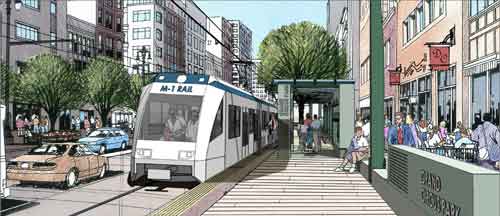
Here's an artist's depiction of the light rail project. (From the M-1 Light Rail Group.)
Here’s an artist’s depiction of the light rail project. (From the M-1 Light Rail Group.)

U.S. Transportation Secretary Ray LaHood  announced Jan. 18 that the M-1 Rail project can move forward immediately using the $25 million TIGER grant previously awarded for transit in Detroit.

These funds support construction of a planned 3.3-mile streetcar line to help revitalize Detroit’s historic Woodward Avenue corridor.

M-1 Rail, a coalition of private-sector philanthropic and business leaders, has committed more than $100 million toward construction and operation of the $137 million project. The remainder will be funded by state and local sources.

The Secretary also announced an additional $6.5 million in Federal Transit Administration (FTA) planning funds available from prior fiscal years to help Michigan develop a bus rapid transit (BRT) network to expand transit options connecting downtown Detroit with its suburbs and key destinations in the region.

“I applaud Michigan’s leaders for coming together to support a regional vision for public transportation that will improve access to jobs, education, medical care, and other destinations for residents in the Detroit metro area,” Secretary LaHood said.

“The Obama Administration is committed to the creation of a modern transportation system that will create jobs Detroit needs right now, while spurring new economic development to help this region grow stronger in the years to come,” he said.

The Secretary was joined by Governor Rick Snyder, Senator Carl Levin, Senator Debbie Stabenow, Congressman John Dingell, Congressman John Conyers, Congressman Gary Peters, Congressman Sander Levin, Detroit Mayor Dave Bing, Officials from the M1 Rail Corporation and Federal Transit Administrator Peter Rogoff.

The streetcar funding announcement comes just weeks after Governor Snyder signed into law critical legislation creating a Regional Transportation Authority (RTA) to develop and more efficiently operate public transportation projects in metropolitan Detroit and across the state.

“The M-1 Rail project will truly be a catalyst for bringing new jobs, employers, retailers, and attractions into downtown, Midtown, and the New Center area along Woodward Avenue,” said Administrator Rogoff. “And with the new regional transportation authority now in place, Greater Detroit can stand up a transit network that meets residents’ needs while expanding economic opportunities.”

The Woodward Avenue streetcar line will be constructed and initially operated by the nonprofit M-1 Rail Corporation – a consortium of local private businesses, foundations, and public and private institutions committed to improving mobility and supporting economic development along lower Woodward Avenue. Investors include the Kresge Foundation, the Penske Corporation, Quicken Loans and a dozen other benefactors.

The streetcar line is expected to include 11 stations, with connections to Campus Martius, Comerica Park (home of the Detroit Tigers), the Detroit Medical Center area, and Wayne State University. The City of Detroit, the Michigan Department of Transportation and the Southeastern Michigan Council of Governments will also be involved in moving the project through development and construction.

FTA’s planning funds will help to develop a BRT network to connect downtown Detroit with Macomb County along the region’s busiest transit corridor; expand east-west transit service between Macomb and Oakland counties, and extend transit service between downtown, Detroit Metropolitan Wayne County Airport and Washtenaw County.

Source: http://www.dot.gov/briefing-room/us-transportation-secretary-ray-lahood-announces-25-million-woodward-ave-streetcar

Ann Arbor officials hope new railroad ownership could boost commuter rail, greenway plans

From AnnArbor.com:

Ann Arbor Railroad logo

The Kansas-based company taking over the Ann Arbor Railroad says it’s open to talking about future commuter rail service and the vision for a greenway trail system along the tracks.

After years of poor relations with the railroad’s current owner, the Howell-based Ann Arbor Acquisition Corp., Ann Arbor officials are calling the promise of new ownership a positive move.

“That is great news and hopefully we can work with them to further our local rail initiatives,” said Eli Cooper, the city’s transportation programs manager.

Mayor John Hieftje is among the supporters of the WALLY commuter rail project and the vision for the Allen Creek Greenway. He said the Ann Arbor Railroad has been an obstacle up to this point.

“They’ve never been easy to work with,” he said. “It’s been hard at some points over the years for the city just to get a good conversation with them about this railroad that runs right through our city.

“We haven’t made much headway, and I know MDOT hasn’t made much headway, over the years with the Ann Arbor Railroad on any of these issues,” Hieftje added.

The Ann Arbor Railroad — a so-called “shortline” that runs from Ann Arbor to Toledo — is being acquired by a Kansas transportation company that wants to expand into Ohio.

Watco Railroad Company Holdings Inc., a subsidiary of Watco Companies LLC, has reached an agreement to purchase the 50-mile railway, which serves southeastern Michigan and the Toledo markets, focusing mostly on the automobile and manufacturing industries.

Most of the Ann Arbor Railroad’s operations are in Toledo, but the headquarters is in Howell. A spokesperson for the company couldn’t be reached for comment.

News of the changing ownership this past week sparked questions about whether Watco will be more amenable to talking with local officials about the proposed WALLY commuter rail line from Howell to Ann Arbor and the city’s vision for the Allen Creek Greenway, which hinges on acquisition of railway right-of-way to develop a system of walking and biking trails along the tracks.

Read more: http://www.annarbor.com/news/ann-arbor-officials-hopeful-new-ownership-of-ann-arbor-railroad-will-bring-improved-relations/

Meeting minutes – Williamston – January 12, 2013

MINUTES
MICHIGAN ASSOCIATION OF RAILROAD PASSENGERS
MONTHLY MEMBERSHIP MEETING
WILLIAMSTON DEPOT, WILLIAMSTON, MI
JANUARY 12, 2013

Members Signing In:  Hugh Gurney, Steve T. Sobel, Kaz Fujita, Julien R. Wolfe, Jim Wallington, Rich Vavra-Musser, Phillip Mange, Jim Roach, Jerry Becker, Clark Charnetski, Dianne Patterson, Robert Patterson, Martha Benedict, Kathleen Newell, Richard Pekarek, Michael Frezell, Tim Fischer, Dan Platz, Kay Chase, John Langdon, Bob Tischbein, Jim Hinkins, Larry Krieg, Doug Wilson, Kim Powell, Ron McClain, Tim Hoeffner

Others Present:  Bruce Becker, Kris Wisniewski, Eric Newberg, Thomas Breeding

Call to Order:  Chairman Tischbein called the meeting to order at 10:20 a.m.

Amtrak/MDOT:  Tim Hoeffner, Director of the MDOT Office of Rail, reported that Amtrak carried 800,000 passengers during FY 2012, a record, even with slow orders during the spring.  The Blue Water also set a record for passengers carried.  Hoeffner sees no impact from the entry of Megabus into the transportation mix.

The extra trains during the Thanksgiving and Christmas holidays did exceptionally well with record ridership on the Wolverines.  Hoeffner suspects some bleed off from the Blue Water.  While additional crews and equipment led to small increases in expense, many expenses such as station staff remained constant. 

Amtrak decided on extra trains during the holidays rather than additional cars on existing trains as a way of better utilizing scarce equipment. 

Krieg noted that the extra trains spread the crowds out in the Chicago Union Station waiting room. 

After hearings in the fall, staff working on the Chicago-Detroit Corridor Plan are carefully evaluating all the segments between Porter, Indiana, and Chicago.  This is an extremely complex piece of railroad.

As of December 7, 2012, all the documents transferring ownership of the Dearborn-Kalamazoo railroad from Norfolk Southern to MDOT were executed.  MDOT now owns the railroad.  It has been leased back to Norfolk Southern for several months to allow NS to negotiate with its unions.  NS will continue dispatching trains until the new train control system is completed.  Both the Dearborn-Ypsilanti track work and the train control system are at the 30% design review phase.

Before the West Detroit Connector gets underway, a few right of way issues must be resolved with CN. 

The Surface Transportation Board is reviewing the accident just east of Niles back in the fall.  Illinois is implanting the same train control system on its Chicago-St. Louis upgrade and the Chinese are using a version of this system.

CN and Amtrak are discussing the problem of long dwelling times on the Blue Water.

Regional Transportation Authority:  Hoeffner reviewed the legislation for the Regional Transportation Authority.  Four counties, Wayne, Oakland, Macomb and Washtenaw are included.  No county and no municipality can withdraw.  Each county will designate two representatives to the RTA Board.  The governor’s appointee will chair the board.  A supermajority will be required to levy taxes.

The RTA Board will be the recipient for all federal funds.  It will appoint the CEO and other staff,  approve transportation plans, and coordinate provider operations.  There will also be an advisory committee.

Four Bus Rapid Transit routes are contemplated. Rail projects will require a unanimous vote of the Board as will the addition of new providers.

The principal bill establishing the RTA takes immediate effect.  The first meeting of the RTA Board will take place in April, 2013.  Four supplemental bills take effect 90 days after being registered with the Secretary of State.

The RTA should be functioning by October 1, 2014.  MDOT and SEMCOG will provide interim staffing. 

Washtenaw County has already appointed its two RTA Board members. Richard Murphy of Ypsilanti, will serve a one year term.  Murphy is active in TRANS4M.  Elizabeth Gerber, whose specialty is transportation planning at UM, will serve a two year term.

Stations: 

Watervliet: Vavra-Musser noted a recent newspaper article reporting that Watervliet was asking for a train stop on the Pere Marquette line.  They are looking for funding for a platform.  The proposed stop would be a flag stop.  Hoeffner responded that no decision has been made by either MDOT or Amtrak.  Neither intend to assume any cost for the stop.  Specifications for a flag stop are the same as for a regular stop.  Langdon added that flag stops are not exempt for all ADA standards.  The platform will have to be designed to serve both Horizon and Superliner equipment.  The mayor is hoping for a grant next month to fund the platform.

            East Lansing: Fujita reported that CATA is the lead agency on the project.  A sign on one of the buildings says it will be coming down soon to make way for the new station, which will be at the west end of the present parking lot.  Amtrak will build the new platform.  The entire north side of the tracks will be fenced off.  Hoeffner added that the long range plan is to extend the project all the way to the diamond.  The grant agreement has not been executed at this point.

            Chicago Union Station:  The CUS Task Force presented its recommendations on December 12 and Amtrak is now reviewing them, Krieg reported.  Major issues include narrow platforms, where passengers must fight with baggage carts; signage, where Amtrak is agreeable to designing new signs for review; and Use of the Great Hall, which Amtrak considers a revenue source.  The Great Hall is managed by a unit in Philadelphia, so anything dealing with it must go through the Amtrak Corporation.  The creation of a new position above the General Superintendent further complicates matters.  The CUS Task Force will continue to meet with Amtrak periodically to monitor progress.

Speaker:  Tim Fischer introduced the speaker, Kris Wisniewski. who heads up the Eastern Border Transportation Coalition, a non-profit advocacy group working to improve the movement of goods and people between the United States and Canada.  Members of EBTC include the states of Michigan, New York, Vermont and Maine and the provinces of Ontario, Quebec, New Brunswick, Nova Scotia and Newfoundland & Labrador.  In the course of a year, some 16 million people travel between the two countries and 75% of all trade between the U.S. and Canada crosses within the territories of member states and provinces.

The position is part time and headquartered at MDOT in Lansing.  When not carrying out EBTC duties, Wisniewski works in MDOT’s Office of Rail.

Wisniewski represents member states and provinces in working with the federal governments of the U.S. and Canada, all of whom want to see goods and people move more easily between the two countries.  Travel and tourism are major issues.  The fact that most border crossings are at tunnels or bridges complicates matters as space is limited for infrastructure improvements.  At the border, a U.S. inspector is attempting to carry out the mandates of 23 separate federal agencies!

At Montreal and Vancouver, the group is working to have U. S. Customs and Immigration officials do all the inspections at the stations, similar to the way air travel is handled between Canada and the U.S.  Trains would be cleared at Montreal or Vancouver and proceed directly to the border without intervening stops.  At the present time, U. S. officials are doing some review at the Vancouver station, but the real inspection continues to happen at the U. S. border.

U. S. Inspections of trains and train passengers in Canada would require a treaty between the two nations, similar to the treaty that permits airport inspection in Canada.  Inspection areas at Canadian airports are considered sovereign U. S. territory, similar to an embassy.  Needless to say, the process will be fraught with complications.  Unlike the situation in Europe, both the U. S. and Canada are very defensive when it comes to national sovereignty.  A proposed treaty would deal with passenger rail, ferries and marine services.  With a treaty in place, passengers would have a better idea of how long they might be held at the border. 

For passenger rail crossings between Michigan and Ontario, the situation will be more like the crossing of the Maple Leaf at Niagara Falls.  There, a new facility is being built on the New York side where all inspections will take place. While designed to facilitate efficiency, all passengers will be required to get off the train and pass through the inspection facility.

As to rail freight, talks continue on having overseas freight inspected once at the North American port of entry.  For example, goods entering at Port Rupert, British  Columbia, would be inspected there, and the train could then enter the U.S. somewhere in North Dakota without an additional inspection.  A similar situation could take place for goods destined for Canada entering at New York City or Long Beach.

The EBTC has prepared a White Paper, “Improving and expanding Cross Border Passenger Rail Service through the Implementation of Pre-Clearance”.  The paper may be downloaded from the website, www.ebtc.info>

Bruce Becker, President of the New York State Association for Railroad Passengers, added that when a passenger buys a ticket on the Adirondack,  they also provide a lot of personal data, which is forwarded to Customs for a background check.  His group is partnering with Vermont, which is anxious to restore service to Montreal. 

Plans are moving along to create a customs clearing area in the station at Montreal.  The construction cost is estimated at $4 million.  Since the customs station would be removing profitable rental space, the building owner would require additional compensation for his loss.  Becker reiterated that a treaty would be required before any plan could be implemented.

Hoeffner noted that passenger trains crossing at Detroit would probably use the old rail tunnel.  There are no plans for Michigan-New York service via Southern Ontario. 

The peak ridership on the International was 120,000 annually, but by 2003, that number had dropped to 83,000.  The 2012 numbers for the Blue Water are 195,000. 

Charnetski asked if a bus transfer between Detroit and Windsor would be more efficient that a cross border train.  Wisniewski thought that might be a viable interim step.

The Monthly Membership Meeting adjourned at 11:50 a.m.


Respectfully submitted:                                              Accepted:


Hugh D. Gurney                                                         Robert Tischbein

Secretary                                                                     Chair