All posts by admin

Che sorpresa ti aspetta nel vivace casinò lazybar: generosi bonus, giri gratuiti e una selezione di giochi colorati renderanno la tua serata fantastica.

Troy City Council approves contract to release $8 million to fund local transit center

From the Troy Times:

Plans for the Troy Multi-Modal Transit Facility chugged ahead after the Troy City Council approved the contract with the Michigan Department of Transportation that allows dispersal of just under $8.5 million in federal grant money to fund the project.

The project is on track to be finished by September of 2013.

The council approved the contract in a 6-1 vote at the Sept. 12 meeting. Troy City Councilman Martin Howrylak opposed the measure. He cited concerns over what rate Davis-Bacon wages would be, which are determined by the federal government and must be paid to workers on federally funded projects, lack of “any new rail service” resulting from the project and the $8.4 million cost on a “very small building” (3,000 square foot).

The estimated cost of the project is $8.484 million.

Read more: http://www.candgnews.com/news/council-approves-contract-release-8-million-fund-local-transit-center

Amtrak, Indiana Dunes team up

From the North West Indiana TImes

As the Wolverine leaves Chicago’s Union Station each afternoon, passengers  aboard the Amtrak train to Detroit look out their windows at the urban maze of  concrete and steel.

Once the train crosses the Indiana state line, though, skyscrapers soon are  replaced with the natural beauty of the thick forests and flowing sands of the  Indiana Dunes National Lakeshore.

Frank and Ruth Maxwell love highlighting that difference.

The Maxwells are among about 20 teams of volunteers who board the Wolverine  in Chicago and ride to Niles, Mich., and back three times a week, explaining the  biodiversity of the Indiana Dunes to passengers as part of the Trails and Rails  program.

Ranger Bruce Rowe said the program, which has 19 routes canvassing the  country, started locally this summer.

“It is designed to give passengers on these trains a chance to explore a bit  of the Indiana Dunes National Lakeshore without getting off the train,” Rowe  said.

Shortly after the train departs Union Station, Frank and Ruth Maxwell take to  the public address system, telling passengers to be on the lookout for the  waving grasses and patches of wildflowers that soon will be outside their  windows, and inviting them to learn more about what they’re seeing.

“About 60 percent of the time we’re either in or on the border of the  National Lakeshore,” Ruth said. “Once we leave Hammond, the National Park starts  in bits and pieces.”

Frank, a train enthusiast, and Ruth, a former teacher and nature guide, said  the program was a perfect fit for them in their retirement. Living in the Porter  Beach area, the Maxwells said they’re happy to help bring the joy they’ve found  along the lakeshore to others.

“We’re actually hoping that we’re sharing our love of the National Park and  letting people know that we’re lucky enough to have a National Park in our  area,” Ruth said.

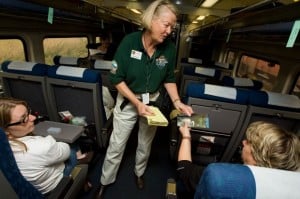
After passing the station in Hammond’s Robertsdale neighborhood, Ruth, who  worked at the Environmental Learning Center taking kids on hikes through the  park, begins working the Wolverine’s five cars, handing out brochures about the  Dunes and giving children an activity sheet and crayons.

“We have a special Junior Ranger program for them,” she said.

Frank stays back in the cafe car and greets people on their way to grab a  quick bite.

After stopping by and talking to Frank, Troy Grivet, an engineer from  Jackson, Mich., on his way to Chicago, said he’d consider bringing his family to  the Dunes to camp and hike.

Frank said helping people discover an often overlooked gem, makes the daylong  rail adventure worth it.

“It’s just a good place to go to have some fun and enjoy nature,” Frank  said.

The Trails and Rails program is set to run again on Tuesdays, Wednesdays and  Thursdays from Oct. 11 through Oct. 20. Travelers will be able to see fall  foliage, as leaves change from their rich greens to deep autumn hues.

Read more: http://www.nwitimes.com/news/local/porter/duneland/beverly-shores/article_f4b5a8f0-3e59-5be5-837d-f5fb3f46efb5.html#ixzz1YSsSRLf6

MARP Volunteers Needed for Train Shows in Sept. & Oct.

One of the important things that MARP does throughout the year is to exhibit at many of the train shows held around the state. We distribute information and talk with people. It is informal and fun! Not only do we create awareness of MARP as an organization, but we help to get passenger train information and issues before the public. To do this, we count on MARP members to volunteer to help staff the table.

We have 5 big train shows coming up in the next month for which volunteers are needed. Please reply marprail@yahoo.com if you can help with any of the shows listed below. Or perhaps you would like to help out at other shows throughout the year — we’d like to know that as well. Just let us hear from you (marprail@yahoo.com). That way we can contact you when there is a show in your area.

Here’s another opportunity. The Amtrak 40th Anniversary Exhibit Train will be at the Jackson station on October 8 and 9. If you would like to help out, just follow the instructions below.

Volunteers Still Needed for Amtrak Exhibit Train

The 40th anniversary exhibit train will be at the Jackson station on October 8 and 9, and you can play a role in its success by helping out. If you want the opportunity to be part of Amtrak history, and to meet Amtrak employees and supporters of passenger rail, please sign up. To volunteer, email your name, shift preference (8:30 a.m.- 1:30 p.m. or 12:30 p.m.-5 p.m.), the day you would like to help out, and your email and phone number to greatamericanstations@amtrak.com. Please write the words Volunteer and your preferred volunteer location in the subject line of the email, e.g. Volunteer-Jackson (JXN).

More information about the Amtrak 40th Anniversary can be found at:   www.amtrak40th.com

See you at the show!
Michigan Association of Railroad Passengers

Ag. Pushes Investment In Rail

From Gongwer News Report Volume #50, Report #173 — Friday, September 2, 2011

Michigan, and other states, have been working the last couple of decades to convert old rail lines to walking and biking trails, but more money now needs to go into refurbishing the remaining lines, the Michigan Agri-Business Association said in a paper released this week.

The report said rail service in a number of areas of the state is at risk without some improvements, but also urged policymakers to consider some expansions to rail.

Most of the group’s recommendations were for federal programs, but it did urge more funding for the Michigan Rail Loan Assistance program, which provides low-interest and interest-free loans for rail improvements.

“This is an important program that has seen much use by Michigan companies, particularly those involved in agriculture,” the report said.

Tim Hoeffner, administrator of the Office of Rail in the Department of Transportation, said the state agrees. He said the program would be open to new applications later in the fall, once it has accumulated enough funds to make adequate sized loans.

Mr. Hoeffner said the state also has a Freight Economic Development Program that makes low-interest loans that can be converted to grants if the borrower meets certain agreed traffic targets.

“With Governor Snyder’s renewed emphasis on agriculture and rural economic development, at transportation we take that very seriously,” Mr. Hoeffner said of efforts to business-related transportation in rural areas.

Agriculture and Rural Development Director Keith Creagh said his department and MDOT had been working to map the current rail lines and their proximity to agricultural development.

The MABA also urged extension of the Federal Short Line Rehabilitation Tax Credit and moving the Federal Railroad Rehabilitation and Infrastructure Financing Program to the U.S. Department of Agriculture.

The group said the financing program, now housed in the Federal Railway Administration, has $35 billion in funds for low-interest loans, but has approved only $1 billion because its application process is too difficult.

Without these state and federal programs, the state risks losing rail lines, which would mean moving more produce by truck. The group said in most cases the additional transportation costs would come out of the bottom line for growers.

Loss of rail in the Thumb region, for instance, would cost corn, soy bean and wheat growers $31.7 million a year for the extra cost of moving their commodities by truck.

“While some may say this is an exaggeration and that the rail is operating just fine, it should be noted that the speed on the track from Reese to Akron and beyond is limited to 20 miles per hour because of bad rail bed issues, and north of Bad Axe to Kindle, the speed is set at 10 miles per hour,” the report said.

“We are one washout, one trestle failure or one other problem away from rail not operating in this area!”

The state is also at risk of losing service because many rail companies are moving to larger cars that the rail in some areas of the state cannot handle, the report said.

Mr. Creagh said his department was working on a project in the Thumb region now to try to improve rail service.

Mr. Hoeffner said any actual improvements to the lines would have to be done by the companies that own the tracks, though the state was ready to step up with assistance if they apply.

He said the state is also working on a variety of projects, including a study with the Federal Highway Administration, to encourage more use of the state’s rail lines.

“In a lot of places, these are underutilized assets and there will be opportunity for more trains,” he said. More trains would mean bringing down costs for transporting produce from rural areas, he said.

The report said rail, because it is more efficient at carrying the bulk and weight of agricultural products and fertilizer, is essential to new agriculture development and that no new processing facilities in particular are likely to be located where rail is not available.

“There’s commonalty in having rail access and being successful over time,” Mr. Creagh said. But he said roads, bridges and communications are also key to success. “We need to have all those components as we look at the infrastructure,” he said.

Mr. Hoeffner said communities not currently served by rail should not expect to seen tracks laid. “I wouldn’t really see that there’s going to be a growth in the miles of rail in Michigan or anywhere in the country,” he said.

But Mr. Creagh did not completely close the door to new rail. “That’s where we’ll continue to work with businesses as they seek to expand,” he said.

Though the report did not specifically call for reopening any prior rail lines, it did note that loss of some lines have converted what were once through lines to short lines, meaning they will take only local traffic and are limited to the local commerce along those lines.

Mr. Hoeffner said the conversion of some lines to shortline providers was not necessarily a disadvantage to the farmers along those lines. “The shortline industry is very attuned to the needs of agriculture, particularly smaller agriculture business in the state,” he said.

The report also chastised efforts to move to high-speed passenger rail in the state. “While no one is against enhanced passenger rail travel, the fact is that in the broadest terms, a network of passenger trains that operate on an interconnected schedule to provide intercity travel is probably a lost cause,” the report said. “What appears to be developing is a patchwork of single lines
that might be dedicated to travel between select cities, without much thought to the broader transportation network or the impact on freight.”

For instance, the move by Amtrak to purchase track between Pontiac and Kalamazoo could inhibit freight movement along that route.

Mr. Hoeffner rejected the group’s concerns. He said improvements in passenger service are only part of the reason the state is seeking to acquire the line for Amtrak. “One of the reasons the state wants to obtain that line is not only increasing passenger service but for more people shipping by rail or more opportunities to ship by rail,” he said.

Make high-speed rail a priority

From CBC News

Windsor-West MP Brian Masse announced Monday he intends to pursue international high-speed rail service between Chicago and Quebec.

“I believe we can make it work all the way to Quebec City,” he said a news conference staged in front of the historic Spirit of Windsor steam engine No. 5588.

Masse wrote Minister of Transport, Infrastructure and Communities Denis Lebel “urging” the government “to move more decisively to make passenger rail investments a priority in Canada.”

Infrastructure exists

Masse said at the news conference existing infrastructure, such as rails and international tunnels beneath the Detroit River, exist to help jump start the program.

Masse called on Lebel to create a working group of stakeholders, similar to the Canadian Automotive Partnership Council, to examine the possibility of high speed rail in the Chicago-to-Quebec corridor.

Masse said there are approximately 30 million people living in the corridor. He said the service “could be international in reputation.”

US on board

Kirk T. Steudle, director, Michigan Department of Transportation, is in favour of the proposed international high speed service.

“Reinstating this service is a priority for the Michigan Department of Transportation (MDOT) as part of an expanded seamless rail corridor providing passenger service from Chicago to Montreal,” Steudle wrote Masse in July.

In May 2011, the U.S. Federal Railroad Admistration announced Michigan will receive $200 million in federal high-speed rail grants to fund projects in the state.

Costs ‘few hundred million’

Masse admitted the cost of such a service is large; “a few hundred million,” he said. However, he also said he has no idea what kind of economic boost – if any – high speed rail would provide to the Windsor-Essex region.

Masse admitted the cost of high speed rail are often met with “sticker shock” but touted the environmental, cultural and economical advantages of such a system.

He noted Canada is the only country in the G8 to not have high-speed rail service despite having the fifth-largest rail network in the world.

“It’s like we quit working on rail 200 years ago,” Masse said.

Source: http://www.cbc.ca/news/canada/windsor/story/2011/09/12/wdr-high-speed-rail.html