
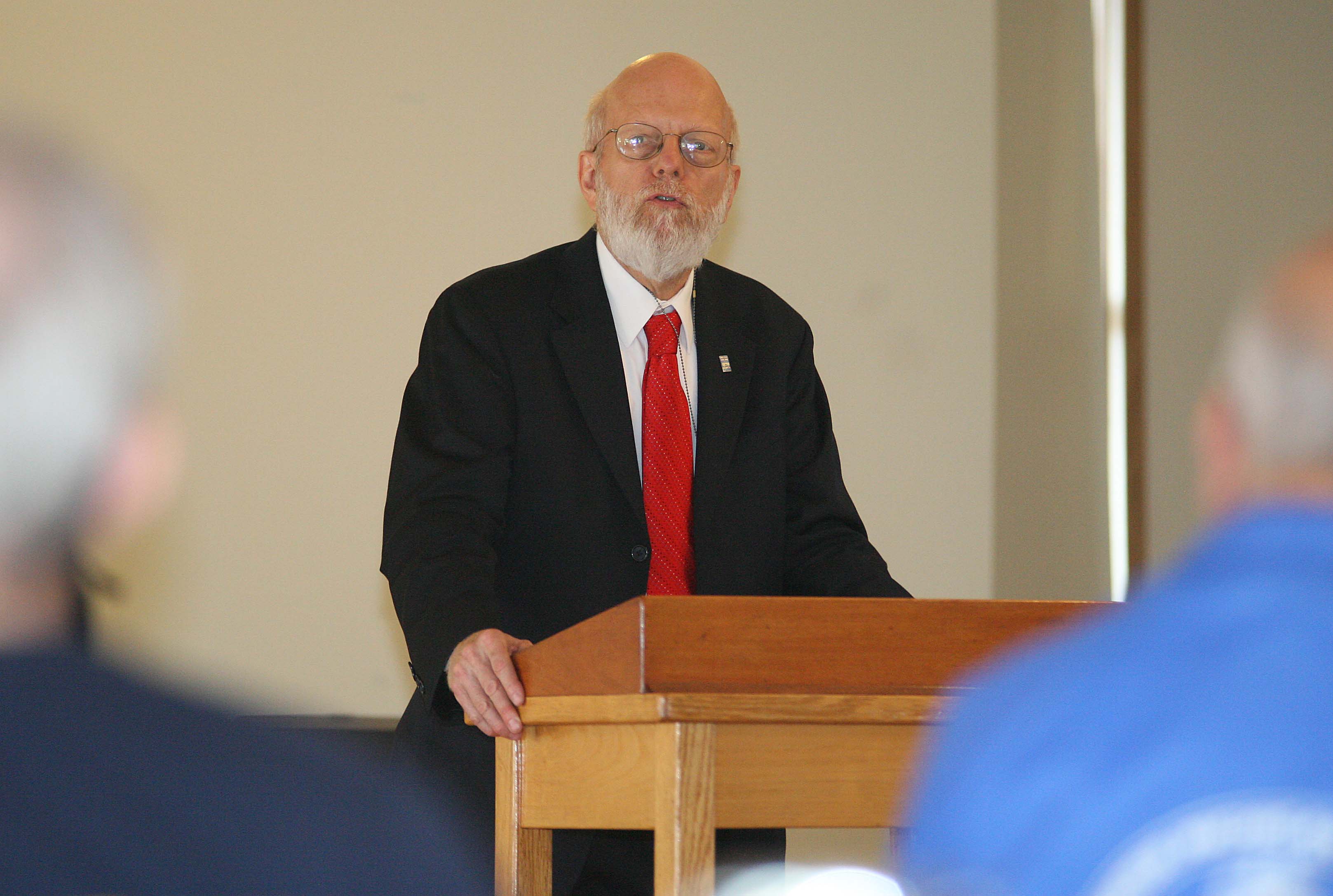
 Ross Capon, Executive Director of the National Association of Railroad
Passengers (NARP), speaks to members of the Michigan Association of Railroad
Passengers (MARP) during the organization’s 35th annual membership meeting
at Durand Union Station in Durand, Michigan Sept. 20, 2008. To learn more
about NARP, click here.
All posts by admin
Che sorpresa ti aspetta nel vivace casinò lazybar: generosi bonus, giri gratuiti e una selezione di giochi colorati renderanno la tua serata fantastica.
Passenger Train Advocate to Speak On Challenges and Opportunities For Passenger Trains in the United States
NEWS ADVISORY
September 14, 2008
Contact: John DeLora, Chair
Michigan Association of Railroad Passengers
(313) 575-6608 jdelora@wowway. www.marp.org
Historic Durand Union Station will be the setting when Ross B. Capon addresses Michigan rail advocates on Saturday.
Mr. Capon is the executive director of the National Association of Railroad Passengers (NARP) based in Washington. D.C. Mr. Capon will speak on the considerable success his organization has had in re-focusing the attention of congressional leaders on the vital role of the nation’s railway system in addressing the challenges of a transportation system under stress.
“Passenger trains are part of the energy deal America needs,” Mr. Capon said in a recent editorial. Passenger numbers have reached their highest level ever as gasoline prices have climbed and people have sought alternatives to both driving and flying. Advocates see this as a golden opportunity for mobilizing the political will to invest in modern, fast, and dependable passenger trains.
Mr. Capon’s appearance is sponsored by the Michigan Association of Railroad Passengers (MARP) which is observing its thirty-fifth year working to improve and expand the state’s passenger train services.
The public is welcome to attend. A registration fee of $20 covers materials and a luncheon following the presentation. Registration begins at 9:45 a.m., Saturday, September 20 at Durand Union Station, 200 Railroad St., Durand MI 48429. Contact Kay Chase (269) 388-3777, email chase@wmich.edu
Joint MARP & Midwest High Speed Rail Assoc. Meeting – Aug. 16
Great news everyone!
Our normal MARP monthly meeting will be changed this month to become a joint Midwest High Speed Rail Assoc. and MARP meeting with attendees from both organizations. The details are below:
August 16, 10:15 am
St. Joseph Public Library
500 Market Street, St. Joseph, MI 49085
1. Rick Harnish, Executive Director of Midwest High Speed Rail Association (MWHSRA ) will be our featured speaker. MWHSRA has been very successful in Illinois in adding train frequencies and routes. MARP is working with MWHSRA, along with the Environmental Law and Policy Center and the United Transportation Union, to build a strategy for similar success in Michigan. The discussion will center on how we can work with Amtrak, the state and our communities to add frequencies, new routes and expand the capacity of the Porter (IN)-Chicago (IL) rail corridor to support better transportation options in Michigan.
This part of the agenda is expected to last 90-120 minutes and our goal will be to lay out a specific plan on what we can jointly do to achieve our goals
2. Rick will then share some information about an upcoming trip to Barcelona – 15-30 minutes
3. Following the joint meeting, we will enjoy lunch at Silver Beach Pizza located in the Amtrak Station. Gelsosomo’s award-winning pizza is featured. Salads and sandwiches also available.
4. We will then reconvene for a condensed MARP meeting as John Delora has some important topics he feels we need to discuss – roughly 1 hour
After the meeting, you’re on your own to explore St. Joseph’s many attractions, including:
• Silver Beach – ranked one of the top 10 family beaches in America
• wineries and fruit orchards- there are 7 wineries in the area – the climate of SW Michigan is ideal for growing fruits
• the Berrien County Youth Fair – the biggest youth fair in the Midwest – it runs from August 10 to August 16
• other things to do may be found at www.michigan.org and www.sjcity.com
Folks in the Grand Rapids-Holland area and points south can ride the Pere Marquette arriving in St. Joseph at roughly 9:30 am. We’ll meet you at the train station for the easy walk to the St. Joseph Public Library two blocks away. The northbound train leaves at 8:00 pm, leaving plenty of time to explore the many pleasures of this great beach community.
If you would like to find someone in your area for carpooling, please email Rich Vavra-Musser doottime@ sbcglobal.net
Hope to see you there!
Minutes of MARP&MHSRA meeting – August 16, 2008 – St. Joseph
MICHIGAN ASSOCIATION OF RAILROAD PASSENGERS
MIDWEST HIGH SPEED RAIL ASSOCIATION
Joint Meeting
St. Joseph Public Library, St. Joseph, Michigan
August 16, 2008
Those Signing In: Hugh Gurney, Michael Frezell, June Troost, John Guidinger, Bob Tischbein, Hazel Rood, John Gottlick, Kay Chase, Jack Kessler, Jared Becker, Dwight Phillips, Jim Hinkins, J. R. Valderas, Diane Patterson, Robert Patterson, J. P. Des Camp, Roger Webster, Rich Vavra-Musser, John DeLora
Also Present: Rick Harnish, Midwest High Speed Rail Assn.; Juan Ganum, City of Niles; Nick Musson, Southwest Michigan Planning Commission; Robert Judd, Mayor, City of St. Joseph
Chairman DeLora called the meeting to order at 10:20 a.m. He thanked Vavra-Musser for the meeting arrangements.
Vavra-Musser introduced Robert Judd, Mayor of St. Joseph, who welcomed the group to the city. Judd expressed his desire to keep the Pere Marquette route open and initiate high speed rail service between St. Joseph and Chicago. He would appreciate anything MARP could do to further these objectives.
DeLora thanked Judd for his remarks and responded that MARP is on record as supporting continuation of Pere Marquette service no matter which way the high speed line is routed.
All in attendance introduced themselves.
Minutes of the June meeting in Owosso and the July meeting in Lapeer were reviewed and approved.
Second Pere Marquette: Because Amtrak has no excess equipment, the state of Michigan will have to rehabilitate damaged coaches at a cost of $200,000-$300,000 each, according to DeLora. A first approach will be to look for the funding from projects not completed in prior years. DeLora has asked Speaker Pro Tem Sak to check on how much might be available in such unexpended funds. If this approach is not fruitful, then we would then have to ask for additional money from the legislature. This is justified because Michigan trains are frequently sold out and there is no more capacity.
DeLora predicted that a second departure from Chicago around 11:00 a.m. connecting with numerous arriving trains and an evening departure from Grand Rapids would produce the most ridership, possibly 125% of the current Pere Marquette. However, an earlier departure would fit business schedules better. Other states are also planning to rehab cars, so we need to get in line. Cars can be rehabbed in about three months, so if the legislature acts, they could be in service by winter.
In response to a question from Vavra-Musser, DeLora indicated that resolutions from as many governmental bodies as possible would prod the legislature to act. Any cars rehabbed must be certified by Amtrak, so older coaches owned by Blue Water would not pass muster. DeLora responded to Mayor Judd by saying that Amtrak will operate any train that is paid for. He agreed with Judd that the ideal is to serve business.
Guest Speaker:
At this point, guest speaker Rick Harnish, President of the Midwest High Speed Rail Association entered the room and was introduced. He thanked all for their recent donations, which have made it possible for him to have an office separate from his residence. He then gave some background on MWHSRA, which was founded in 1993. At that time, Spain, France, Japan and Germany had at least one high speed line operating. The difficulty of implementing high speed rail in the United States has prompted the organization to resort to manageable objectives, such as having five daily trains operating from Chicago to Springfield in three hours or under. The concept is that if lobbyists were using the conventional trains, they would support high speed projects in the future. MWHSRA has been successful in getting funding for these five daily trains to Springfield plus one additional frequency to Carbondale and one to Quincy. Now the hope is to add trains to additional points in Illinois and to Grand Rapids.
According to Harnish, we need to take advantage of the upcoming change of administration in Washington. Because we will need as much support as possible, Harnish has helped form the Transit Riders Alliance, which now has an e-mail list of 35,000. This group has already demonstrated its effectiveness by barraging the Illinois governor with 1,600 e-mails protesting his proposal to slash Amtrak funding.
Now is the time for a huge expansion with as much as $200 million more expended on an expanded passenger rail system. If Amtrak is unwilling, METRA could run all Midwest trains.
One problem high speed rail faces in the U.S. is that the FRA prohibits high speed trains from operating on conventional tracks. In Europe, many high speed trains continue on conventional tracks direct to beaches, ski resorts and other destinations. Many began operation on conventional tracks through the cities until high speed lines were completed the entire distance of each route.
Harnish sees Spain as the model for the Midwest. That nation has a goal of having all points in Spain within three hours of Madrid. Harnish feels the Midwest’s goal should be similar – every major Midwest city within three hours travel time to Chicago by rail. In addition to high speed, Harnish visualizes a much expanded commuter rail network, with trains on many lines running as frequently as subway lines, similar to what Spain is doing.
Ganum commented that if high speed rail were available, Niles would be within commuting distance of Chicago. He feels the political will to make that possible is now there. DeLora and Phillips agreed that at the national level, they are seeing far more interest in passenger rail among Michigan’s federal delegation. Chase noted that more elected officials appeared pro-rail, but don’t seem to understand the implications of such a stand. Judd observed that from Michigan, we face bottlenecks in Indiana and Illinois. A second line into Chicago was torn out many years ago.
Vavra-Musser agreed that a high speed line from Porter, Indiana into Chicago would be a big improvement. DeLora responded that Amtrak had done a south of Lake Michigan study several years ago. Now Amtrak CEO Kummant sees a Chicago-Detroit high speed line as his showpiece, so action seems likely.
Harnish added that support from Mayor Daley is critical. Unfortunately, Illinois state government is dysfunctional at this time, so transportation improvements tied to a bid for the Olympics are unlikely. The proposed acquisition of the Elgin, Joliet and Eastern Railroad by CN has also poisoned relationships with many suburban communities.
Harnish recommended that Michigan supporters develop a proposal for additional rail service in Michigan, a proposal that was specific enough for people to support, but not so specific that people would get lost in the details. The proposal would be something that could be accomplished in one year. It would build on routes that a public entity had already expended money on. He suggested that it be part of the ninestate Midwest High Speed Rail Plan. He recommended that the first Michigan proposal ask Michigan state legislators to fund one additional train on each route and ask Michigan’s federal legislators to fund the Porter-Chicago high speed line. He would urge Michigan to double its annual support from $7 million annually to $14 million. Some of this appropriation could go for more rolling stock. At the federal level, we would also ask for more equipment. When the first proposal is accomplished, we would then come up with a second proposal, then a third one year proposal.
Harnish suggested that supporters take every opportunity to attend political fundraisers and keep asking the question, “What about more trains?” If they keep hearing from constituents and receiving small donations from them, they will feel that there are votes out there supporting more trains. We need to talk about our proposal at every opportunity and put together a video to aid those for whom public speaking is not easy.
To all elected officials, we should be ready to ask, “Will you support _________________? Will you put that in writing”? Persuade them to introduce or co-sponsor a bill containing your proposal. When the bill goes to the conference committee, let the members of the conference committee know that it has a lot of support. This may require hiring a lobbyist.
Guidinger recalled that MARP did have a lobbyist at one time. He wondered if we could go together with TRU on hiring such a person.
In response to a question from the floor, Harnish agreed that the relationship between Amtrak and the states must change, with the states having more voice. Illinois has a large enough state supported system that they can negotiate with Amtrak from a position of strength. Also, MWHSPA can now afford a lobbyist, who can be at the table.
DeLora suggested an e-mail forwarding service which could keep in contact with legislators. According to Harnish, such a service would cost about $400 per month.
As to what is available for capital improvements from the federal government, $30 million can be expended this year on low cost, sure fire proposals. $100 million is proposed for next year.
In response to Mayor Judd’s concern about initiating commuter service from St. Joseph to Chicago, Harnish acknowledged that state lines complicate the issue. The three states involved must cooperate.
Returning to the issue of a lobbyist, Harnish reported that MWHSRA was paying $24,000 annually for one who also worked for an organization known as the Campaign for A Popular Vote. This lobbyist will be spending more time in Lansing and MARP should stay in touch with him. We need to push passenger trains as a #1 priority. Michigan already has a plan. Now is the time to say, let’s do this this year. Guidinger agreed and urged that we stick to promoting our proposal without beating up on others.
In promoting proposals for trains, Harnish urged that we stress cost effectiveness. Bringing a four lane highway into Galena, Illinois, the cost would be $1 billion. Four trains a day would cost $400,000. We need to talk about energy independence and all alternatives to the automobile, including trains and walking.
Vavra-Musser agreed and stated the alternative was a huge increase in gasoline taxes. One reason for the increase in oil prices is that North Sea production has started down. We need to change the “drill, drill, drill” message. Most of the oil being talked about is speculation – discoveries have not been confirmed. Easy to get oil and easy to get coal are gone. India and China are just getting started, added DeLora. Harnish urged coordination with transit in developing a statewide public transportation plan.
Harnish is trying to get high speed rail into the Obama strategy. He sees nothing positive concerning rail with McCain. In response to Guidinger’s concern about the bad name Amtrak has in some circles, Harnish urged that we keep the Amtrak name out of our discussions and proposals.
Wrapping up, Harnish stressed the need to develop a simple, affordable proposal that can be accomplished within a year or two. We need to then move it to passage by talking to and gaining the support of the people who interact with state legislators, the governor, and our federal representatives. We need to lobby. We need to get the message in the newspapers. We need to get candidates for state and federal offices supporting it. We need to attend political fundraisers and ask questions. In developing and pushing our proposal, we must stress the need, and not worry about the how . If Amtrak can’t run the trains, maybe the freight railroads can be paid to run them. What we need to stress is that we want a workable system.
DeLora suggested that we first review our vision, then develop the proposal. Harnish offered the following steps:
- Always show the state plan, the end product
Then offer the next step to the state plan
Point out the key problem, Chicago-Porter
Then note the second problem, Kalamazoo-East
Stress the need for rolling stock
Indicate what can be done right now
When talking to state legislators, point out what they can do and what the federal government needs to do. Ask state legislators to call their federal counterparts and demand Congressional action where needed. To Harnish, the ideal would be trains on all Michigan routes arriving in Chicago by 8:00 – 8:30 a.m.
Particularly when we talk about the national system, we need to support long distance trains as well as those running 400 mile trips. The most reasonable way to get frequent service Chicago-Cleveland is to have four Chicago-New York trains daily. We need to stress that a train is not a plane on the ground, but can connect many intermediate points.
In concluding, DeLora thanked Harnish for all his advice and urged that he join others for lunch at the St. Joseph station. The meeting adjourned at 12:30 p.m.
Respectfully submitted:
Hugh D. Gurney, Secretary
Approved:
John DeLora, Chair
MARP July 12 meeting in Lapeer features president of Great Lakes Central Railroad
Including a typically busy and important agenda, the July 12 meeting of Michigan Association of Rail Passengers (10 a.m. in Lapeer, east of Flint) will have both historic and current features for members and guests.
The historic portion is the site of the meeting, which is the early 1900s GTW Railroad Depot on the north side of the CN tracks, at 73 Howard St., 48446. That’s just south of old M-21 and south of downtown Lapeer. Historical buffs should check this link: http://www.michiganrailroads.com/RRHX/Stations/CountyStations/LapeerStations/LapeerArea/LapeerMI.htm.
Not only will the historic depot and its adjacent rail equipment be a top attraction, but the guest speaker will bring the group up to date on the status of the the Great Lakes Central Railroad, the company that took over the operations of TSBY.
And he will know what he is talking about. The guest is Mike Bagwell, president of Great Lakes Central. Link to en.wikipedia.org/wiki/Tuscola_and_Saginaw_Bay_Railway
Vice-chair Don Monteith is responsible for bringing Bagwell our way so he can discuss the status of Wally, the proposed commuter service from Howell to north of Ann Arbor along the Great Lakes Central route that probably will be using commuter passenger equipment owned by the GLC.
Just as importantly, Monteith wants Bagwell’s take on the proposal that MARP actively support the state’s smaller freight rail lines, like GLC, “to help keep what operations (that) are still going in the state of Michigan, and in reality, to expand these lines usage!”
Monteith wants to preserve these lines for future passenger service and contends that “If we lose the freight lines, we won’t have passenger trains there, like to Traverse City, Petoskey, Grayling, Gaylord, Tawas City and Alpena!”
Monteith also says: “We have a great opportunity to expand these operations, because rails have a big advantage over trucks, by using only 25 percent the fuel when compared to trucks! Truck’s biggest expense, is fuel cost. Also, almost everything that travels over 600 miles on U.P.S., travels on trains, except air service, but these costs are also skyrocketing!
“Trucks can move between 70 to 90 ton-miles per gallon of fuel, and rails haul over 430 ton-miles per gallon of fuel – and nobody is making any more oil to put into the ground!” (Can you believe that Monteith is a retired auto company executive.)
Monteith also will report on his progress on helping to bring Indian Trails service to Charlevoix and an indirect connection to the Beaver Island ferry service there.
If you would like to carpool with someone from your area, please email Rich Vavra-Musser at doottime@sbcglobal.net
-0-
Those who checked this link http://www.michiganrailroads.com/RRHX/Stations/CountyStations/LapeerStations/LapeerArea/LapeerMI.htm learned that the depot is just a few yards west of the defunct interlocking with the New York Central line from Detroit to Mackinaw City. Remnants of that line are still operated by the Lapeer Industrial Rail Road (LIRR) south of the CN line and can be traced by drivng south through Lapeer before or after the meeting. LIRR is owned by the Adrian & Blissfield Railroad. Check this link: http://cnplus.cn.ca/it/Shortlines/SL_Static.nsf/Shortlines/AC066CBBE1822576862567F5004CEC63?OpenDocument
Questions? Email Jim Wallington at jwallington@msn.com
The agenda will be posted at marp.org before the meeting.
Dick Pakarek should be credited for setting up the meeting site and Don Monteith for arranging the speaker.
-0-
Station Location:
73 Howard Street Lapeer MI 48446
Directions:
Take I-69 to exit 155, Lapeer Road, M-24. Turn north onto Lapeer Road (a.k.a. M-24) and go 1.8 miles. Turn right onto Genessee Street and go 1/2 mile. Turn right onto Court Street. The Amtrak station is just before the railroad tracks on your left (Howard Street.)
##