Che sorpresa ti aspetta nel vivace casinò lazybar: generosi bonus, giri gratuiti e una selezione di giochi colorati renderanno la tua serata fantastica.
NARP President & CEO Receives Enthusiastic Response at MARP Annual Meeting
MDOT’s Robert Kuehne Honored After Long Career
Coast-to-Coast Passenger Rail Study Wraps Up Public Engagement Meetings
New Meetings Coordinator Seeking Your Suggestions for Venues & Speakers
A Clever Idea for Asking Congress To Keep Food Service on Trains
Volunteers Needed for Lansing & Grand Rapids Train Show
We hope you enjoy the issue and that you will let us hear your comments and suggestions. If you would like to write a story or suggest an item to be covered, email us at marprail@yahoo.com
Click on images below if you don’t have a PDF reader.
Amtrak and RLE International (an engineering firm) worked with the Michigan Department of Transportation to develop an innovative system for getting people easily onto trains. People needing wheels for their mobility have been a special concern, given that many trains’ floors are several feet above the level of the platform at most stations around the USA. With this system, gentle slopes lead up to a platform at the same height as the floor of train coaches. To allow freight trains to pass the platform safely, however, it must be a couple of feet from the train. This system bridges the gap with a sliding platform that can be remotely controlled by Amtrak iPhones, or deployed manually.
The first, experimental installation was built at the Ann Arbor, Michigan, Amtrak station. Dedicated on July 23, 2015 – the 25th anniversary of the Americans with Disabilities Act – the platform was not put into regular service until September 23, when it was used for train 353, Wolverine service Detroit/Pontiac to Chicago. The first full day of use, September 24, bagan with the station-stop shown in this video by train 351, also to Chicago.
Please plan to join us in Mt. Pleasant as we explore the question “Passenger Trains on the Annie Again?” As you know, the folks in Traverse City have created a good deal of excitement around the idea of reviving passenger train service between Traverse City and Ann Arbor, a project they call A2TC.
We are fortunate to have as our speaker, Chris Bagwell, who will give his perspective as Executive Vice-President and General Manager of the Great Lakes Central Railroad (GLC) on potential for passenger services along the former “Annie“route. He will also update us on the status of the MITRAIN equipment that was refurbished by GLC for use on the proposed WALLY and Ann Arbor-Detroit commuter routes.
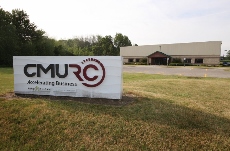
Also on the agenda is Erin Strang, President and CEO of the Central Michigan University Research Corporation, and our host for the meeting. She will lead a group discussion of ideas for instituting a local shuttle service in Mt. Pleasant.
Following the program and business meeting, we will gather at one of Mt. Pleasant’s former railroad depots for our usual no-host lunch.
Our Speakers:
Chris Bagwell is Executive Vice-President and General Manager Great Lakes Central Railroad (GLC). Chris is well known to MARP for his enthusiastic work retrofitting the MITRAIN cars and facilitating their display at events. Chris was honored in 2013 as a “Rising Star” by Progressive Railroading. You can read his profile here. Chris recently “starred” as well in a video talking about GLC operations in Michigan and promoting the proposed WALLY commuter train.
Erin Strang is
President and CEOof the Central Michigan University Research Corporation. CMU-RC is a non-profit business accelerator that provides guidance to entrepreneurs to bring their ideas to market. CMU-RC is designated a Michigan SmartZone — one of 15 technology-oriented centers across the state — established to offer tax incentives while supporting research development and commercialization of new technology to promote economic growth.
While the city and Grand Sakwa Properties have settled on the cost of the property that the Troy Multi-Modal Transit Center sits on, who will reimburse the city for the additional cost is not yet clear.
While the city paid Grand/Sakwa $3.1 million Sept. 3 and the lawsuit was dismissed, Oakland County Circuit Court Judge Leo Bowman must sign the final order dismissing the case, which had not been filed at press time.
Troy City Attorney Lori Grigg-Bluhm explained that the matter was decided by case evaluation, a procedure in which three attorneys put a value on a case, which both parties accepted.
Bowman signed an order Aug. 15, 2014, giving the city the title to the land and requiring the city to pay developer Grand Sakwa Properties $1.07 million, based on a land appraisal.
Grand Sakwa had donated 2.7 acres of the total 77-acre mixed-use commercial and residential property at Maple and Coolidge to the city of Troy on the condition that Troy would develop the land for use as a transportation center. The consent agreement — dated June 2, 2000 — required that the city fund the center within 10 years of the date of judgment, which the Michigan Court of Appeals ruled never happened.
Last summer, Alan Greene, attorney for Grand Sakwa, said Grand Sakwa did not believe $1.07 million to be a proper number.
The transit center grand opening was Oct. 15, 2014.
The case evaluation award that the city must pay was set at $4.15 million, which includes all costs, including Grand Sakwa’s attorney fees and the land value. The city paid the $1.07 million to Grand Sakwa last summer to gain title of the land.
Grigg-Bluhm said that based on a trial court decision on Michigan condemnation law, the city and Grand Sakwa were required to value the property to include the transit center structure, rather than the vacant parcel.
Greene could not be reached for further comment before press time.
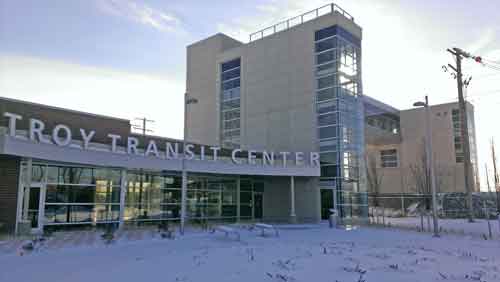
The 2,000-square-foot transit center building has a waiting area and public restrooms, an elevator, a 90-foot pedestrian bridge from the building to the tracks, a crash wall, platform enhancements, designated parking on the Troy side, and slips for taxis and buses, although the Suburban Mobility for Regional Transportation bus schedule does not include a stop at the transit center at this point.
Under the terms of a Federal Rail Administration Grant, the FRA has the right to demand reimbursement of the $6.62 million cost of the transit center if it is not operated for at least 20 years. If the center was to be abandoned, the city could be disqualified from any further federal transportation grants, Grigg-Bluhm said.
The city will work with the FRA, the Federal Transit Administration, the Michigan Department of Transportation and SMART for reimbursement of the settlement amount.
“The city does intend to seek all available federal funding,” Grigg-Bluhm said.
She noted that funding is available through the FTA and the FRA, and that the city needs to go through procedural steps to seek it.
The terms of a 20-year lease agreement with Amtrak stipulate that the city perform all necessary maintenance on the center and cover operating expenses, for which Amtrak will reimburse the city 100 percent.
“I’m very confident when all is said and done that Troy taxpayers will not have to pay for a federally funded project,” said Troy Mayor Dane Slater.
“We didn’t dip into the reserves,” Slater said of the $3.1 million payment. “We can use the transit center. It belongs to the city. It (the lawsuit) is over, which is very good. My goal is that Troy taxpayers will not pay for a federally funded project. I’m very optimistic.”
The Southeast Michigan Council of Governments will receive $250,000 in federal funding to support the development of a Bus Rapid Transit project along Woodward Avenue, the U.S. Department of Transportation announced Monday.
SEMCOG is among 21 organizations nationwide that will receive a share of $19.5 million in grants from the U.S. Department of Transportation’s Federal Transit Administration to support comprehensive planning projects that improve access to public transit.
The funds are made available through FTA’s Transit-Oriented Development Planning Pilot Program for communities that are developing new or improved mass transit systems, the agency reported.
SEMCOG and the transit authority are planning the Bus Rapid Transit for a 27-mile corridor along Woodward Avenue from downtown Detroit to Pontiac.
Specifically, the the local funding will go towards creating a plan for communities to guide development around transit facilities; formulating strategies for economic growth; assessing development opportunities in the corridor; and evaluating the use of mixed income housing and public private partnerships in relation to the project, the report said.
“Our nation’s transportation demands have exceeded our capacity, causing millions of Americans to lose precious time stuck on congested roads and transit systems,” said U.S. Transportation Secretary Anthony Foxx. “By investing in transit planned around housing, jobs and services, these communities are creating ladders of opportunity for their citizens and laying a strong foundation for economic development that our growing nation demands.”
A list of transit projects selected to receive federal funding can be found online at www.fta.dot.gov/grants.