Che sorpresa ti aspetta nel vivace casinò lazybar: generosi bonus, giri gratuiti e una selezione di giochi colorati renderanno la tua serata fantastica.
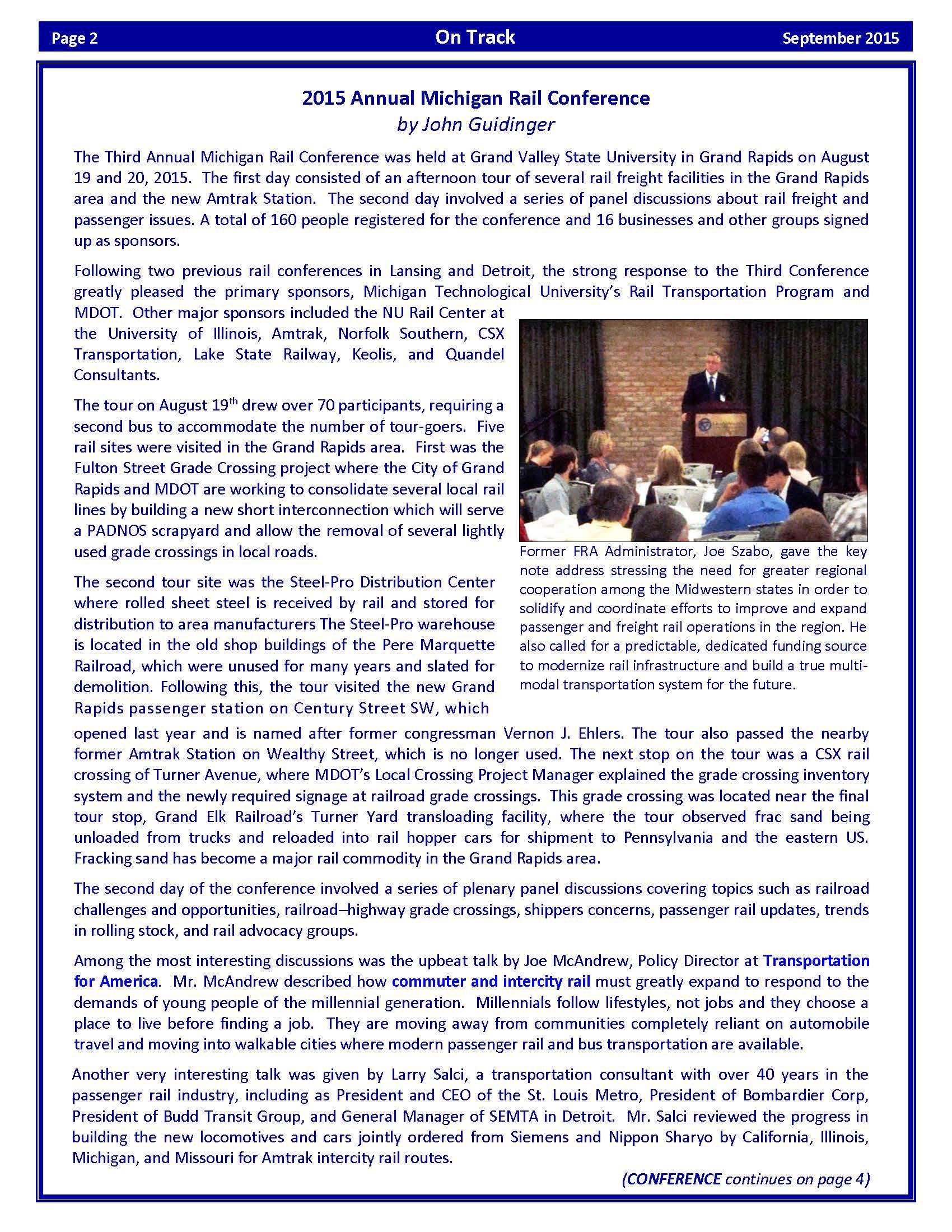
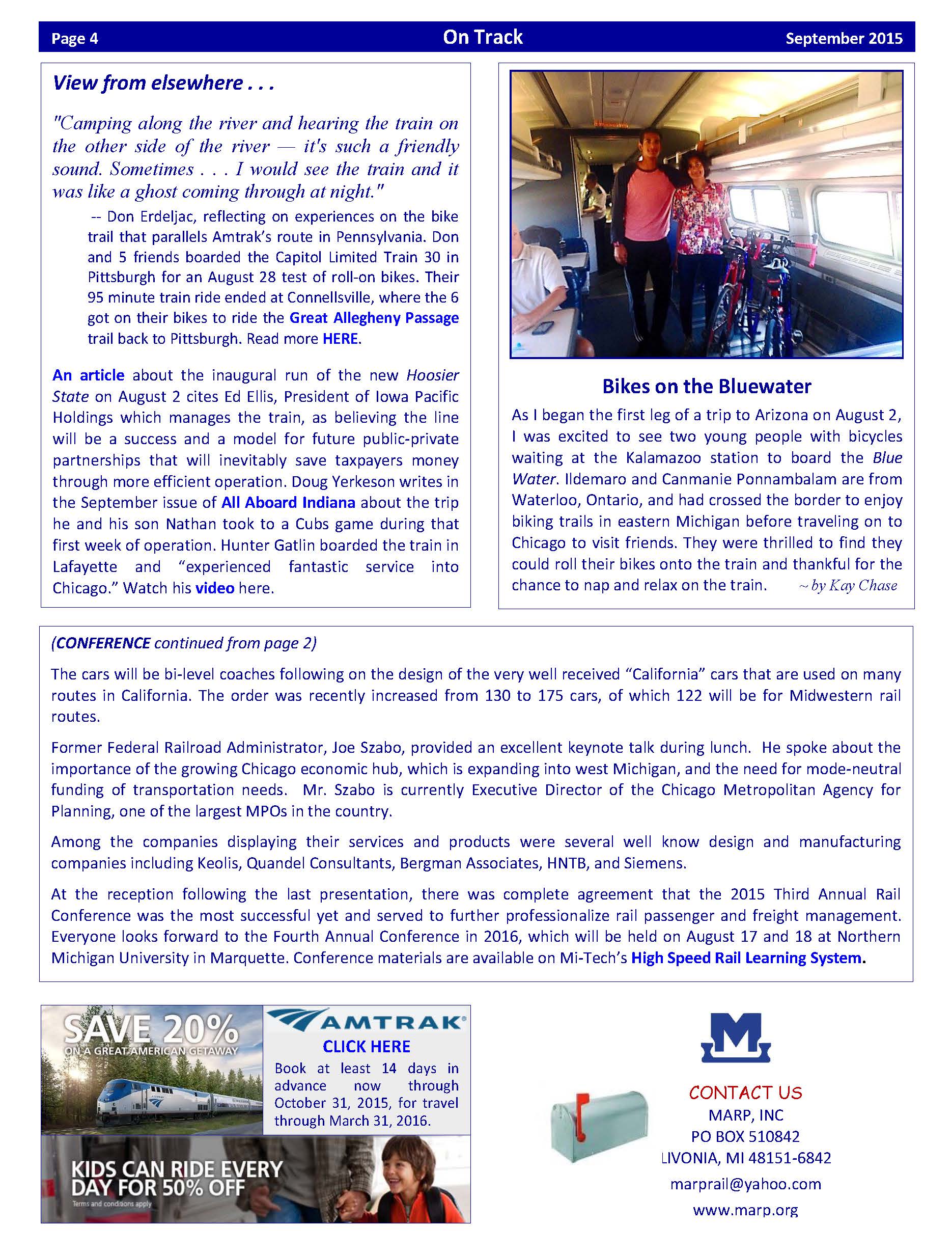
We hope you will enjoy the reports on the recent Michigan Rail Conference held at Grand Valley State University. You will also learn about the next round of public meetings for the Coast-to-Coast rail project. These will engage students at five campuses beginning at GVSU on September 30. And be sure to follow the links to stories about the inaugural run of the new Hoosier State train which features dining in a full length dome car and other amenities.
The Michigan Statewide Transit Study, funded through a Veterans Transit Community Living Initiative (VTCLI) grant, is looking at regional gaps in mobility, particularly for special-needs populations; barriers and opportunities to meeting these needs; and identifying actions that can be taken by local transportation providers and Michigan 2-1-1 to increase mobility. Visit the website register for the workshop being held in your area.
We hope you enjoy the issue and that you will let us hear your comments and suggestions. If you would like to write a story or suggest an item to be covered, email us at marprail@yahoo.com
Click on images below if you don’t have a PDF reader.
CLICK TO ENLARGECLICK TO ENLARGECLICK TO ENLARGECLICK TO ENLARGE
The Michigan Department of Transportation, responding to criticism from lawmakers and taxpayers after the Free Press reported the state agency is paying more than $1 million a year to lease railcars it can’t even use, is finalizing an agreement to halt the payments on Sept. 30, according to the state’s top rail official.
Tim Hoeffner, director of MDOT’s Office of Rail, said details aren’t finalized, but this much is agreed between MDOT and the owner of the cars, Great Lakes Central Railroad: The state will stop the lease payments of $3,000 a day, but the railroad will still promise to make the railcars available to MDOT, should they be needed, for up to five years.
MDOT wants the double-decker passenger cars, formerly used by commuter train operator Metra around Chicago, for proposed commuter services between Detroit and Ann Arbor and between Howell and Ann Arbor. But neither service has been approved or funded, some of the tracks the trains would use are not ready and officials say start dates are likely about four years away.
Matthew Moroun, son of depot owner Manuel (Matty) Moroun, floated the idea of moving some of the family’s business operations into the Michigan Central Depot that it owns.(Photo: Mandi Wright)
Over the years, dreamers have recommended all sorts of schemes for the old Michigan Central Station, from casinos to vertical agriculture. But it may turn out that the best new use may be closer to the station’s original purpose — a transportation hub.
Matthew Moroun, son of depot owner Manuel (Matty) Moroun and the new public face of the Moroun business empire, told WWJ radio recently that it was possible the family might consider moving some of its operations into the train station.
The Morouns’ Warren-based CenTra (a shortening of Central Transport) is a North American trucking network employing thousands of employees. The family also owns and operates the Ambassador Bridge as well as a growing logistics network that operates in part from facilities at the I-94 Industrial Park on Detroit’s east side.
The Morouns’ umbrella CenTra organization today operates from a converted school building in Warren where they employ hundreds of workers and operate a mission-control center for their far-flung trucking network.
Moving even a portion of that into the old train station would recreate a transportation hub there even if it doesn’t replace the train service that once made the depot famous as a city landmark.
A spokeswoman for Matthew Moroun said Tuesday she couldn’t add anything to the speculation and that Matthew Moroun was concentrating on “doing right by the depot” by continuing renovations of the station. So far, the family’s Detroit International Bridge Co. has spent an estimated $12 million to reinstall electricity at the station, to put in a new elevator, and to install new windows.
Estimates of the cost of a total renovation of the train station generally start at $100 million, but the figures could vary considerably depending on what use to make of the station.
Steve Morris, managing principal for the Axis Advisors real estate consulting firm in Farmington Hills and an adjunct professor of real estate finance at the University of Michigan, said the train station will benefit from the revitalization taking place in the greater downtown.
“The location of the old Train Station has become significantly more valuable over the past three years given its proximity to the dynamism of (downtown) Detroit,” he said Tuesday, also citing the residential growth in the nearby Corktown district and the forthcoming new development on the former Tiger Stadium site near the depot.
Reusing the tower portion of the depot as either housing or office space could make sense given current economics, he said. One possibility not mentioned yet: that Wayne County might move its offices from the Guardian Building, which it owns but is considering selling to an investor like Quicken Loans Chairman Dan Gilbert, and move into the train station instead.
If something like that happened, Morris said, the Moroun family potentially could “receive a boat load of tax benefits” for their renovation of the historic structure.
Moreover, with the current push to develop residential apartments throughout the greater downtown area, the train station potentially could find a new use as that, he added.
Any new use for the train station is likely at least a few years away, as it would take that long at a minimum to complete the cleanup of the station and to plan for and complete a transition to a new use.
Now’s the time for companies that have expressed interest in running passenger rail service between Sault Ste. Marie and Hearst to put their plans in writing for evaluation.
Last Friday, the Algoma Central Railway passenger service stakeholders working group issued a request for proposal for a new operator. The service stopped in mid-July because third-party operator Railmark Canada couldn’t meet a precondition and get a line of credit of $550,000.
The group invited 25 companies in North America to submit their proposals.
Tom Dodds, interim chair, says he was fielding calls and emails from interested business before the RFP was sent out.
The request was also sent to Railway Association of Canada, electronic tendering service MERC, politicians in the Sault and area and a short-line railway operator association in the United States.
“I think we’ve done a pretty broad broadcast,” said Dodds. “I’m pretty confident the industry will know that we’ve sent this out.”
Applications, due Sept. 9, will be evaluated for ideas to increase passenger volume and “the value of the passenger experience,” by offering travel options running a day or more, said Dodds.
“You’d have a combination of increased enthusiasm for using the passenger service because it’s a nicer level of service, as well as different types of experiences that you could undertake on the railway,” he told The Sault Star.
With Canadian National Railway Co., charging a track access fee that “is not insignificant,” the chosen firm “has to see this as way beyond just simply a passenger service,” said Dodds.
“The passenger service and the support provided by the federal government has to be a means to an end,” he said. “You can organize a number of different types of tourism products, or activities or experiences, along the line and get revenue generated. Something like that happens in many other jurisdictions.”
Transport Canada agreed to fund $5.3 million in bridge financing over three years based on Railmark Canada’s business case. Federal support is assured for the new operator. That wasn’t guaranteed when an earlier search that eventually led to Railmark being selected by CN was done.
“We think that’s critical,” said Dodds.
An annual subsidy of $2.2 million from Transport Canada to offer passenger service was cut in 2014, then extended a year to help the working group find another operator after CN stopped running the train. CN wouldn’t operate the passenger line without the subsidy.
The co-chair of Coalition for Algoma Passenger Trains is “very optimistic” a new operator will be found even after Railmark’s short run. The difference, says Linda Savory-Gordon, is firm federal funding.
“That could make the big difference right there,” she said. “People know that if they follow the guidelines of Transport Canada that they will be able to be reimbursed for the eligible expenses. I think that it’s a very good chance that we’ll find a very good operator.”
She, and other working group members, reviewed the RFP last week before it was sent out to interested businesses.
“We’re glad that things are progressing,” said Savory-Gordon. “I’m very pleased that it’s a short turnaround too. Last time was a little longer process.”
A new operator is expected to be in place between October and December.
The Agawa Canyon Tour Train is still run by CN. It’s not affected by the suspension of passenger rail service north of the Sault.
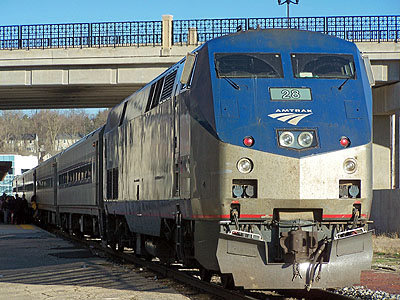
Amtrak’s Wolverine train at the Ann Arbor station.
Ann Arbor officials said back in May the Ann Arbor Station study was nearing the final stretch and a recommendation was expected in the next month or so on a preferred location for a new Amtrak station in the city.
More than three months later, nothing has been announced, but city officials say there should be news sometime in September.
Eli Cooper, the city’s transportation program manager, said a final draft analysis of alternative locations for a new train station was to be delivered to the Michigan Department of Transportation on Wednesday afternoon.
He said the draft report includes a comprehensive review of options for a new train station both on Fuller Road and Depot Street, as well as a no-build option.
“The report also discusses a recommendation to preferred location,” Cooper said in an email on Wednesday, declining to disclose the preferred location.
“Recognizing this is a draft document and subject to agency review, comments and amendments, it is best to wait until the final version is available,” he said.
The Ann Arbor News has filed a Freedom of Information Act request for a copy of the draft report and is awaiting a response from the city.
City officials have been talking about building a new Amtrak station for several years, and the current study has been ongoing since early 2014.
It’s the city’s position that the existing station on Depot Street is inadequate and will become increasingly inadequate in the years ahead in terms of passenger demand, quality and comfort, access, intermodal connectivity, and integration within the city.
Assuming MDOT’s review indicates the draft report is responsive to previous input from MDOT and the Federal Railroad Administration, Cooper said it will be forwarded to the FRA for final review, and a final report could be released in September.
“I’m thinking we’re into early- to mid-September if all goes well,” Cooper said, noting public meetings to discuss the recommendations will be scheduled after that.
Cooper said late last month the city was leaning toward holding off on the public engagement until after Labor Day to avoid summer vacation issues and to maximize the opportunity for public engagement and comment.
When asked for an update in early July, Cooper said the city’s project team was working through the FRA’s comments on an earlier draft report.
The city has given serious consideration to demolishing the existing Amtrak station on Depot Street and building a new station at that location, as well as another option that would involve building on the footprint of a city-owned parking lot along Fuller Road in Fuller Park in front of the University of Michigan Hospital.
As for the idea of returning the historic Michigan Central Railroad Depot on Depot Street to use as a train station, something the federal government asked the city to explore as part of the Depot Street alternative, the city’s project consultant laid out a list of reasons in May why that wouldn’t be a very good option.
If the city decided to stick with the existing Amtrak location on Depot Street, the city’s project team has concluded the city would need a portion of the DTE-owned MichCon site north of the station to build a new station and parking facilities there. DTE has agreed to collaborate with the city to make that work if that option is chosen.
The project team has evaluated options for Depot Street that include a new station either at ground level or elevated.
The project team is working with assumptions that ridership along the Detroit-to-Chicago corridor will increase significantly in the coming decades, with daily roundtrips by Amtrak increasing from three to 10, along with new commuter rail service between Ann Arbor and Detroit that’s expected to start within a few years.
City voters will have the final say before a new station can be built.
The city hired URS Corp. for $824,875 to lead the train station study. A little less than $165,000 came from funds the city previously budgeted, with the rest covered by a federal rail grant the city accepted in 2012.
The $2.8 million federal rail planning grant also is expected to cover some additional future expenses as the project moves forward.
Final design of a new Amtrak station is identified as a $2.6 million expense in 2016-17 in the city’s Capital Improvement Plan. The actual construction of the new station is shown as a separate $44.5 million line item in 2017-18.
City officials expect 80 percent of the funding to come from the federal government with other local partners potentially contributing funds.