Che sorpresa ti aspetta nel vivace casinò lazybar: generosi bonus, giri gratuiti e una selezione di giochi colorati renderanno la tua serata fantastica.
Upcoming Events
o MARP’s 42nd Annual Meeting
o 3rd Annual Michigan Rail Conference
o NARP Fall Council Meeting
o Michigan Railroad History Conference
News from Indiana and Wisconsin
We hope you enjoy the issue and that you will let us hear your comments and suggestions. If you would like to write a story or suggest an item to be covered, email us at marprail@yahoo.com
Click on images below if you don’t have a PDF reader.
The Michigan Environmental Council has undertaken a $100,000 feasibility study on public transporation options, including establishing rail service between Detroit and Grand Rapids.(Photo: John T. Greilick;file / The Detroit News)
Passenger train service between Detroit and Grand Rapids could be reinstated in the next decade if state transportation experts determine the public has an appetite for a new line and can figure out how to pay for it.
Supporters say the idea of connecting Michigan’s two largest cities by train is gaining appeal on both sides of the state as each undergo economic and cultural revivals making passenger service more appealing to business travelers and tourists.
The Michigan Environmental Council, the Lansing-based group that supports increasing public transportation options, has undertaken a $100,000 feasibility study and embarked on a series of hearings this summer along the route to get the public’s input. More hearings are scheduled later this month in Dearborn, Plymouth, Ypsilanti and Brighton. Also involved in the effort are the Ann Arbor Area Transportation Authority and the Michigan Department of Transportation.
“There really is not a way to connect to Michigan’s major cities and our coasts without taking a car,” said Elizabeth Treutel, a transportation police expert with the council. “There are no rail options. If Michigan wants to be competitive, if we want to attract talent, if we want to keep our college-educated people here, we have to have more and better options to get around. And people have to be willing to recognize that and invest in it.”
Even boosters acknowledge that re-instituting the service will be challenging.
“Getting rail service up and running is a very difficult task,” said Kathleen Lomako, executive director of the Southeast Michigan Council of Governments, which helps regional leaders with transportation planning. SEMCOG has been working on a passenger rail project from Ann Arbor to Detroit for years and struggled with funding.
“Connecting our region to other parts of the state, it’s a good thing. It’s about figuring out how difficult is that going to be to do, how much it’s going to cost and who pays for it. Those are all questions that need to be answered.”
The Detroit to Grand Rapids line isn’t the only one being explored. Preliminary discussions have been underway for months on establishing a rail connection from Ann Arbor to Traverse City. The Michigan Land Use Institute is pushing MDOT officials to study the feasibility of the route using existing freight rails with the hope that it could be operational by 2025.
Michigan hasn’t had a Grand Rapids-to-Detroit line since Amtrak was created in 1971. Those heading the effort said that four feasibility studies on resuming service were done in the 1980s through 2002.
The current Coast-to-Coast Passenger Rail study is examining three possible routes that would run on freight tracks from Holland through Grand Rapids and Lansing and to Detroit. Two routes would go through Ann Arbor; one going through Jackson and Ann Arbor and the third through Plymouth and Brighton.
The study will be conducted by a transportation management firm to determine cost, time, ridership and how to fund it. It will also consider public feedback given at meetings held by the Michigan By Rail team, a coalition of organizations led by MEC and the Michigan Association of Railroad Passengers.
Organizers said the line could take a decade to implement. The train, Treutel said, would have to go between 79 and 110 mph to compete with car travel.
The only way to get from Detroit to Grand Rapids and back by passenger train involves traveling to Chicago and connecting for a return trip.
Andrew Layman, who lives in Ann Arbor and attended a public hearing on the rail project there last month, said he’s interested in seeing better rail options in the state that are “reliable and affordable.” But he worries about whether the public will eventually support the service with tax dollars.
“The entire country and the state of Michigan is lacking, really,” said Laymen, 29, comparing the state’s train service to that of Europe. “I just think we’re behind the times and this is long past due. It’s a good initial study.”
Grand Rapids Mayor George Heartwell, who backs the passenger rail concept, said he’d like to see it “be a reality” rather than a “pipe dream of train enthusiasts.’’
“I suspect that people here would want to make good use of a train if it was available to Detroit for business, for entertainment, to go over and see a Tigers game in the afternoon and the Red Wings in the evening,” Heartwell said. “I hope there would be a similar appetite in Detroit to come over to Grand Rapids … for ArtPrize or to drink the craft beers.”
But Heartwell sees more taxes as the stumbling block.
“If you are looking at Proposal 1, you say it’s a pretty slim appetite,” the mayor said of last spring’s statewide road proposal that was trounced by voters.
State officials said they are interested but proceeding cautiously.
“MDOT is working with the locals to address the legislative requirements, but there is a lot of ground to cover before this would advance beyond a study,” said Tim Hoeffner, director of MDOT’s office of rail. “We will need to examine various factors like what the ridership and revenue will be, where the operating funding would come from, whether or not communities would provide stations, would the host railroads allow it, and what kind of safety systems are needed.”
Still, Treutel said there is a “viable reason to look at this right now” in part because Amtrak ridership has been climbing over the last decade.
Michael Ford, the CEO of the Regional Transit Authority, said that although his focus is on improving transit in southeastern Michigan, the discussions for the passenger rail service are important for the public to weigh.
“Any mobility options that can connect the region from a city like Grand Rapids into Detroit would be obviously very, very important,” Ford said. “People want more mobility, they want to be able to get to great cities and go back and forth and not have to take their car.”
Michigan lawmakers and Congress grapple with transportation funding issues
Round 2 of public engagement meetings scheduled for the Coast-to-Coast rail project July 13-23
Information on upcoming meetings including the Michigan Rail Conference in Grand Rapids, a Rail Summit in Wisconsin, the NARP fall meeting in Indianapolis and the biannual Michigan Railroad History Conference in Lansing
priority boarding for Legacy Club members at Chicago Union Station; introductory memberships are $10
We hope you enjoy the issue and that you will let us hear your comments and suggestions. If you would like to write a story or suggest an item to be covered, email us at marprail@yahoo.com
Click on images below if you don’t have a PDF reader.
The state is getting a new grant to boost rail safety education. Michigan Operation Lifesaver has been awarded $8,400 from Operation Lifesaver, Inc., in partnership with the Federal Railroad Administration.
It is part of the nonprofit safety group’s ongoing “See Tracks? Think Train!” public awareness campaign.
The money will be used to boost awareness on billboards, movie theater advertising and displays for public events.
Federal statistics show that about every three hours, a person or vehicle is hit by a train in the United States.
Michigan ranks 10th nationally for crossing collisions train incidents, with 13 deaths from 79 crashes in 2014 according to Sam Crowl, State Coordinator for Michigan Operation Lifesaver.
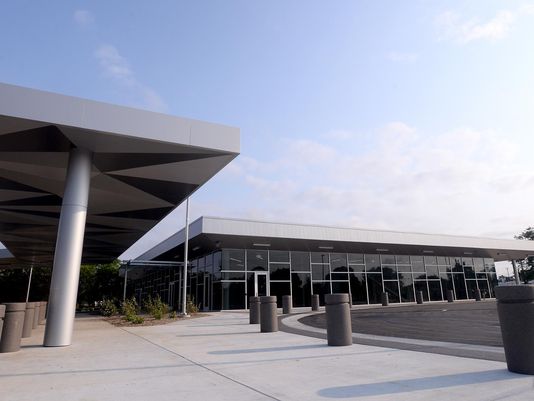
The new Amtrak Station in East Lansing .(Photo: Dave Wasinger/Lansing State Journal)
The new Amtrak station near Harrison and Trowbridge roads will be complete this summer (2015).
The station, which is part of the new $6.3 million Capital Area Multimodal Gateway, will be three times larger than the existing station on the property. It will have an enclosed lobby with floor-to-ceiling windows as well as luggage and bike storage, said Laurie Robison, spokeswoman of Capital Area Transportation Authority, which operates the station.
There is no set date for completion of the station. Construction crews just have to finish mechanical and electrical work before final inspections can begin, Robison said.
Once the station is ready to open, CATA will demolish the smaller station – something customers have been waiting for.
“It’s absolutely needed,” said Gerald Lee, of Lansing. “This station is very small and a lot of Michigan State University students use it when they move in. I can’t wait.”
Lee was waiting for a Greyhound bus to Buffalo, N.Y., to meet with his six sisters for a small family reunion. Lee said he uses the bus service at the station three times a year, but would likely travel more often when the new passenger station opens.
Renovations include adding four canopied bus bays, 150 parking spaces with a payment kiosk and an overflow area for taxis and buses. When the project is fully complete this fall, the station will serve as a transit hub for Amtrak trains as well as bus service from Greyhound, Megabus and Indian Trails.
Jonathan Keith, a cab driver for M-Cab, is relieved there will be spaces for taxis. In the cramped parking lot only made smaller by construction, Keith said he’s had to wait 15 minutes to exit onto Harrison Road with a van full of passengers.
“It’s a pain,” Keith said. “Buses just park on the road because they can’t navigate through the parking lot. This is long overdue. I’m glad CATA stepped up to it.”
Work began on the property in August 2014 when the former Michigan State University Surplus Store and Printing Services buildings were torn down. MSU owns the site and leases it to CATA.
The project is funded by a $6.3 million grant by the U.S. Department of Transportation.