Che sorpresa ti aspetta nel vivace casinò lazybar: generosi bonus, giri gratuiti e una selezione di giochi colorati renderanno la tua serata fantastica.
The Michigan Department of Transportation (MDOT) is seeking to temporarily forgo payments on 23 unused commuter-rail cars it leased from the Great Lakes Central Railroad (GLC).
Under an agreement still in progress, GLC would eliminate MDOT’s lease payments on the cars for up to five years. The railroad would then assure the cars’ availability for future commuter-rail service in southeast Michigan, according to an MDOT press release.
To generate revenue from the cars in the interim, GLC would be able to sublease the cars to other commuter-rail agencies in the U.S. and Canada, MDOT officials said.
The agency expects to terminate lease payments to GLC after Sept. 30.
“This agreement removes MDOT’s lease expense and protects the state’s investment in the commuter rail cars,” State Transportation Director Kirk Steudle said.
The cars were initially rehabilitated for two separate commuter-rail projects: one from Dearborn, Mich., to Detroit, and another from Howell to Ann Arbor, Mich., also known as the Washtenaw Livingston Rail Line.
MDOT would resume payments on the vehicles once the state begins commuter-rail service, which is expected to occur in 2019.
Michigan’s transportation organizations are studying planes, trains and automobiles.
More options for public transit could play a huge role in the state’s competitiveness in attracting and retaining people young and old, Michigan transportation experts say. They’ve recently launched four studies to assess the feasibility of new Michigan rail routes.
The studies will assess traffic flows, taking into consideration automobile, bus and air traffic, said Elizabeth Treutel, a Michigan Environmental Council policy associate.
“A big goal of the studies is understanding what are the traffic flows now?” she said. “Where are people going? Where are people coming from? How are they getting there? And then what is the likelihood that [they] would switch to a train if they had that option?”
About one-third of Michigan’s population is too young or too old to drive or they are physically or financially unable to, Treutel said. And rail is the friendliest motorized transportation for the environment. It helps attract and retain recent college graduates who care about protecting it, she said.
Rail also has economic impacts for the communities it connects.
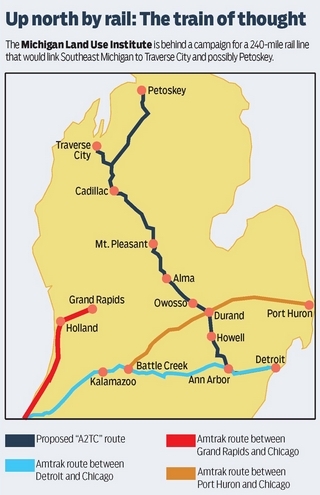
“We know that passenger rail brings in $64 million in community benefits to the state every year,” Treutel said. “That’s the passenger rail lines that exist currently, which are the three Amtrak lines that go from Grand Rapids to Chicago, Detroit to Chicago, and then Port Huron to Chicago.”
Grand Valley State University recently quantified those benefits, such as the money Amtrak spends on equipment and labor and the money travelers save and can then spend in local businesses, she said.
The four major proposals for railways between cities in Michigan include a commuter line that would run from Howell to Ann Arbor and another from Ann Arbor to Detroit, Treutel said. Longer routes are proposed to run from Ann Arbor to Traverse City and from Detroit through Lansing and Grand Rapids and end in Holland.
“They’re all very different,” Treutel said. “They’re serving different areas of the state, and they’re at different points of development.”
An artist’s rendition of the completed M-1 Rail project.
The official name of the M-1 Rail project under construction along Woodward Avenue will be decided by Quicken Loans Inc.
Project officials have confirmed the mortgage giant — founded by Detroit businessman Dan Gilbert — secured the naming rights to the 3.3-mile streetcar line “as part of its financial support during fundraising for the project.”
“M-1 Rail is also working on other branding items — including recognition of donors who have sponsored station stops,” said M-1 Rail Chief Operating Officer Paul Childs in a statement. “The process is a dynamic one and will be done in a way that reflects the pride we have in the project and its importance to Detroit.”
No additional information was available. Childs said officials “will provide further details in the future as work progresses.”
The M-1 Rail streetcar line will run from downtown to the New Center area. The $137 million publicly and privately funded line is expected to be operational by fall 2016. Construction on the light rail started in late July.
Quicken receiving the naming rights shouldn’t come as a surprise. The company has given millions to the project and Gilbert is vice chairman of M-1’s board of directors.
Quicken obtaining the naming rights was first reported over the weekend by Crain’s Detroit Business.
MARP Vice Chairman Jim Wallington was on WPHM, 1380 AM in Port Huron, on May 18 to discuss the state of Amtrak and the recent Amtrak wreck in Philadelphia.
Photo by NATHAN SKID, CBD (left) / ISTOCK PHOTO (right) With that spring ritual — the weekend slog up and down I-75 — about to rev up, you’d be excused for thinking there has to be a better way to get up north. Could that way be a railway?
It’s an idea with appeal: Riding the rails north from Ann Arbor to Traverse City, maybe for a summer weekend — and no highway congestion to contend with, there or back.
The Michigan Land Use Institute hopes to make that a reality.
The Traverse City-based nonprofit is spearheading a campaign to explore passenger rail service on an approximately 240-mile stretch of track between the two cities — an “A2TC” initiative that’s generated interest and discussion as well as about $18,700 raised in a Land Use Institute crowdfunding campaign in March.
“There’s a lot of work to be done and questions to be answered, and our goal is just to keep moving this forward to get the questions answered,” said Jim Bruckbauer, a policy specialist at the Land Use Institute.
It’s a 10-year vision to provide a new and more environmentally friendly option to travel the state and boost the downtown economies of communities along the route, while speaking to public sentiment for passenger rail connecting Traverse City and Southeast Michigan.
At statewide community forums in 2010 while the Michigan Department of Transportation was developing a state rail plan, a consistent and top theme that emerged was that Michigan’s passenger rail system should include a Traverse City-to-southern Michigan connection, said Liz Treutel, a policy associate at the Michigan Environmental Council — which, with the Michigan Association of Railroad Passengers, convened the meetings.
Feedback ran both ways, Treutel said. People in northern Michigan wanted easier access to downstate, and tourists were interested in rail service heading north.
Conducting a feasibility study for a new route to Traverse City, among other destinations, became a recommendation of the 2011 state rail plan.
“If it’s done, we would want to do it in partnership with others that are looking at it,” like the Land Use Institute, said Tim Hoeffner, director of MDOT’s Office of Rail.
The Land Use Institute has been discussing A2TC with MDOT and other organizations and potential stakeholders and is looking at how a feasibility study could proceed next year to answer many unknowns — such as potential ridership, cost of track improvements, operating costs and structure, and travel time between communities.
Track is ready … almost
The track, predominantly state-owned and used for freight, is operated by the Great Lakes Central Railroad. About 95 percent of the tracks are in condition for passenger service. Small sections, like one outside Traverse City, only meet Federal Railroad Administration standards for freight use and would need to be improved.
In addition, controls that would allow freight operations and passenger trains to run at the same time would be federally required, said Chris Bagwell, Great Lakes Central’s executive vice president and general manager.
He did not have a cost estimate but said installing what are known as positive train controls would involve “a full GPS system of the railroad” and improving locomotives and grade crossings so that if two trains are approaching each other, they would be able to communicate and brake.
The railroad is working with the Land Use Institute and providing information, Bagwell said. With MDOT and the institute, Great Lakes Central could run a test ride from Ann Arbor to Traverse City next summer, assessing the track and the time it would take.
MDOT’s Hoeffner said additional questions include how much people would pay for tickets. “Most passenger service does not cover the operating cost from what the passengers pay,” he said, “so where would the operating subsidy come from?
“That said, it’s an interesting idea, and it is the type of thing that we work with the local communities on. If they have a vision or a concept, then we’re here to work with them on it.”
The Michigan Environmental Council is project manager on a $100,000 study examining another passenger rail route — connecting Detroit, Lansing, Grand Rapids and Holland. The council has been discussing A2TC with the Land Use Institute and hopes to be involved, perhaps contributing staff time or knowledge from the “Coast to Coast” study, Treutel said.
Also offering to share information is the Ann Arbor Area Transportation Authority, which is conducting a feasibility study on a host of brick-and-mortar issues associated with a nearly 27-mile proposed commuter service connecting Howell and Ann Arbor, said Michael Benham, a strategic planner for the authority. That stretch of track is part of the line that goes north to Traverse City.
The A2TC route envisions several community stops between Ann Arbor and Traverse City and a possible jog up to Petoskey.
One stop could be Mount Pleasant. That city’s community services and economic development director, William Mrdeza, sees many possible benefits, including a new way for students to commute to Central Michigan University, an asset to downtown development and a selling point to attract residents and tourism.
“And obviously all of that brings in some economic impact to the community as well,” Mrdeza said. “I think we’re really interested in seeing where this might go and if we can be a part of determining the feasibility.”
With some of its crowdfunding money, the Land Use Institute expects this summer to create videos showing the impact the service might have on communities.
An economic engine?
In Traverse City, community transportation advocate Kimberly Pontius, executive vice president of the Traverse Area Association of Realtors, said A2TC service could help attract clients such as second-home buyers and cater to executives who opt to live in the Traverse region and commute to Southeast Michigan. The rail line could benefit economies on both ends of the route, he said.
That includes a boost to tourism. Southeast Michigan is the Traverse City area’s biggest market, other than the state as a whole. Connecting Southeast Michigan populations to northern destinations via rail is worth looking at, said Brad Van Dommelen, president and CEO of Traverse City Tourism.
Train travel, Van Dommelen said, “is so much more leisurely and enjoyable … instead of a grind on the highways” and would add to the experience of coming north.
“Normally, your enjoyment of the weekend doesn’t begin until you get to your destination,” Van Dommelen said. “Traveling by train, your experience, your enjoyment begins the moment you step on the train. It becomes part of the adventure.”