All posts by admin

Che sorpresa ti aspetta nel vivace casinò lazybar: generosi bonus, giri gratuiti e una selezione di giochi colorati renderanno la tua serata fantastica.

Algoma Central Railway passenger service transition is a work in progress

From the Sault Star:
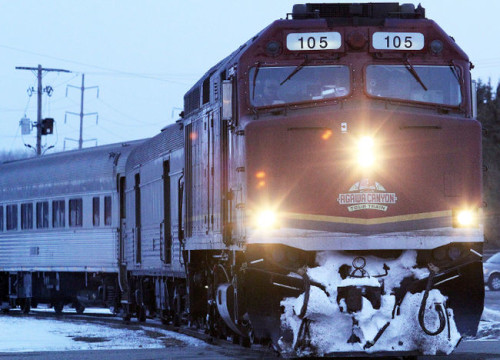
The ACR passenger train rolls into Sault Ste. Marie from Hearst March 31, 2015 at the CN Rail yard in the city's west end. Jeffrey Ougler/Sault Star
The ACR passenger train rolls into Sault Ste. Marie from Hearst March 31, 2015 at the CN Rail yard in the city’s west end. Jeffrey Ougler/Sault Star

The third-party operator selected to run the ACR passenger train service between Sault Ste. Marie and Hearst is working through the conditions required to formally seal the deal.

Economic Development Corp. CEO Tom Dodds said Railmark’s owner B. Allen Brown is working through conditions needed to ink the final agreement that will see the short-line railway company take over operations.

“There are regular conversations between CN and Railmark and really, we’re at that point that all but one of the pre- conditions have been checked off,” Dodds said.

Dodds said the “couple” of outstanding items not yet covered off are resolvable but it becomes a question of time.

Railmark “really has progressed remarkably but we’re all in the same position, we all want it done yesterday.”

Both federal and provincial operating licenses have been obtained, as well as insurance.

Dodds called the transition process a little more complicated and longer than expected, but that is partly due to the eleventh hour of the funding approval announcement and the number of things that needed to be done, all in a short period of time.

The final transition to Railmark won’t happen until all the conditions are met, he said. In the meantime, CN continues to operate the service.

“Council provided Railmark an approval in principal but they need to see the final agreement and that arrangement needs to give them a level of comfort with how all of this unfolds and demonstrates to them that they’re not on the hook,” Dodds said.

Under the federal government’s funding plan, the City of Sault Ste. Marie is the recipient of the funding and it in turn needs to create a mirror agreement with Railmark.

The agreement stipulates maximum amounts of funding per month, what expenses are eligible for funding and what documentation or receipts must be presented for reimbursement, among other things.

Dodds said a monitoring committee will oversee the expenditures to ensure they meet the criteria for quick submission and reimbursement.

He said it’s also important that there is a high degree of understanding between the city and Railmark on how the process will work and how funds will move back and forth.

“We are attempting to minimize the amount of time anyone will be out of pocket and we want to make sure that the expenses are well documented and covered off as part of the agreement to demonstrate payment,” he said.

Dodds said scheduling changes cannot occur until the agreement is signed and the stakeholders have a chance to examine the relative volumes of traffic and see what makes sense.

“The government is funding a passenger service. Transport Canada is willing to be flexible but up to a point. They want to ensure that the service they are funding is being provided,” he said.

Railmark will need to determine how to grow revenue through its other services and cut the costs associated with the passenger train service.

Ultimately, it will be up to council to determine whether the agreement meets its standards and whether it is willing to take a limited risk and serve as a go-between for the funding transfer.

Dodds said other community tourism groups needs to work with Brown to ensure the passenger train service is maintained.

It’s expected that a working group meeting will be held shortly so that the stakeholders are all aware of the circumstances.

In April, it was announced that Transport Canada will provide $5.3 million of funding over three years for the continued operation of the passenger rail service between Sault Ste. Marie and Hearst.

The announcement marked a year-long drive by stakeholders to develop a plan that would see the service eventually become self sufficient.

Source: http://www.saultstar.com/2015/05/13/passenger-service-transition-a-work-in-progress

May 2015 edition of OnTrack

Click here to save this file or to view it as a PDF in full screen.

Included in this issue:

  • information to help you make an informed decision on Proposition 1 on the May 5th ballot
  • notes on the recent meeting held in the Ypsilanti Freighthouse
  • how you can help with the “Detroit-Holland Rail Ridership and Cost Estimate Study” that has recently gotten underway
  • Amtrak Train Days official kick-off at Chicago Union Station
  • Amtrak Train Days events in Michigan


We hope you enjoy the issue and that you will let us hear your comments and suggestions. If you would like to write a story or suggest an item to be covered, email us at marprail@yahoo.com

Click on images below if you don’t have a PDF reader.

ontrack_44_Page_1ontrack_44_Page_2ontrack_44_Page_3ontrack_44_Page_4

Come to Durand May 16, 2015 for a MARP meeting and Railroad Days

The Michigan Association of Railroad Passengers (MARP) will be having its monthly membership meeting at Durand Union Station 200 Railroad Street, Durand MI, 48439, on Saturday, May 16, 2015. The meeting will start at 10 a.m. in the second floor Ballroom at the station.

Following a membership meeting, MARP and DUSI will be co-sponsoring a Durand Railroad Days Program presented by Joseph M. Mishler on the “Flint and Holly Railroad, its economic impact on the area and the man that built it, Henry Howland Crapo”.

The MARP meeting and the program that will follow the meeting are open to all interested persons. Membership in MARP or DUSI is not required, however membership forms will be available for anyone that would like to join and support either or both of these organizations.

20150516meetingflyer

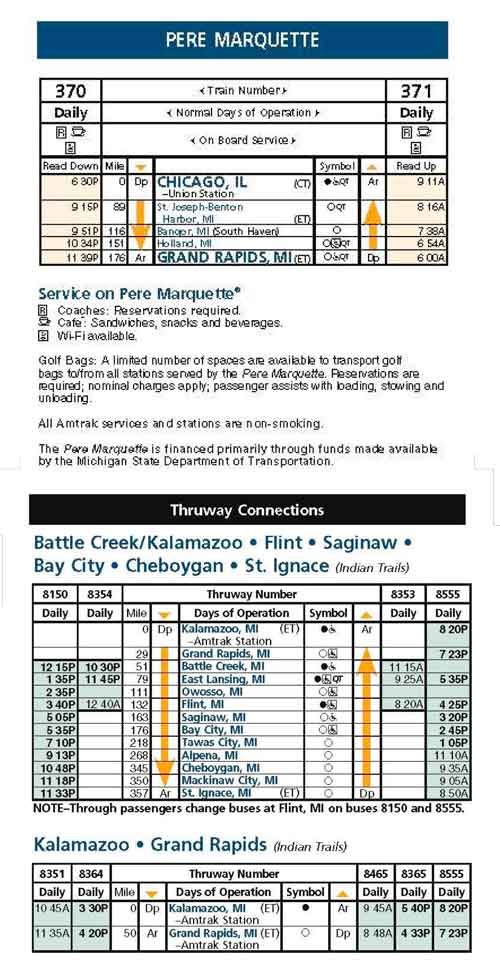
In case you haven’t noticed, Amtrak’s Pere Marquette is on a new schedule

Amtrak press release:

A new schedule for the Amtrak Pere Marquette will make it more convenient for passengers to attend sports, music and theatre events in Chicago and result in eight to 10 jobs being based in Grand Rapids, Mich.,effective May 4, 2015. The new schedule (attached) also improves connections with other Amtrak trains.

The current schedule allows a six-hour day in Chicago and was crafted for Chicago-based crew cycles. Last year’s opening of the Vernon J. Ehlers Station allowed for the creation of a crew base in downtown Grand Rapids and a nine-hour day for passengers to work or play in Chicago.

Amtrak employed 237 Michigan residents last year, with total wages of $19.5 million. Goods and services purchased in Michigan by Amtrak totaled $17.3 million in 2014.

All Amtrak service in Michigan is operated under a contract with the Michigan Department of Transportation (MDOT).

Amtrak-Pere-Marquette-Schedule-Change-ATK-15-024-2

Back to the future: $400-million, car-free proposal would link Southwestern Ontario communities

From The London Free Press:

Scott St. John is organizing a public meeting in London to discuss a proposed $400-million bus-and-rail network linking Southwestern Ontario. (CRAIG GLOVER, The London Free Press)

In too many places in Southwestern Ontario, the travellers’ refrain is the same: You can’t get there from here. Or get here from there.

All but abandoned by bus and passenger train service, rural Southwestern Ontario is rolling out a $400-million car-free travel plan to stitch together its various large and small communities into a cohesive whole, using bus and train services.

“Almost as much money is being spent to patch over the cracks as there would be to fix this thing properly,” said Terry Johnson, a Chatham-Kent businessperson who also is president of the Southwestern Ontario Transportation Alliance. “There’s a lot of duct tape being applied.”

Proponents say the investment required by a bus-and-rail proposal called Network Southwest can generate an economic benefit of more than $1 billion.

And, they say, it can convert the exodus from small Ontario into a mere commute.

The plan is outlined in a 72-page report (online at swota.ca) that says connecting communities is both practical and affordable, the whole thing buildable for about the same price-tag as constructing one kilometre of subway line.

Since 2009, inter-city bus and passenger rail travel in the region has shrunk two-thirds, said the report’s author, Greg Gormick.

Cars, “the junk food of transportation” with high environmental and economic costs, have become the only way of travelling between and among communities.

The group proposes to close the “mobility gap” by creating a web of bus networks feeding high-performance rail lines.

Johnson, an economics grad from Oxford University, said the success of high-speed rail, a $2.5 billion plan promised by the province, is dependent upon creating effective links throughout this region.

Scott St. John, a London violinist who is organizing a forum in London to discuss the report’s recommendations, said tourism and business are suffering from lack of such a network.

“The train would be the backbone or the spine of the network but we would try to establish better connections with bus and (in-city) transit to make more effective transportation links,” he said.

Johnson noted that some people have said they’re moving businesses out of Southwestern Ontario or setting up companies where there’s better access and amenities for commuting employees.

“(Having) the ability to take your kid to Toronto on a Saturday and getting back the same night — that matters to young professionals.”

It matters in cities and it matters to small communities. He cited Wingham as an example of where trains no longer stop and buses no longer run: “A community . . . pushed off a demographic cliff.”

He said the push now is to build public support and persuade Ontario and Ottawa to co-operate.

deb.vanbrenk@sunmedia.ca

— — —

NETWORK PLAN

The plan

  • Proposes passenger bus and rail links among large and small communities in Southwestern Ontario.
  • Would operate bus routes from Kingsville to Fort Erie to Owen Sound and along existing rail lines stretching from Sarnia and Windsor to Niagara Falls.
  • Five-year cost to build network would be $400 million.
  • That would cover buying modern, Ontario-built trains, making safety and capacity improvements to rail lines and establishing bus routes to reconnect dozens of communities that have lost bus service since 2009.
  • Economic benefit would be at least $1.2 billion.
  • Several regions in the U.S., including in Michigan and California, operate successfully on similar business models.

The cost

The plan’s $400 million cost is the equivalent of:

  • 1 km of Toronto subway tunnel
  • 12 km of six-lane toll highway
  • 1.4% of Ontario’s $29-billion transportation pledge

Source: On Track Strategies, prepared for Southwestern Ontario Transportation Alliance

— — —

Source: http://www.lfpress.com/2015/04/07/back-to-the-future?utm_source=addThis&utm_medium=addthis_button_email&utm_campaign=Back+to+the+future+|+The+London+Free+Press#.VSXDqKZ1aNw.email