All posts by admin

Che sorpresa ti aspetta nel vivace casinò lazybar: generosi bonus, giri gratuiti e una selezione di giochi colorati renderanno la tua serata fantastica.

Mayor’s Press Release: $7 Million Funding to Improve Train Service at Chicago’s Union Station

Funding Will Go Towards Planning that is Critical to Addressing Transit Center’s Aging Infrastructure

From Chicago Mayor’s Press Office:

Mayor Rahm Emanuel, Senator Dick Durbin, Senator Mark Kirk, Representative Mike Quigley, Amtrak and Metra today announced an additional $7 million funding to develop infrastructure improvements and train operating strategies that will enhance passenger rail service at Chicago’s Union Station. The funds will be used to conduct a Terminal Planning Study and create a Service Development Plan that will increase capacity at the 90-year-old station and on the railroads that lead to it. This builds on the announcement in January 2015 that Amtrak has made a commitment of $12 million to continue renovations of Union Station this year. In the coming weeks and months, Mayor Emanuel will continue to work in coordination with the United States Department of Transportation, the State of Illinois, Metra, and Amtrak to facilitate a complete overhaul of Union Station that will require a multi-year, $500 million investment.

“Union Station provides an essential link to jobs and economic opportunities for residents in neighborhoods throughout the City of Chicago and these resources will help us ensure that it serves our city more effectively for the future,” said Mayor Rahm Emanuel. “With the help of these federal resources, Union Station will be able to keep pace with rising demand on our railways to remain an economic engine for Chicago and keep our city on the move for many more decades to come.”

“Union Station serves as the gateway to Chicago for thousands of commuters and visitors every day,” Senator Durbin said. “Yet most are met with congestion on the rails and within the station. With this infusion of federal, state and local funding we’ll be easing rail congestion outside the station and laying the groundwork for a vast improvement of the passenger experience inside the station. I commend Mayor Emanuel and Amtrak for having the vision to reimagine a Union Station with improved air quality, pedestrian flow and retail space and look forward to working with them to make it a reality.”

Chicago’s Union Station is the third-busiest railroad terminal in the United States, serving over 300 trains per weekday carrying nearly 125,000 arriving and departing passengers – a level of passenger traffic that would rank it among the fifteen busiest airports in the U.S. Due to this, the station currently operates at or near capacity during peak periods. Moreover, demand for both passenger and freight rail service throughout the Chicago region is expected to continue to grow considerably in the years ahead. Chicago’s ability to capture this railroad traffic will generate an estimated 17,200 jobs over a ten-year timeframe and up to $7 billion in annual production.

“As the only Illinois member of the House Appropriations Committee, I’m proud to help bring much needed funding back to the City of Chicago. Today, we take an important step towards a faster, more efficient, and environmentally conscious transportation system,” said Rep. Quigley. “By developing a 21st century infrastructure plan we can ease congestion on the tracks, take more cars off the streets, and improve air quality for our great city and our region.”

“As Illinois’ most senior member on the House Transportation and Infrastructure Committee and a chief proponent of the CREATE rail modernization program, I fought in 2013 alongside Congressman Quigley to get unspent federal funds reprogrammed for rail safety and improvement projects,” said Rep. Dan Lipinski (IL-3). “Today, I’m proud to announce that our region is getting some of those funds to develop a plan to ease congestion on our rail lines, benefitting passengers using Union Station and aiding economic growth by improving freight movement. This will be a great help to so many of my constituents who want safer and more efficient rail traffic through our region.”

The Terminal Planning Study and Service Development Plan will help to coordinate routes and operations and enhance passenger rail service into and out of Union Station for travelers and commuters approaching Chicago from the east, south, and west. More than 700 commuter and passenger rail trains and 500 freight trains operate each day in the Chicagoland area. Union Station is the busiest railroad station in Chicago, serving approximately 115,000 Metra and 10,000 Amtrak passengers every weekday.

In 2014, 32.5 million Metra customers arrived or departed on commuter trains at Union Station. Meanwhile, nearly 2.3 million passenger trips were made between Union Station and destinations throughout the Midwest using Amtrak’s state-supported passenger train services. An additional 1.1 million trips to and from Union Station were made on Amtrak’s long distance trains. Train ridership is forecast to increase significantly in the next few years as major track improvements are completed and new rail cars are introduced.

“Like flying, when delays taxing to and from the runway are frustrating, on some Amtrak routes the delays are often in the miles closet to Chicago Union Station,” said Derrick James, Amtrak Government Affairs. “This grant will go a long way toward fixing those problems, so investments in higher-speed Amtrak routes in Downstate Illinois, Northern Indiana and Michigan are not negated by trains crawling in — or even backing out — at Union Station.”

The Terminal Planning Study and Service Development Plan are critical steps towards increasing Union Station’s capacity while enabling the station to better connect Chicago’s neighborhoods and suburban communities and provide residents with access to jobs; accommodate high-speed and intercity trains and passengers; reduce congestion to improve passenger safety; and improve intermodal connections.

The funding includes $3 million from the Federal Railroad Administration that will be matched by $2 million from the State of Illinois, $1 million from Metra, and $1 million in tax increment financing (TIF) from the City of Chicago.

In addition to this Study, in the coming months, Mayor Emanuel will work with Amtrak, Metra and state and federal partners to initiate improvements recommended in the Union Station Master Plan. Investing in transit infrastructure and transit-oriented development supports Mayor Emanuel’s efforts to enhance quality of life and create jobs for residents in neighborhoods across Chicago.

The rehabilitation of Union Station will be supported by projects already underway to expand its role as a central and growing transit hub, linking neighborhoods to jobs, and neighboring states and counties to Chicago. These projects include building the Union Station Transportation Center, a consolidated Chicago Transit Authority (CTA) bus terminal on city-owned land next to Union Station that will anchor the new Loop Link. This new corridor will connect Amtrak, Metra, all of CTA’s downtown rail lines and many downtown destinations, resulting in faster, more reliable transit serving residents and commuters across all of Chicago’s neighborhoods.

# # #
Source: http://www.cityofchicago.org/city/en/depts/mayor/press_room/press_releases/2015/april/mayor-emanuel–senator-durbin–senator-kirk–representative-quig.html

New East Lansing CATA center nears completion

From WKAR:

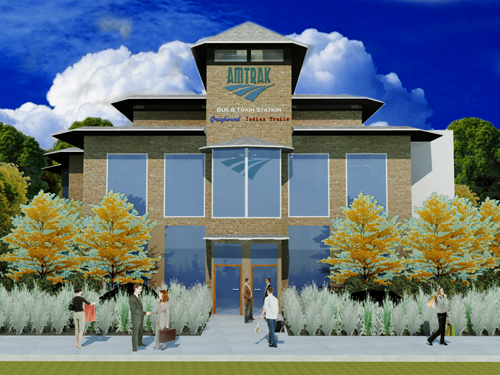
This is an artist's rendering of the future East Lansing Station.
This is an artist’s rendering of the future East Lansing Station.

The Capital Area Transportation Authority will soon unveil its new Multi Modal Gateway in East Lansing.

The station, just south of East Lansing’s existing Amtrak facility will incorporate rail, city, regional and national bus lines in one large modern locale.

The Multi Modal Gateway is slated to open this July, which is earlier than originally expected.

Current State’s Peter Whorf spoke with CATA assistant executive director Debbie Alexander for an on-site update.

Listen to the radio interview at: http://wkar.org/post/new-east-lansing-cata-center-nears-completion

Michigan voters soundly reject Proposal 1 road tax plan

From the Detroit Free Press:

Proposal 1, likely one of the most complicated and confusing questions ever placed on a Michigan ballot, was soundly rejected Tuesday as many voters expressed anger at lawmakers and state government for failing to come up with a better solution to the sorry state of the roads.

With all counties reporting, 1.4 million Michiganders voted no on Proposal 1 while less than 351,000 voted yes, according to the Michigan Secretary of State’s office. The 80-20 rejection was the most one-sided loss ever for a proposed amendment to the state constitution of 1963, records show.

The Free Press called the election for the no side less than one hour after the polls closed, based on analysis of exit poll results and early returns.

Even before the polls closed on a rainy day across much of Michigan — a fact expected to depress voter turnout already projected to be as low as 20% — the talk had turned to what happens next.

“We need to go ahead and get these roads and infrastructure fixed immediately, given the nature and the extent of the damage that has occurred from not maintaining them,” said Rep. Peter Lucido, R-Shelby Township.

But Tuesday’s vote was not expected to make it easier to find a solution to the infrastructure problem Republican Gov. Rick Snyder and the GOP-controlled Legislature have grappled with for several years. Tuesday’s result sets up a fight between tea party conservatives who want to address the roads issue without raising taxes and others in the Legislature who say the public is willing to pay more to fix the roads — just not the way they were asked to do this time.

Proposal 1 would have hiked the state sales tax to 7% from 6%, taken the sales tax off fuel sales, and hiked fuel taxes — raising close to $1.3 billion extra for roads.

When fully implemented, the plan would have also generated about $200 million a year more for schools; $116 million for transit and rail; sent $111 million more to local governments; and given a $260-million tax break to low- and moderate-income families through restoration of the Earned Income Tax Credit.

The complex nature of the proposal resulted from the need to replace school and local government revenues lost as a result of removing the sales tax from fuel sales to make room for higher fuel taxes, which unlike sales taxes, support roads and transportation. Features such as the restoration of the EITC were concessions to Democrats, whose votes Republican Snyder needed to get the plan through the Legislature.

The special election cost Michigan taxpayers about $10 million.

Read more: http://www.freep.com/story/news/politics/2015/05/05/angry-voters-reject-proposal-michigan-roads-await-viable-fix/26950451/

Tuesday, May 5, 2014 ballot proposal could increase train and transit funding

Passenger train and mass transit programs in the state may see an estimated $112 million increase annually if voters approve an amendment to the state constitution on Tuesday, May 5, 2014, raising the sales tax and restructuring how taxes are collected for transportation.

In a December lame-duck session, Michigan lawmakers approved plans for a statewide ballot proposal, called Proposal 1, and an 11-bill package that could yield $1.2 billion a year in new funding for roads and bridges as well as the estimated $112 million increase to the Comprehensive Transportation Fund (CTF) which funds programs such as passenger trains, transit programs, intercity bus and freight rail.

The $112 million figure forthe CTF was announced by Michigan Governor Rick Snyder at a Dec. 18 press conference.

Actual funding levels for each program in the CTF are subject to future legislative debate and appropriation bills. The revenue generated for the CTF also will depend on fuel prices and other factors.

The proposal has been criticized as complicated and it has left many voters wondering what are the implications of a yes or no vote.

Gary Kuecken researched the issue and has broken it down here in terms of yes and no:

Click to enlarge
Click on chart to enlarge

1The funding formula:

  • 90% road repair and maintenance (for use only on road work)
  • 39.1% Michigan Department of Transportation
  • 39.1% county road commissions
  • 21.8% cities and villages
  • 10% Comprehensive Transportation Fund to benefit public transit programs

2Although it is very likely that this error will be corrected if the proposal is passed, the current wording of the current bill is as follows:

“the first $400,000,000.00 received and collected under this act” in FY2016 and “the first $800,000,000.00 received and collected under this act” in FY2017 would be distributed through the state funding formula

This amount applies to new revenue as well as existing funds such that around $1.7 billion (the $800 million intended earmark plus current baseline fuel tax revenue of around $900 million) would be earmarked for debt reduction in FY2016 resulting in a decrease in funding of $500 million from current levels.

Meeting Minutes — Ypsilanti – April 25, 2015

MICHIGAN  ASSOCIATION OF RAILROAD PASSENGERS
Membership Meeting
April 25, 2015
Ypsilanti, MI

Members Present: Larry Krieg, Jim Wallington, John Langdon, Robert and Diane Patterson, Jeanie Merckel, Chuck Merckel, Don Monteith, Dan Platz, Charley Bonnell, Clark Charnetski, Barb Spaulding-Westcott, Don W. Westcott, Steve T. Sobel, Dennis & Pat Schumaker, Warren Williams, Julien Wolfe, Jim Hinkins, Dan Sommerville, Jim Roach, Ren Farley, Rosemary Horvath, Mark Campbell, Richard L. King Jr.

Guests: Art Cole, Liz Treutel, Pete Murdock,

Call to Order: Chairman Krieg called the meeting to order at 10 a.m.

Freighthouse host Pete Murdock welcomed MARP and gave a brief history of the building the city purchased in 1979 for an indoor farmers’ market. Friends of the Ypsilanti Freighthouse formed to restore the building and bring it up to code. The Ann Arbor-Detroit Commuter Rail will stop at the site but the building cannot be used as a station as supporters once hoped for. A farmers’ market is located outside the building rather than inside. One day it will be used as a community building.

ACTION ITEMS:

March Minutes: John Langdon moved for approval with the correction of 23 commuter cars. Motion passed.

Treasurer’s Report:

Langdon clarified 59 presentations to lawmakers were part of the Meet & Greet program paid from a Michigan Environmental Council grant awarded to MARP to promote Michigan By Rail, composed of several organizations advocating for passenger rail.

  1. Merckel noted a $40 transaction fee is paid to PayPal for memberships to be paid online.

MARCH 2015

Checking         Opening balance:        $16,310.58

Receipts:                            3881.00

Expenses:                           2178.28

Closing balance:           $18,013.30

Langdon moved for approval of the treasurer’s report. Motion passed.

REPORTS:

MEETING SCHEDULE – Don Westcott

May 16: Durand Union Station during Railroad Days. Retired history teacher Joe Mishler will talk about the Holly-Flint Railroad, which is one of the state’s earliest railroads. Mishler will give the talk at the Michigan Historical Conference in October.

June 20:  Crossroads Village in Flint.  We will meet there but the final agenda has not been settled. One idea is to meet in the Warehouse with a box lunch served to those that reserve or to meet on the paddle wheeler on Mott Lake if maintenance on the boat is completed in time. The boat would cruise along Mott Lake while we have our meeting and eat our box lunches. Crossroads Village will be open. There is a operating steam powered saw mill and cider mill, an operating water powered grist mill, turn of the 20th century amusement rides and historic buildings with interpreters. There is the historic 3 ft gauge steam powered railroad (the engine and many of the cars came from Colorado and were built in the late 19th century and the early 20th century) that gives a little over 8 mile round trip thru the 4500-acre Genesee Recreation Area.  As an added attraction for MARP, the railroad restoration and maintenance facilities will be open for a guided tour.  The shops are not usually open for public tours.  I will be getting more details out as the plans come together.

July 25: Grand Rapids. The Amtrak Exhibit Train is expected.

August is open Sept. 5 is the annual MARP meeting in Durand.

October meeting is in Charlevoix

OUTREACH – Chuck Merckel

Langdon has plans for Amtrak Train Day. Chuck has other events on his schedule and asked for volunteers.

RAIL CONSTRUCTION UPDATES – Steve Sobel, MARP Michigan Passenger Photographer & Reporter

Steve presented a 15-minute “Newsreel” or summary of the progress along the Amtrak Wolverine route since late 2013. He included the two new intermodal stations: The Troy Transit Center which opened on October 14th, 2014, and Dearborn’s John D. Dingell Transit Center which opened on Dec.13th, 2014.

This was followed by photos of the M-1 rail construction along Woodward Avenue, concentrating from Grand Circus Park to Campus Martius.

He also showed a few pictures of the ongoing construction of the soon to be completed Junction Ave viaduct which will permit Amtrak trains to move much more smoothly and quickly between the West Grand Blvd (Detroit) and Dearborn stations. According to Amtrak, MDOT, this will save 5-10 minutes of travel time.

Steve briefly took us back to the Fall of 2013 where two track gangs provided by Norfolk Southern Railroad and supervised by Amtrak personnel was doing rail and tie replacement in the vicinity of the Ann Arbor Amtrak station.

He concluded by showing photos along the Michigan Avenue corridor where a 2nd track is being installed from the old Dearborn station to a point just East of downtown Ypsilanti. When completed in the Fall of 2015, it will act both as a long passing track for trains, both passenger and freight and will save a lot of lost time for Amtrak waiting for trains to pass each other.

The current Amtrak schedule has been changed to allow a 6 hour track work “window” so work can be performed without interruption. A supplement has been issued to the current Amtrak schedule. This covers a period from the present to October, 2015.


NARP “Day on the Hill” Report – Larry Krieg

Larry Krieg, John DeLora, Rich Vavra-Musser and Dwight Phillips, all on NARP Council of Delegates, visited offices of Michigan’s U.S. Senators and Representatives to convey support for passenger rail.


Special Report – Liz Treutel, policy associated, Michigan Environmental Council, outlined Proposal 1 on the May 5 ballot targeting roads and transportation. Treutel sought MARP support which generated discussion. Langdon noted MARP had indicated on its nonprofit certificate it would not take political stands. Treutel clarified 501 © (3) federal status allows for supporting issues but not monetary contributions. Langdon disagreed and moved for MARP not to take a stand on Prop 1. Voice vote. Majority supported. Discussion ensued. Langdon moved to extend meeting. Motion passed.


OTHER DISCUSSION:

Historian Ren Farley circulated packets on Depot Town and Ypsilanti history. Don Monteith announced the Michigan Land Use Institute would announce a name change at the May 16 meeting. R. Patterson attended the MEC meeting.


Meeting adjourned 12:07 P.M.

Rosemary Horvath

Acting Secretary