All posts by admin

Che sorpresa ti aspetta nel vivace casinò lazybar: generosi bonus, giri gratuiti e una selezione di giochi colorati renderanno la tua serata fantastica.

New policy worries states supporting short Amtrak routes

From the Fort Wayne News-Sentinel:

The leader of a coalition of states that foot most of the costs of Amtrak’s short passenger routes says its members are awaiting answers from a federal agency about a new policy Indiana cited in its decision to end a line between Indianapolis and Chicago.

Depending on its final form, the policy being drafted by the Federal Railroad Administration could make it impossible for some states to keep their Amtrak routes running, said Patricia Quinn, who chairs the Portland, Maine-based States for Passenger Rail Coalition.

The Hoosier State line’s last day of service is April 1, and the Indiana Department of Transportation in Friday’s announcement blamed an emerging FRA policy that the state said would effectively deem Indiana a rail carrier even though it does not own any tracks or trains.

INDOT Commissioner Karl Browning called that idea “insane,” saying it would significantly increase costs, paperwork and liability for operating the line, which was among 28 Amtrak routes under 750 miles affected by law Congress passed in 2008 that forced 19 states to pick up most of the costs of those lines by late 2013.

Indiana and seven local government partners, agreed in October 2013 to pay Amtrak $2.7 million to keep the 196-mile Hoosier State line rolling for one year. Indiana twice extended funding for that line.

INDOT had been negotiating for months on long-term agreements with Amtrak and Iowa Pacific, a private company that wanted to take over the Hoosier State’s operations when it decided to end the line because of the FRA’s new policy.

The Federal Railroad Administration has said that as states take on bigger roles managing Amtrak’s short passenger lines, they assume a greater burden to ensure they are safe for passengers and train crews.

“We continue to offer assistance to the state of Indiana — we want to see this service continue, and we continue to work with the state and local officials to ensure that it can,” the FRA said Wednesday in a statement.

The Hoosier State line began service in 1980 and runs four days a week between Indianapolis and Chicago, with stops in four Indiana cities. It’s Amtrak’s least-traveled route, moving only about 34,000 passengers in fiscal year 2014.

Most of the 19 states affected by Congress’ cost-sharing law are coalition members, Quinn said, and each is worried about the new policy’s impact. She said details FRA provided to Indiana contain new oversight requirements and extra costs those states “just aren’t willing or able to take on.”

Quinn added that the coalition’s member states are “anxious to engage” policymakers to make those concerns known.

INDOT has said it would only reconsider its move to end the Hoosier State line if the FRA or U.S. Department of Transportation reversed the rail carrier policy.

U.S. Sen. Dan Coats, R-Indiana, sent a letter Wednesday to the FRA’s acting administrator urging the agency to “reverse its decision” to deem INDOT a railroad carrier.

“INDOT is not in a position to assume either the additional liability or the regulatory burdens that a designation of ‘railroad carrier’ would impose,” Coats said in a statement.

Source: http://www.news-sentinel.com/apps/pbcs.dll/article?AID=/20150312/NEWS/150319878/-1/LOCAL

Here’s where to look for updates on the M-1 Rail project in Detroit

An artist's rendition of the completed M-1 Rail project.
An artist’s rendition of the completed M-1 Rail project.

M-1 Rail is posting weekly constructions updates on its website, Facebook page and Twitter feed. There is even an option to receive weekly updates via email. Visit their website at http://m-1rail.com for more information.

M-1 RAIL is a non-profit organization formed in 2007 to lead the design, construction, and future operation of a 3.3-mile circulating streetcar along Woodward Avenue between Congress Street and West Grand Boulevard in Detroit, Michigan.

Once completed, there will be a stop at the Detroit Amtrak station.

M-1 RAIL is an unprecedented public-private partnership and model for regional collaboration Notably, the first major transit project being led and funded by both private businesses, philanthropic organizations, in partnership with local government, the State of Michigan, and U.S. Department of Transportation.

The mission of M-1 RAIL is to create a catalyst for investment, economic development and urban renewal that positively impacts the entire region through the construction of a streetcar circulator system running along and connecting Woodward Avenue from the Riverfront to the New Center and North End neighborhoods

The M-1 RAIL Woodward Avenue Streetcar project is envisioned to be one element of a future modern, world-class regional transit system where all forms of transportation, including rail, bus, vehicle, bicycle and pedestrian, are considered and utilized to build a vibrant, walkable region that includes a thriving Downtown Detroit. This city center is envisioned by supporters of M-1 RAIL to become a foundation for growth and prosperity throughout the surrounding neighborhoods adjacent to the Central Business District, Midtown, New Center and North End.

Hoosier State line gets 30-day extension

From the Lafayette Courier and Journal:

Journal & Courier file photoPassengers prepare to board Amtrak’s Hoosier State line at the Riehle Plaza station in downtown Lafayette in 2013

The end of the Amtrak Hoosier State passenger rail got a 30-day reprieve, and a deal to save the four-day-a-week service might still be within reach.

Last week, Indiana Department of Transportation announced the rail service would end April 1, but Friday, March 13, 2015, INDOT announced the extension, meaning the rail line from Indianapolis to Chicago continues through next month.

Officially, INDOT said the announcement Friday followed a phone call between officials from the Federal Railroad Administration and INDOT Commissioner Karl Browning. During the conversation, Sarah Feinberg, acting commissioner for the railroad administration, indicated the federal agency would reconsider the position that would force the end of the Hoosier State passenger line, according to INDOT.

State Rep. Randy Truitt, R-West Lafayette, said, “They (railroad administrators) gave their commitment that they are willing to review it.”

Unofficially, the announced review of the Federal Railroad Administration’s ruling is likely the result of pressure from state and U.S. officials, Truitt said, noting they’ve received support from Indiana’s congressional representatives and senators.

It is the latest twist in a seven-year drama to keep the trains running.

INDOT spent 2014 and the first three months of this year working to create a public-private partnership, Truitt said. The deal was nearly inked until the Federal Railroad Administration derailed the negotiations last week.

It ruled that Indiana needed to become a railroad carrier under the public-private partnership, Truitt said. This is despite the fact that Indiana would not own tracks, cars or equipment.

That ruling spurred state officials to reach out to U.S. representatives and senators, and it appears the railroad administration felt the pressure, Truitt said.

“You want to talk about a team effort on this thing,” Truitt said of the state and federal officials who took up Indiana’s fight to preserve the rail line.

“It is not clear that the … (Federal Railroad Administration) will change its mind,” Browning said in a press release. “Because Ms. Feinberg committed to reviewing this, we want to give the … (Federal Railroad Administration) another opportunity to consider the problems Indiana has been airing.”

Truitt said the 30-day extension is a promising sign since Browning had said earlier this month that there was no point in extending the service unless there was a chance that the railroad administration might reverse its decision.

“I think it is promising,” Truitt said of the extension.

“Everybody is still participating in good faith,” Truitt said of the public-private partnership negotiated with INDOT, Amtrak and Iowa Pacific Holdings Inc.

Under that agreement, Iowa Pacific Holdings Inc. provides and maintains the railroad cars and markets the service, Truitt said. Amtrak agrees to operate the trains and sell the tickets, and INDOT pays $3 million a year for the service, Truitt said. Half of that $3 is still split between Indianapolis, Crawfordsville, Lafayette, West Lafayette, Tippecanoe County and Rensselaer.

Indiana has been wrestling with how to preserve the Hoosier State line since 2008, when Congress ended funding for Amtrak’s shorter passenger rail lines. Congress, Truitt said, announced states could fund the routes that are shorter than 750 miles if they wanted to keep them.

Indiana came up with a viable and fiscally responsible solution for funding the line, Truitt said, then the Federal Railroad Administration threw up a barrier that is impossible for states to overcome. He is hopeful the review is the final hurdle to the public-private partnership.

Source: http://www.jconline.com/story/news/2015/03/13/hoosier-state-line-gets-day-extension/70283594/

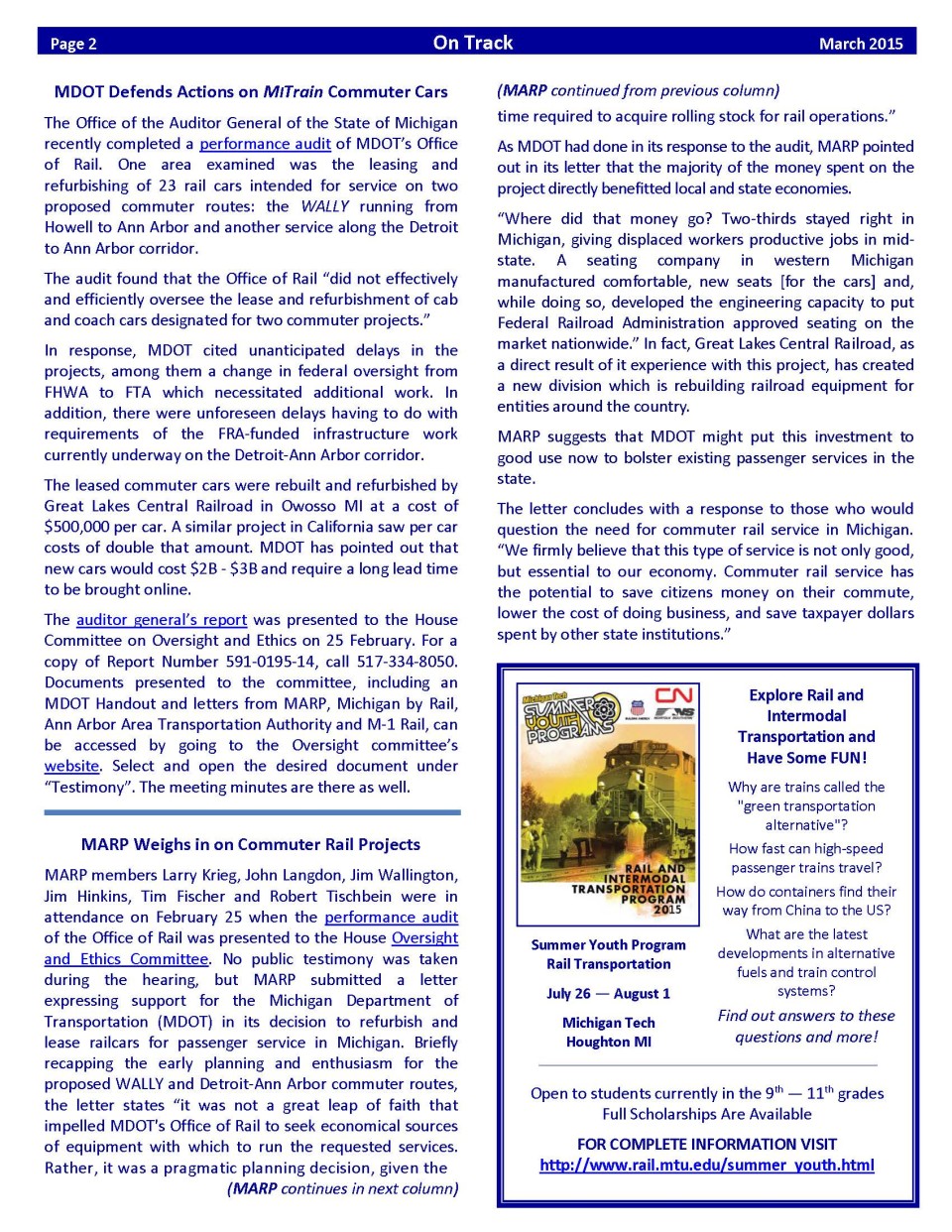
March 2015 edition of OnTrack

Click here to save this file or to view it as a PDF in full screen.

Included in this issue:

  • Proposal 1 on the May Ballot Does More than Fill Potholes
  • MDOT Defends Actions on MiTrain Commuter Cars
  • MARP Weighs in on Commuter Rail Projects
  • Midwest High Speed Rail Association Spring Meeting, March 21
  • Supreme Court Rules for Amtrak
  • MARP Outreach: Earth Day in Rochester, National Train Day in Toledo, more

We hope you enjoy the issue and that you will let us hear your comments and suggestions. If you would like to write a story or suggest an item to be covered, email us at marprail@yahoo.com

ontrack_42_Page_1ontrack_42_Page_2ontrack_42_Page_3ontrack_42_Page_4

Implications aplenty in Supreme Court Amtrak ruling

From Railway Age:

The Supreme Court March 9 sent back to a federal appellate court for reconsideration a freight railroad challenge to a provision of the 2008 Passenger Rail Investment and Improvement Act (PRIIA) that allowed the Federal Railroad Administration (FRA) and Amtrak to collaborate in establishing minimum on-time performance standards for Amtrak passenger trains operating on freight railroad-owned track. The 9-0 unanimous decision was written by Justice Anthony Kennedy.

The case originated in 2010 when the Association of American Railroads (AAR), on behalf of its freight railroad members, challenged the PRIIA, complaining that the law’s Section 207 improperly delegated to Amtrak, allegedly operated as private, for-profit company, authority to exercise with the FRA joint regulatory control over freight railroads.

In 2012, a federal district court denied the AAR challenge and upheld the law. That decision was overturned in 2013 by an appellate court, which agreed with the AAR that Amtrak is a private company; and that Section 207 of the PRIIA is an unlawful delegation of governmental power to Amtrak.

That the Supreme Court overturned the appellate court does not mean the district court ruling holds. In sending the case back to the U.S. Court of Appeals for the District of Columbia, the Supreme Court ruled only that the appellate court was wrong in concluding Amtrak is a private company. The appellate court now must reconsider the other merits of the AAR’s challenge to the PRIIA’s Section 207.

In fact, concurring opinions by Justices Samuel Alito and Clarence Thomas suggest the AAR may yet prevail because Section 207 of the PRIIA may have overstepped the Constitution’s Delegation of Powers and Appointments clauses by improperly vesting regulatory powers with a private arbitrator and an Amtrak president and board of directors who may lack the necessary constitutional authority notwithstanding Amtrak’s governmental entity designation.

While a final judicial determination could be delayed by at least a year—and longer if the case returns to the Supreme Court—the March 9 decision does not affect other sections of the PRIIA.

Embedded in the Alito and Thomas concurring opinions is an implication that unrelated legislation being drafted in the Senate—to initiate voluntary, but binding, arbitration of freight-shipper rate and service disputes—could be problematic, as will be explained.

As for the March 9 decision affecting Amtrak, when the freight railroads turned their money-losing passenger service over to the newly created and federally owned Amtrak in 1970, it was understood that Amtrak trains primarily would utilize privately owned freight railroad tracks, with Amtrak paying a user charge.

In 1973, Congress gave Amtrak a statutory preference over freight trains. Years of Amtrak train delays—allegedly because freight railroads failed to provide the required preference—caused Congress in 2008 to include the challenged Section 207 in the PRIIA. Section 207 instructed the FRA and Amtrak to develop, in concert with freight railroads, metrics and minimum standards for measuring the performance and service quality of intercity passenger trains.

Section 207 further provided that if the parties could not agree, the Surface Transportation Board could appoint an arbitrator to resolve the dispute through binding arbitration. Failure to meet those arbitrated standards, to be made part of the track-use contracts between Amtrak and freight railroads, would subject freight railroads to monetary damages and a requirement they modify freight operations for the benefit of Amtrak.

The AAR alleged in its initial complaint with the federal district court that Section 207 of the PRIIA unconstitutionally places “legislative and rulemaking authority in the hands of a private entity [Amtrak] that participates in the very industry it is supposed to regulate.”

Without determining if Amtrak is a private company or government entity, the district court ruled in 2012 that even if Amtrak could be deemed a private company, the FRA, STB, Department of Transportation and Congress exercised sufficient control and enforcement over Amtrak so as to turn away any argument that there was an improper delegation of regulatory authority to Amtrak.

In reversing the district court in 2013, the Court of Appeals for the District of Columbia concluded Amtrak is a private company, and thus cannot constitutionally be granted the regulatory power prescribed by Section 207 of the PRIIA. Such power is limited to government entities, said the appellate court.

The Supreme Court said the appellate court’s “premise was flawed” and rejected its finding that Amtrak is a private company. Simply because Congress termed Amtrak “not a department, agency, or instrumentality of the United States Government,” and further made “a pronouncement that Amtrak shall be operated and managed as a for-profit corporation” is not sufficient to classify Amtrak as a private company, ruled the Supreme Court.

It listed reasons why Amtrak is a government entity, including having a board of directors nominated by the President of the United States, confirmed by the Senate, having their salaries set by Congress, and being subject to removal from office, without cause, by the President of the United States. Additionally, said the Supreme Court, Congress exercises “substantial” supervision over Amtrak, including its federal subsidies, budget and route structure, plus Amtrak is subject to congressional oversight hearings. “Amtrak was created by the government, is controlled by the government, and operates for the government’s benefit,” said the Supreme Court.

The justices flubbed the dub, however, in saying “most” of Amtrak’s common stock” is held by the Department of Transportation. In fact, all of Amtrak’s common stock is held primarily by the private-sector American Financial Group and several privately owned freight railroads. This error is probably not fatal, as the other criteria used in determining Amtrak is a public entity are numerous and compelling. (See, “Fini to saga of Amtrak’s common stock.”)

It is now up to the appellate court to revisit the case and determine—with a new understanding that Amtrak is a government entity—whether other allegations of the AAR as to the constitutionality of Section 207 of the PRIIA are valid. And here is where the concurring opinions of Justices Alito and Thomas suggest something is still rotten in Section 207 with regard to appointment of an arbitrator and the structure of the Amtrak board of directors.

“It is hard to imagine how delegating binding, tie-breaking authority to a private arbitrator [appointed by the STB] to resolve a dispute between Amtrak and the FRA could be constitutional,” wrote Alito. Amtrak’s argument ”that the word ‘arbitrator’ does not mean ‘private arbitrator’ is in some tension with the ordinary meaning of the word. We usually think of arbitration as a form of private dispute resolution.”

Moreover, wrote Alito, because the arbitrator would be appointed by the STB rather than nominated by the President of the United States and confirmed by the Senate, the arbitrator is “not accountable to the people … Nothing final should appear in the Federal Register unless a Presidential appointee has at least signed off on it. Then there is the matter of Amtrak’s president and its board of directors.

Citing the Constitution’s Article II Appointments Clause, Justice Thomas doubted whether Amtrak—even as a public entity—is “constitutionally eligible to exercise executive power” such as collaborating with the FRA to establish performance standards. This, wrote Thomas, is, again, because the Amtrak president, appointed by the Amtrak board of directors, does not answer to the people by being nominated by the President of the United States and confirmed by the Senate. The Amtrak president, who could cast a deciding vote if the Amtrak board is deadlocked, should not be inferior to Senate confirmed board members, wrote Thomas.

Justices Alito and Thomas went further, questioning whether the Amtrak board of directors even has constitutional authority to appoint the president of Amtrak. “While I entirely agree with the Court that Amtrak must be regarded as a federal actor for constitutional purposes, it does not by any means necessarily follow that the present structure of Amtrak is consistent with the Constitution,” Alito wrote.

“Congress,” through Section 207 of the PRIIA, wrote Thomas, “has permitted a corporation subject only to limited control by the President [of the United States] to create legally binding rules. This arrangement raises serious constitutional questions to which the majority’s holding that Amtrak is a governmental entity is all but a non sequitur. These concerns merit close consideration by the courts below and by this Court if the case reaches us again. We have too long abrogated our duty to enforce the separation of powers required by our Constitution. We have overseen and sanctioned the growth of an administrative system that concentrates the power to make laws and the power to enforce them in the hands of a vast and unaccountable administrative apparatus that finds no comfortable home in our constitutional structure. The end result may be trains that run on time (although I doubt it), but the cost is to our Constitution and the individual liberty it protects.

Finally, Justices Alito and Thomas, by implication, touched on an issue affecting freight railroads and their freight shippers. When now Senate Commerce Committee Chairman John Thune (R-S.D.) co-sponsored with his predecessor, Jay Rockefeller (D-W.Va.), Senate Bill No. 2777 in the previous Congress, they included a provision to establish a voluntary, but binding, arbitration process to resolve rate, practice and common carrier service-expectation complaints subject to STB jurisdiction. A similar provision is under consideration for inclusion in new legislation this year. Some shippers have been pushing for mandatory, rather than voluntary, arbitration.

In light of this Amtrak decision, and the justices’ concern over a private arbitrator acting independently, as private arbitrators do, it is appropriate to question how a statutorily binding arbitration process for freight railroad-freight shipper disputes might pass constitutional muster. In the end, it would be a private arbitrator, who does “not answer to the people,” making decisions. A mandatory, as opposed to a voluntary, arbitration process seems unlikely now to satisfy the courts.

Whether a voluntary, but binding, arbitration procedure for freight railroads and freight shippers will pass judicial muster depends on its language. The apparent rub with Section 207 of the PRIIA is that Amtrak and the FRA (with or without an arbitrator) have been granted power by Congress to establish rules coercively applied to third party freight railroads.

The implications of this Supreme Court case are many. It would do well for opinion leaders and decision makers to follow events closely.

Source: http://www.railwayage.com/index.php/blogs/frank-n-wilner/implications-aplenty-in-supreme-court-amtrak-ruling.html?channel