Che sorpresa ti aspetta nel vivace casinò lazybar: generosi bonus, giri gratuiti e una selezione di giochi colorati renderanno la tua serata fantastica.
Transportation expert Greg Gormick wants people to use public transportation to show politicians there is a demand for improvements, including three daily round-trip trains in Sarnia.
Gormick unveiled an improvement plan for rail and bus service in southwestern Ontario during a presentation at Sarnia library on Saturday, Jan. 31, 2015.
Through the co-operation of municipal, provincial and federal politicians, Gormick wants to have 16 daily round trips on VIA’s existing routes and 18 feeder bus lines serving 100 southwestern Ontario communities within five years.
He set the cost at an annual $60 million operating subsidy and $400 million in capital investment.
The cost shock was softened by Gormick saying there’s a current $60-million operating subsidy to rail service. Moreover, $400 million is what will be spent in Toronto to build one kilometre of new subway line.
Gormick’s Network Southwest plan was created for the Southwestern Ontario Transportation Alliance (SWOTA), a regional rail advocacy group.
Gormick said the automobile remains the “junk food of transportation”, dominating the present transportation system. Yet the automobile comes with a big cost and yet has left the region with a mobility gap.
His assertion was supported by audience members who don’t own an automobile who spoke of their own personal experiences, such as being unable to get to Chatham from Sarnia, and having to endure a 10-hour train ride to Ottawa at a cost of $400.
Improved bus service is part of the plan, but the service must be integrated into the regional transportation system, Gormick said.
An intercity bus terminal must connect with rail service and local transit. Mobility hubs that bring all services to one terminal are part of the plan.
Such hubs are part of a successful rail renewal plan in North Carolina, where after years of decline ridership has doubled on some of that state’s rail lines, Gormick said.
Municipal transit systems have the operational expertise for intercity bus service but would need financial support from senior governments, said Gormick, citing it as an example of the need for co-operation among governments.
Local transit provides a person’s first and last miles in an intercity trip, he said.
Beyond the personal hardships, the mobility gap reduces the region’s appeal to new business, said Gormick.
Sarnia’s transportation accessibility is a factor considered by businesses searching for new locations, said George Mallay, executive director of Sarnia- Lambton Economic Partnership, following the presentation.
Closing the mobility gap does not require a one-time giant step but multiple steps using existing facilities. Buses being sold by seniors levels of government could be given to municipal governments and rebuilt for intercity service.
Rather than jumping to high-speed rail service with trains traveling on specially created tracks at speeds of 240 kilometres per hour, high-performance trains with speeds of 160 kilometres per hour could be a starting point.
“That’s the beauty of it (the plan). It can be done incrementally,” said Gormick.
One of first steps is to get people talking about the plan.
Audience members were encouraged to sign provided postcards that will be sent to MPs and MPPs to promote the plan.
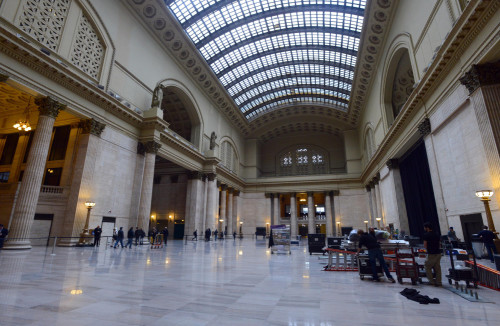
Union Station, 210 S. Canal, is slated for a major renovation. | Brian Jackson/ Sun-Times
Amtrak announced Thursday, January 28, 2015 a $12 million renovation project at Union Station that will include rehab of the marble stairway made famous in the movie “The Untouchables” as well as plans to commission a redesign of the often-congested concourse area where commuters board and de-board trains.
Improvements will also be made to the station’s facade, and updates will be made to the sprinkler and temperature control systems.
More than 120,000 people make their way through the 90-year-old station every day, said Amtrak spokesman Marc Magliari.
“It’s a disgrace compared to how smooth things are run at Ogilvie [Transportation Center],” said Ed Arnold after commuting into Union Station from Naperville Thursday morning. “I’ve missed trains because of congestion in the concourse. It’s screwed me up big time,” said Arnold, 61, a consultant.
The improvements are part of a multimillion-dollar master plan that is a collaboration by Amtrak, Metra and the Illinois and City Departments of Transportation.
“Amtrak and Metra ridership has grown significantly since the 1991 reconfiguration of the concourse level,” Magliari said. “We’ve outgrown that design.”
New doors will be added to help control the building’s heat and prevent bursting pipes, which occurred twice this month to the sprinkler system.
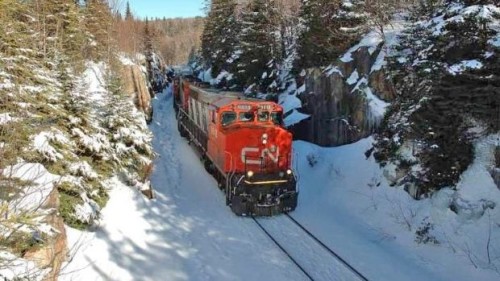
A third-party operator expected to run Algoma Central Railway’s Agawa Canyon Tour Train and passenger service offers “a new beginning” for the rail line.
Al Errington, owner of Errington’s Wilderness Island, calls Friday’s announcement that will see the unnamed company with experience in passenger and tourism service “a sea change” for ACR.
“There’s a lot more development that can happen from the basic passenger train,” Errington said Saturday in a telephone interview from Detroit where he was attending Motor City’s Ultimate Fishing Show. “I think it’s going to be a big story over the next couple of years as far as development. A third-party operator really opens up a lot of development opportunities.”
But owner Canadian National Railway, he adds, wasn’t interested in pursuing those possibilities because of its emphasis on shipping freight.CN
bought Wisconsin Central
Transportation, owners of ACR, in 2001.
The not-named firm and CN signed a letter of intent for ACR operation.
“Now they’re getting into the nitty gritty of the agreement,” said Errington. It’s a process the cochair of Coalition for Algoma Passenger Trains expects will take “weeks to maybe a month or more.” The new player, he added, wants to make plans for the summer tourist season. Running rights on the CN-owned tracks need to be negotiated.
“They’ve got basically a broad agreement that they’ve agreed to . . . now they have to take care of all the finer details,” Errington told The Sault Star.
His lodge, on Wabatongushi Lake in Chapleau Game Preserve, is only accessible by rail or float plane. Errington hopes the new operator will change the train schedule to encourage more ridership.
Three-day-a-week service between the Sault and Hearst -northbound on Saturday, Monday and Thursday, southbound on Friday, Sunday and Tuesday -is “not a great schedule.”
“It really cuts down on the number of guests I can bring in,” said Errington.
The executive director of Algoma Kinniwabi Travel Association and member of ACR Passenger Service Stakeholders Working Group calls Friday’s announcement “a step in the right direction.”
“We’re very, very excited and very, very pleased,” said Carol Caputo, also attending the Detroit tourism show.
About a dozen members of her group operate lodges along the ACR line. The train offers tourists another option to explore Algoma’s wilderness.
“Passenger rail allows us to stand out from other areas in the province,” she said. “It’s diversification of product. We basically have something for everyone.”
Tracks to Trails brings snowmobilers, and their sleds, from the Sault to Hawk Junction, Dubreuilville or Hearst. Travellers opting for ACR’s Tour of the Line can take the entire 950-kilometre trip between the Sault and Hearst.
“There’s a whole bunch of product lines with regards to the passenger rail,” said Caputo. “It’s more far reaching than just the businesses along the line because of all the experiences it offers. It gets people into areas that are inaccessible unless they go by train. It’s getting people immersed in everything that’s great about Algoma.”
Linda Savory Gordon, also cochair of CAPT, wants to start work on a sustainability plan the working group will present to the federal government.
A third party was sought because CN announced in early 2014 it would cut passenger service between the Sault and Hearst because Ottawa chopped a $2.2-million annual subsidy. The working group is asking the Conservative government to offer $7 million over five years to help with service transition.
CAPT already has an “in-depth” draft sustainability plan, created over the last year with help from other players including the communities of Hearst, Dubreuilville and Searchmont and resorts along the rail line. It will be shared with chair Joe Fratesi and working group members “and see what everybody agrees on.”
“We suspect that there will be a lot of agreement on most of it because these are things that we’ve been discussing with each other,” she said. “It really shows the kinds of things that could be done on that train, could expand the ridership dramatically and also be quite a draw for both local people as well as farther away.” Plan components include trips that bring travellers to Wawa to learn about the Group of Seven and Canadian pianist Glenn Gould. A Searchmont trek offers children a chance to see Santa Claus at the North Pole. The latter event, held Dec. 20 and 22, sold out in less than 30 minutes with a minimum of publicity and drew 180, said Savory-Gordon.
She’s expecting further public interest in such excursions when the third-party operator promotes them in its existing “marketing and promotional networks.”
“People who really like rail excursions, tourism and so on will want to try this out now,” said the Algoma University associate professor.
The third party, to be named when the final operating agreement with CN is finalized, “want to make it work.”
“They’re just enthralled with our geography, our cultural mix up here,” said Savory-Gordon. “They just see the potential, potential, potential, potential. They just couldn’t get over it.”
The working group met with three potential operators. Each company sent representatives to the Sault in November. Group members did their research too, said Errington, checking company websites and annual reports in addition to telephone calls and face-to-face meetings.
Amtrak Reauthorization approved by House T&I Committee
Administration proposes multi-year transportation infrastructure plan
Bob Johnston, writer for TRAINS Magazine, speaks at MARP meeting
Understanding how Michigan funds transportation
Traverse City to Ann Arbor – by train?
CN Railroad helps plant 50,000 trees along the Lakeshore
We hope you enjoy the issue and that you will let us hear your comments and suggestions. If you would like to write a story or suggest an item to be covered, email us at marprail@yahoo.com
The state of Michigan is paying more than $1 million a year to lease 23 passenger rail cars it that likely won’t be in use for another two to three years. (Photo: Mandi Wright Detroit Free Press)
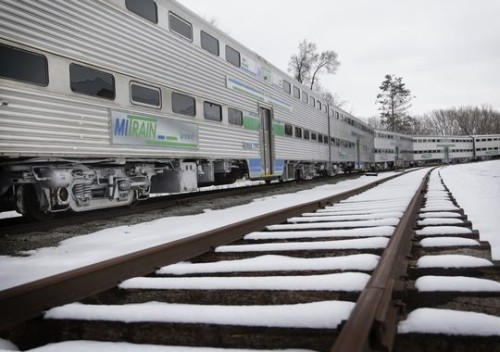
The State of Michigan is paying $1.1 million a year to lease 23 passenger rail cars it can’t use — and likely won’t use for at least another two years — as the taxpayer tab for the troubled project approaches $12 million and counting.
The 1950s and ’60s-era double-decker cars are sitting in a rail yard in Owosso, where they are expected to remain for the indefinite future.
The Michigan Department of Transportation started leasing the cars in 2010 for two commuter rail passenger services proposed between Detroit and Ann Arbor, and Howell and Ann Arbor.
But nearly five years later, none of the cars has logged a single commuter passenger mile. There still is no funding and no operator for either proposed commuter service, required environmental studies are not complete, and in the case of the Detroit-Ann Arbor service, even the tracks won’t be ready for another two years.
So far, the state has paid the owner of the rail cars, Great Lakes Central Railroad, about $7.6 million to overhaul the cars and another $2.7 million in lease charges. But the per-car lease costs more than doubled in 2013 and 2014 as refurbishments were completed and the cars were certified as rail-worthy. Under the terms of the state’s contract with the railroad, MDOT then had to start paying “in-service” rates that total about $3,000 a day, even though the cars are just sitting in a railway maintenance yard in Shiawassee County about 30 miles northeast of Lansing.
MDOT has paid another $1.1 million to its consultant on the rail car project, Pennsylvania-based Quandel.
The roughly $11.4 million spent as of Dec. 31 was mostly paid from Michigan’s $300-million Comprehensive Transportation Fund, which is largely raised from fuel taxes and vehicle registration fees and is mainly used to pay for transit and rail.
Under state law, at least 10% of appropriations from the fund must be allocated for intercity passenger services, which includes rail projects. Michael Frezell, a spokesman for MDOT, said the project money came from that allocation and could not have been spent on roads, though it could have been spent on other eligible projects such as a bus service between two Michigan cities or another rail-related project.
The project costs continue to grow, but are still small change compared with the $1.2 billion Gov. Rick Snyder wants to raise for additional road repairs through a May 5 ballot proposal that would raise the sales tax to 7%. Still, lawmakers expressed strong concerns about the expenditures after learning about them from the Free Press.
“They’re betting on something that might not even come to fruition,” said Rep. Marilyn Lane, D-Fraser, who is minority vice-chair of the House Transportation and Infrastructure Committee.
“I’m mad,” Lane said. “If we have these dollars to peel off, we should be fixing the roads. For MDOT to jump so far out front on this is concerning.”
Tim Hoeffner, director of MDOT’s Office of Rail, conceded the project is “costing us more money than we wished it would.”
“I’m not going to try and spin this,” Hoeffner said. “Would we have liked to have gotten the service up and running sooner? Absolutely. Would we have liked to have timed the lease and the overhaul of the equipment to better fit with the start of the services? Absolutely.”
But Hoeffner said he doesn’t think MDOT made a mistake. There’s often a long lead time involved in securing equipment, so the department was right to tackle that issue before other needed items were in place, he said. He blamed a poor economy for the commuter rail services not getting up and running more quickly and said the project has been a boost to Michigan workers and businesses, with a large chunk of the renovation money spent in-state.
“Monday morning quarterbacking, hindsighting this, yes, we could have done a lot of things differently,” Hoeffner said. “Based on the available information, and based on the estimated risks, we made sound decisions,” and “time will tell … whether or not we have failed miserably or been great visionaries.”
Sen. Goeff Hansen, R-Hart, chairman of the Senate Appropriations Subcommittee on Transportation, said he doesn’t want to say much until he has more information on the contract. The deal was signed during the administration of former Gov. Jennifer Granholm, a Democrat, but amended four times during the administration of Snyder, a Republican — each time to increase the contract’s maximum cost.
“Any lease that we’re not using for something does concern me,” Hansen said. “I need to find out at the end of the day, what are their plans, what is the time frame, when are the cars going to be used.”
Under its deal with Great Lakes Central, MDOT could have leased and overhauled just 15 of the cars. Hoeffner agreed that in hindsight it would have made sense to go with a smaller number than 23, since he estimates only five cars, including a spare, would be allocated to a Howell-Ann Arbor commuter service — the one he said he feels has the best chance of going into operation first — and nine cars would be allocated to the Ann Arbor-Detroit service.
For now, MDOT has been putting the cars on display in places such as Ann Arbor and Dearborn to drum up interest in the commuter services. The state agency is also looking for temporary and short-term uses for some of the cars — which were part of Chicago’s Metra fleet before their sale to Great Lakes Central — to help offset the hefty lease costs, Hoeffner said.
Possibilities include Amtrak using some of the cars on its Grand Rapids-Chicago service, Hoeffner said. That would require cars with handicapped-accessible restrooms. Initially, Hoeffner opted to refurbish the cars without restrooms but has since reconsidered. MDOT recently spent $300,000 to equip two of the cars with handicap restrooms and may pay to put similar restrooms in other cars, he said.
In the meantime, Michigan Auditor General Doug Ringler has also been looking into the expenditures and a report to the Legislature is expected soon.
Carmine Palombo, deputy executive director of the Southeast Michigan Council of Governments, has been working with local officials on developing the commuter rail services. He said there’s enthusiasm for the projects all along the proposed lines, but the best bet for the Detroit-Ann Arbor service might be if the new Regional Transit Authority of Southeast Michigan decides to include the proposed service in a four-county transit-related ballot proposal planned for November 2016.
Rail upgrades are under way for the next two construction seasons on the rail line the Ann Arbor to Detroit service would use, and both Hoeffner and Palombo said they don’t want to start that service during construction work that could cause delays.
“The real key on both of these services is that without a commitment from the local communities to provide funding to help cover the operating deficits of the service, they’re not going to get moving,” Palombo said.
Michael Cicchella, a former supervisor of Northfield Township in Washtenaw County, said he worked hard on promoting the commuter service in 2007 and 2008 before stepping aside in frustration. He cited resistance in Livingston County government for the project not proceeding when he thought it should have.
It’s too bad, Cicchella said, because commuter rail service between Howell and Ann Arbor could save lives by taking thousands of commuters a day off heavily congested U.S.-23.
Hoeffner said it can cost $2 million to $3 million per car to purchase new cars, and $400,000 to $500,000 per car to purchase new equipment. On that basis, the cost of the project — which now approaches $500,000 per car when renovation costs are included — is not out of line, he said.
Still, “without having firm dates as to when these services are going to start and what all of that is, I believe that it is prudent to question what we’ve done,” Hoeffner said.