All posts by admin

Che sorpresa ti aspetta nel vivace casinò lazybar: generosi bonus, giri gratuiti e una selezione di giochi colorati renderanno la tua serata fantastica.

Open house Dec. 15, 2014 at the new Dearborn Amtrak station

Photo by Steve Sobel

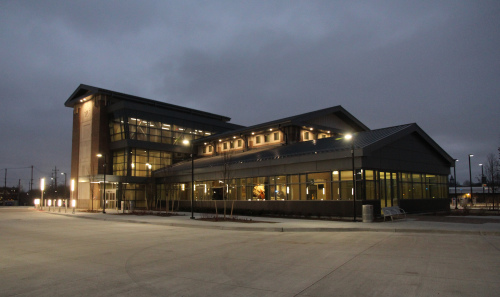
The city of Dearborn is hosting an open house 4 to 6 p.m., Monday, Dec. 15, 2014 at the John Dingell Transit Center, 21201 Michigan Ave.

The new 16,000-square-foot facility is the first of many steps to boost intermodal transportation and encourage more people to take the train when they travel.

The transit center was funded entirely with $28.2 million from the federal American Recovery and Reinvestment Act of 2009. With almost 80,000 travelers in 2014, the old facility located about a mile east of the new station, was one of the busiest train stations in Metro Detroit.

During the open house, visitors can tour the station, see informative displays and talk with people knowledgeable about the future of train travel. A mural created by Dearborn students will also be featured. Congressman John Dingell (D-MI) and his wife, Debbie are expected to be at the open house.

Meeting Minutes – Executive Committee — Ann Arbor – December 13, 2014

MINUTES
MICHIGAN ASSOCIATION OF RAILROAD PASSENGERS
EXECUTIVE COMMITTEE RETREAT
OFFICES OF SMITH GROUP JJR
201 DEPOT STREET, ANN ARBOR
DECEMBER 13, 2014

The Executive Committee met on December 13 for an all-day session to organize for the coming year. We enjoyed the hospitality of the planning consultants Smith Group JJR at 201 Depot Street in Ann Arbor, who made their facilities available to us for the day.

Voting Members present: Kay Chase, Warren Fritz, Larry Krieg, John Langdon, Jeanie Merckel, Don Monteith, Kathleen Newell, Robert Patterson, Jim Wallington (Quorum: 5)

Non-Voting Members present: Jim Hinkins (alternate for Patterson), Hugh Gurney, Chuck Merckel

Call to order. The meeting was called to order at 10:00 a.m. by Chair Larry Krieg.

Approval of Order of Business. The Order of Business was unanimously approved.

Approval of Minutes. Minutes of the Executive Committee October 4 conference call were not available.

Treasurer’s Report. The Treasurer’s November 2014 report was accepted as presented.

Future Meetings. The January 10, 2015 meeting will be held at the former GTW Depot in Lansing.

Action Items. Action was deferred until discussion was held under New Business
a. Budget
b. Bylaws Amendments

Officer Reports. There were no officer reports.

Old Business. There was no old business.

New Business.

a. Budget.

Treasurer Jeanie Merckel presented the draft budget for 2015, projecting income from dues ($7000), donations ($1000) and a grant from Michigan Environmental Council ($5000). A major expenditure is for the four issues of The Michigan Passenger provided to the membership and widely distributed through train stations and outreach events. MARP pays membership dues to the National Association of Railroad Passengers ($150), Midwest High Speed Rail Association ($200), Transportation Riders United ($100), and Transportation for Michigan ($150). An annual grant of $500 to Durand Union Station, Inc. supports a basic organizational purpose of MARP (preservation of historic train stations) and allows us use of the facility for the annual meeting. The Michigan Environmental Council (MEC) grant aids MARP in covering expenses associated with our participation in MEC (www.environmentalcouncil.org) and Transportation for Michigan (Trans4M.org) projects which this year will include a number of community meetings to promote the Coast-to-Coast rail project, as well as other activities associated with the Michigan By Rail campaign (mibyrail.wordpress.com). A contribution of $1000 from American By Rail will fund speakers for special events such as the annual meeting.

Discussion of reimbursement for expenses of such things as travel to the Toledo National Train Day will be discussed at a later date in conjunction with creating a set of guidelines or “best practices.

Langdon moved, Westcott seconded, to approve budget with expenditures of $16,750 and income of $14,300. The Treasurer projects carry over from the current budget year to bring budget into balance. Motion carried unanimously.

Merckel asked that a Finance Committee be formed to assist in budgeting and planning. Langdon moved, Newell seconded, to form a Finance Committee. Motion carried with 7 in favor, 1 opposed, 1 abstention. Jeanie Merckel will chair the committee. Langdon and Fritz were named to the committee.

Following discussion of the potential of using phone conferencing and/or online tools to conduct executive committee business, Steve Vagnozzi volunteered to investigate an internet-based meeting tool, as well as conference calling with 800-numbers.

b. Bylaws Revision

The bylaws committee, chaired by Hugh Gurney, has been working for several months to assess the need for, and suggest possible revisions to, the MARP bylaws. After considerable discussion, a number of changes were approved. When finalized, the document will be presented to a vote of the entire membership.

A key change would be to allow election of regional chapter officers by their regional chapter membership if more than ten members in that region so request. Other changes include: wording to allow use of electronic means to distribute MARP news publications, send notices and to conduct business; clarification of duties of officers; and assignment of authority for disbursement of funds.

It was moved and seconded that the bylaws changes presented today be approved with the exception of Article 12 concerning finances. Westcott moved, Langdon seconded, to amend the motion to exclude section 2.1 as well from approval of the bylaws revisions until the goals subcommittee has further discussion. Motion passed with 7 in favor. The original motion to accept the recommendations of the bylaws committee with exception of 2.1 and article 12 passed with 8 in favor, 0 opposed, 1 abstention.

Fritz, Vagnozzi, and Gurney will continue to work to resolve the questions with 2.1 and Article 12.

The Executive Committee proposed developing a set of “best practices” to guide its work in carrying out the various functions of the organization. Electronic communications and teleconferencing provide opportunities for policy discussions and decision-making, but it is unclear how best to incorporate these resources into our work.

There was not time to discuss the results of the questionnaire presented at the beginning of the meeting in which the committee was asked to rank a number of possible activities for the coming year. Responses were tallied and summarized by Carolyn Lusch, a student of urban design at U of M, who was engaged to take notes during the meeting. This summary is included on a separate document accompanying these meeting notes.

Adjournment: The meeting adjourned at 4:00 p.m.
Respectfully submitted: Accepted:
_____________________________________ _________________________________
Kay Chase Larry Krieg
Transcribed from notes taken by Carolyn Lusch

First train pulls out of new Dearborn Amtrak station

From Detroit Free Press:

Rev. John Koski, associate pastor of Springwells Church in Dearborn, waves as the trains departs.(Photo: Eric Lawrence, Detroit Free Press)

As Wolverine Train No. 351 to Chicago left Dearborn this morning, the Rev. John Koski was there, waving as it pulled away from the platform after picking up 68 passengers at the new John D. Dingell Transit Center shortly after 7 a.m.

Koski, 64, of Dearborn and associate pastor of the city’s Springwells Church, was impressed.

“This is going to be a great place,” he said, noting its proximity on Michigan Avenue near Evergreen to The Henry Ford and a local bike path. “This is going to be a great asset to Dearborn.”

Koski said he was also at the station to “dedicate this to the Lord” ahead of an open house planned for 4-6 p.m. Monday.

The federally funded, $28.2 million, 16,000-square-foot center is designed as an intermodal passenger rail station on the Chicago-Detroit/Pontiac. It’s near the Rouge River Gateway Greenway Trail that connects to the University of Michigan-Dearborn and Henry Ford College campuses, and a pedestrian bridge should make it easy for passengers to enter the Henry Ford and Greenfield Village, Dearborn city spokeswoman Mary Laundroche has said.

The station, which features a mosaic of blue tiles stretching out in rays and stars and smaller green arches designed by local students, also has a number of interesting features, including heat lamps in a mostly enclosed waiting area outside. And the platform itself can adjust so the distance to the train is less for those boarding or move to accommodate wider loads passing through, according to Amtrak spokesman Marc Magliari.

A Tim Hortons also is being completed near the station.

It’s the third train station to open in Michigan in recent months. In October, the long-delayed $6.4 million Troy Transit Center and the $6.1 million Vernon J. Ehlers Amtrak Station opened in Grand Rapids opened for business.

This morning, the lobby of the new Dearborn station at 21201 Michigan Ave., which is about two miles west of the old station, was filled with riders, many of them who had visited Niagara Falls as part of a tour group.

Gary King, 54, of Ridgway, Ill., called the station gorgeous, while Sherri Ulbrich, 72, who was traveling with her husband Bob Cox, of St. Charles, Mo,, noted with a smile that the temperature could be warmer.

But Debbie Williams, 43, of Riverview marveled at the packed lobby.

“I’ve never seen it this full,” she said, describing the new station as an improvement. “The old station could fit in (this lobby). … It’s probably a little overwhelming compared to the last one. I had to make sure I was in the right place.”

Williams said she was traveling to Chicago to see a Bob Seger concert with a friend.

Patrick Socia, 58, of Texas Township near Kalamazoo, was headed home. He works for Quicken Loans in Detroit and travels back and forth regularly.

He takes the train more often when gas prices are high.

“You can plug in, do your work. It’s comfortable, not as ugly as a bus,” he said.

Hyginia Malinowski, 54, who recently moved to Dearborn from Williamsburg, Va., after her husband got a job with Ford, was traveling to Chicago with her friend, Susan Smith, 56, of Basel, Switzerland.

She was a bit anxious about the trip after learning that a man with possible mental health issues had been accused of stabbing four people Friday on a train heading to Port Huron, but she noted that “what are the chances it would happen again?”

This trip would mark her first in Dearborn.

“Everybody tells us it’s the best way to go,” she said.

Source: http://www.freep.com/story/news/local/michigan/wayne/2014/12/10/amtrak-opens-new-train-station-dearborn/20195409/

Via Rail eyeing private capital to build its own dedicated rail lines

From the National Post (Canada):
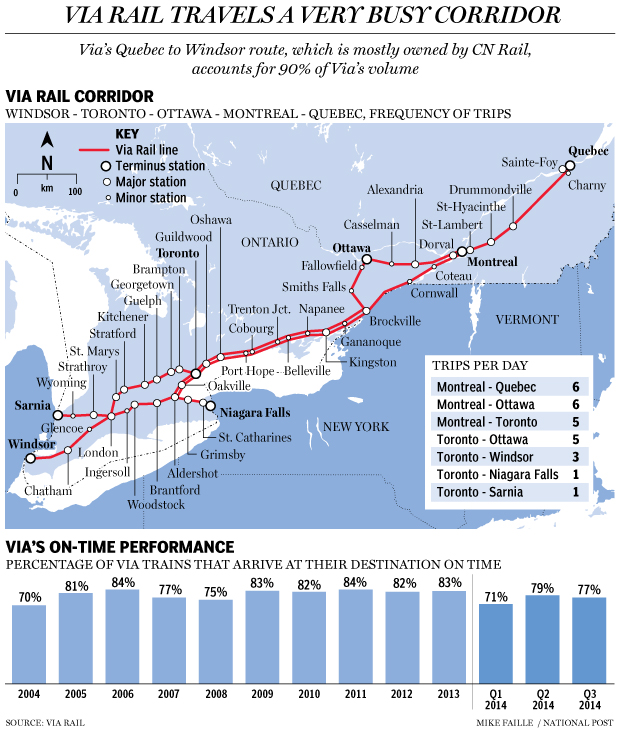
fp1205_viacorridor_c_mfVia Rail Canada hopes to reduce congestion by building its own network of dedicated tracks, and the passenger rail service wants to enlist the help of private equity to do it.

Currently, 90% of the track that Via uses is owned by Canadian National Railway Co., and this shared infrastructure can result in bottlenecks as freight and passenger trains vie for space.

“Our on-time performance has deteriorated significantly over the last 12 months,” Yves Desjardins-Siciliano, president and CEO of Via Rail, said in an interview at Via’s headquarters in Montreal.

“Congestion is the No. 1 issue, and it has negative impacts on the Canadian economy as a whole because it makes both freight traffic and passenger traffic less efficient.”

CN said it does not publicly disclose how much of its revenue comes from Via.

In the third quarter, Via’s trains were on time 77% of the time, down from 83% a year earlier. The worst performer was the tourist-friendly route from Toronto to Vancouver, known as the Canadian, where on-time performance fell to 25% from 41% in the second quarter.

Mr. Desjardins-Siciliano — who was Via’s chief corporate and legal officer before he was appointed CEO in May — said the solution is to gradually build up a network of dedicated tracks that Via can use, separate from the freight carriers and commuter trains. Currently, Via owns only 2% of the network on which it operates.

Via’s first priority is acquiring track in the busy corridor between Quebec City and Windsor, Ont., which accounts for 90% of the railway’s volume. But the challenge for the Crown corporation is finding the money to undertake the costly process of building its own dedicated line.

Last week, the federal government announced $204 million in new funding that will be divided between Via and federally-owned and operated airports.

Mr. Desjardins-Siciliano said he doesn’t know exactly how much of that money will go to Via, but the funds will be used to acquire rail lines. And he plans to ask provincial and municipal governments for funding as well if they want Via to provide additional service — something Amtrak has done in the United States.

Via will consider buying tracks that other railways don’t need anymore, acquiring existing railway beds that have been abandoned, or building new tracks from scratch, he added.

“You don’t build it overnight,” he said. “You build it a trunk at a time.”

Unlike his predecessors, Mr. Desjardins-Siciliano is also open to exploring funding options beyond taxpayer dollars, including private capital.

The Ontario Teachers’ Pension Plan and Borealis Infrastructure — an arm of the Ontario Municipal Employees Retirement System — paid approximately $3.4-billion in 2010 for the rights to operate High Speed One, the rail link between London and the mouth of the Channel Tunnel to France.

“So there is an interest in investing in infrastructure for passenger rail, provided there’s a business opportunity,” said Mr. Desjardins-Siciliano.

“And we believe that business opportunity is self-feeding, meaning if you have dedicated tracks, you’d be able to provide reliable, on-time service at greater frequencies and shorter trip times, and that’s what justifies private investment.”

Mark Romoff, president and CEO of the Canadian Council for Public-Private Partnerships, said he believes there would be “a lot of interest” from the private sector in Via’s project.

“Depending on how they chose to structure it, it could go ahead as a public-private partnership and yes, there would be a lot of interest on the part of the financial community to engage in a project like this,” Mr. Romoff said.

But Mr. Desjardins-Siciliano said he won’t make his pitch to private investors until Via improves its financial results.

“You can’t go to the private markets when you have bad on-time performance, lower or stagnant passenger volumes and congested rail infrastructure and are losing $300-million a year and expect private investors to be interested,” he said. “I believe you have to make the case first.”

In the third quarter, Via shrunk its operating loss by 12.1% to $65.8 million, allowing the government to reduce its contribution by 9.4% to $83.1 million. Passenger revenues rose 6.6% to $77 million.

Mr. Desjardins-Siciliano said his goal is to reduce Via’s reliance on federal funding by getting its busiest routes — those in the Quebec City-Windsor corridor and tourist-friendly offerings like the Canadian — to break even. The government would then only need to subsidize remote routes and capital investments like locomotives and train tracks.

“You don’t get subsidized to go to Cuba and someone shouldn’t be subsidized to go see the Rockies or go to the beach in New Brunswick,” he said.

You don’t build it overnight… You build it a trunk at a time

One way for Via to break even on its busier routes is to increase passenger volumes so that each train generates more revenue at a lower cost per passenger.

The company is making a concerted effort to become more attractive to potential passengers. Since 2007, Ottawa has invested almost $1 billion in Via and the railway has put that toward renovating its carriages, offering better food, improving service and developing promotions aimed at particular groups, such as university students and business travellers.

Mr. Desjardins-Siciliano said Via is focused on attracting people who usually drive but are frustrated by the amount of congestion they encounter.

“There are days when getting in and out of Montreal or Ottawa, for example, will be 50% if not more of the travel time between Montreal and Ottawa,” he said. “That’s where train travel is a huge advantage.”

He added that congestion is much more likely to motivate people to take the train than high gas prices, and he doesn’t expect much impact on passenger volumes from the recent drop in oil prices.

Ultimately, though, Via needs to change Canadians’ perceptions of the value of train travel if it wants to win them over, Mr. Desjardins-Siciliano said.

“One of the drawbacks or difficulties of promoting and marketing Via Rail is many Canadians have not experienced Via since they were kids, so they may have a romantic view of Via, or they may have a past experience of Via as being old technology,” he said.

“We are trying to get people to recognize that the Via of today is a much more modern experience than people may remember.”

Source: http://business.financialpost.com/2014/12/04/via-rail-eyeing-private-capital-to-build-its-own-dedicated-rail-lines/

Three companies submit bids to operate Algoma Central

From the Sault Star:

1297568111753_ORIGINALThree rail companies have submitted formal bids to operate the Algoma Central Railway passenger service between Sault Ste. Marie and Hearst.

The same three rail companies have also submitted bids to CN Rail to operate the tour train service.

The ACR Passenger Service Working Group met Monday to hear CN Rail’s take on the formal bids and to further assess the bids for the passenger service.

“We will move the markers forward, we’re just not sure how much yet,” said city CAO Joe Fratesi prior to the meeting.

If CN Rail provides information that it has selected a preferred operator, then the working group will need to determine how it’s plans and ideas will merge with that operator.

Following the meeting, Fratesi said that CN and the working group have zeroed in on a provider but still needs to seek some clarification and missing information.

“It’s fairly important details that we’re looking for,” Fratesi said. He anticipates a response by the potential operator in early January.

He could not disclose what information is needed by either CN or the working group.

Once that information is received, and all the parties are satisfied, Fratesi said a plan can be put together for the Transport Minister.

It’s believed that all parties are pleased that the same companies submitted bids to run both the passenger service and the tour train operations.

“It would be very awkward if they were not the same of if one company was good for one purpose but not the other,” Fratesi said.

He stressed that there will be a role for the federal government to play in the continued operation of the passenger rail service.

“We have been told that they (the federal government) won’t play a role to the contribution they are currently involved in, but there will be a role for them,” he said. “And we have never faltered in our view that there needs to be federal support there for the long term and we all need to feel comfortable with the arrangement.”

Linda Savory-Gordon, co-chair of the Coalition for Algoma Passenger Trains and member of the working group, said she’s pleased with the quality of the applicants.

“We’re anxious for a decision to be made so we can move forward with a sustainability plan and increase ridership and train events,” she said.

Savory-Gordon is a firm believer that special train events will create a strong draw and boost in revenue for the successful operator.

“We saw our Searchmont North Pole Express sell out in 20 minutes and I believe that’s a strong indication that these type of events could boost the revenue stream and make the train more sustainable,” she said.

Once a third-party operator is selected to operate the passenger service, a sustainability plan will be presented to the federal government, outlining recommendations that include efficiency improvements, economic benefits of a continued rail passenger service and a request for assistance to continue the train operations.

The ACR Passenger Service Working Group represents a large number of stakeholders who rely on the passenger train service for their communities, businesses or tourism, among other things.

It was formed in 2014, shortly after the federal government announced its intention to eliminate a $2.2 million annual investment in the remote passenger rail operation.

The service is currently operating as a result of the government granting the funding a one-year extension, giving the stakeholder’s group an opportunity to come up with a working plan.

The funding ends in March.

An economic impact assessment completed by BDO Canada showed that the ACR passenger service generates more than $38 million in annual economic activity in the region.

Source: http://www.saultstar.com/2014/12/08/acr-passenger-stakeholder-group-moving-forward