All posts by admin

Che sorpresa ti aspetta nel vivace casinò lazybar: generosi bonus, giri gratuiti e una selezione di giochi colorati renderanno la tua serata fantastica.

Amtrak train stabbings suspect arraigned in Niles; preliminary exam set for Dec. 16

From The Kalamazoo Gazette:

A Saginaw man accused of stabbing four people on an Amtrak train in Niles Friday was arraigned today in Berrien County District Court.

Michael Darnell Williams, 44, was formally charged with four counts of assault with intent to murder, according to the Berrien County Prosecutor’s Office. Each charge carries a maximum penalty of life in prison.

He is being held in the Berrien County Jail on a $1 million bond.

Williams’ preliminary examination has been scheduled for Tuesday, Dec. 16. He is expected to be represented by a court-appointed attorney, according to the prosecutor’s office.

At about 7 p.m. Friday, the Niles Police Department received a report of a man “acting odd and becoming agitated” on board an Amtrak train heading toward Niles and was requested to send officers to investigate.

Niles Police Chief Jim Millin previously said officers who arrived at the depot noticed a “commotion” on one of the train cars as passengers tried to exit quickly. Officers then pushed their way onto the train and confronted Williams, who was armed with a knife.

Williams was subdued with the use of a Taser and was taken into custody, Millin said.

Millin said officers located four victims on the train car who had been cut and stabbed by the suspect. The victims included a train conductor, who remains hospitalized in stable condition, an Amtrak spokesman said Monday.

Since the incident, several family members have expressed concerns about Williams’ mental health, including his sister, Tracy Williams. She told the Saginaw News that Michael Williams is a veteran who she believes was suffering from paranoid hallucinations that made him fear for his life.

Berrien County Assistant Prosecutor Amy Byrd, who is leading the prosecution of Williams, did not immediately respond to an inquiry Wednesday pertaining to whether a psychological evaluation would be conducted on Williams to determine if he was mentally fit to stand trial.

Amtrak spokesman Marc Magliari said earlier Monday that Amtrak is assisting Niles Police Department in the investigation and isn’t conducting its own investigation into the incident.

Knives are prohibited on Amtrak trains, and Amtrak police perform random inspections of passenger baggage, the company said in a statement issued to the Kalamazoo Gazette on Monday.

The stabbings occurred on Amtrak train 364, the Blue Water line, which runs between Chicago and Port Huron, and 172 passengers were on board at the time of the incident.

Source: http://www.mlive.com/news/kalamazoo/index.ssf/2014/12/amtrak_train_stabbings_suspect.html#incart_story_package

More stories:

Dearborn train station construction finally reaching the end of the line

From the Dearborn Press & Guide:

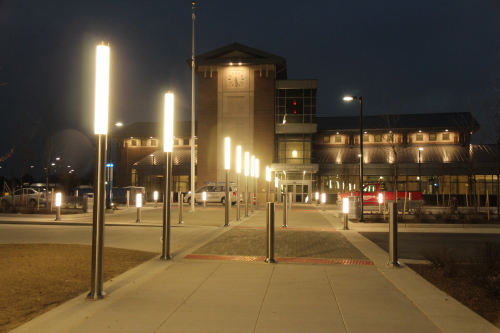
The John D. Dingell Transit Center is ready to take on its first passengers on Dec. 10th. (Photo by Steve T. Sobel)
The John D. Dingell Transit Center is ready to take on its first passengers on Dec. 10, 2014. (Photo by Steve T. Sobel)

Amtrak passengers have to wait just a few more days before taking advantage of the new station’s amenities. It is scheduled to open Wednesday, Dec. 10, 2014.

The first train will roll into the new station, 21201 Michigan Ave. at 6:51 a.m.

Amtrak is moving all of its operations from the current train station behind the Dearborn Police Station to the new 16,000-square-foot Dingell Transit Center.

City leaders say the transit center promotes intermodal transportation, connecting travelers via train, bus, taxi and pedestrian and bike paths to work, education, cultural attractions, shopping and recreation in Dearborn and beyond.

The station is an important component in initiatives to boost commuter rail from Ann Arbor to Detroit and accelerated speed rail from Pontiac to Chicago.

Six Amtrak trains will stop daily at Dingell Transit Center, with increased Amtrak service and the addition of commuter rail expected in the coming years.

Almost 80,000 passengers used the current Amtrak station during the 2014 fiscal year.

In fact, Dearborn is the most popular Amtrak location in the Detroit metropolitan area, according to Marc Magliari, spokesman for Amtrak.

He expects that number to grow.

“Dearborn is excited to be part of the future of rail. We will continue to work with our partners to increase convenient travel that starts in Dearborn and takes riders throughout southeast Michigan, as well as between Dearborn and Chicago,” said Mayor Jack O’Reilly.

“We’re anticipating bringing more customers to our Dearborn businesses and more visitors to our cultural and entertainment venues,” O’Reilly said. “And in the near future, people are going to find it very easy to get on a train in Dearborn and connect with the new M1-Rail in Detroit for an evening out or to go to a game.”

Magliari said Amtrak is planning to expand in the future, adding to the six lines already running from Dearborn.

Right now, he said the most popular trips from Michigan are to Chicago and sites in western Michigan.

The transit center was funded entirely with $28.2 million from the federal American Recovery and Reinvestment Act of 2009.

The city of Dearborn owns the station and the seven-acre site, while Amtrak will run the facility.

Residents hoping to get a look inside the new facility are welcome to attend an open house scheduled for Dec. 15.

The open house takes place from 4-6 p.m. at the transit center, which sits near Brady Street and marks the entrance to the west downtown business district.

During the open house, visitors can tour the station, see informative displays and talk with people knowledgeable about the future of train travel. A mural created by Dearborn students will also be featured.

Congressman John Dingell (D-MI) and his wife, Debbie are expected to be at the open house.

In addition, people attending the open house can enter a free drawing to win tickets to The Henry Ford’s popular Holiday Nights in Greenfield Village.

The Henry Ford has historic displays inside the center, including an iconic Davenport train engine.

The transit center also features a pedestrian bridge over the tracks that will allow travelers to access a new entrance to The Henry Ford complex, including the Henry Ford Museum, Greenfield Village, the IMAX Theater, and Ford Rouge Factory Tours.

About 1.6 million people a year visit The Henry Ford.

Ford Motor Company expects to showcase a new F-150 on site, as well.

The transit center has received a silver certification from the U.S. Green Building Council’s

Leadership in Environmental and Energy Design. The building features a metal roof with solar collectors, energy efficient lighting and geothermal heating and cooling.

Source: http://www.pressandguide.com/articles/2014/12/05/news/doc5481b8177aefd896121105.txt?viewmode=fullstory

Car-train crashes happen about weekly in Michigan and are almost always avoidable, authorities say

From M-live.com, The Kalamazoo Gazette:

car-train-accidents-kalamazoo-cbc2e86f9932659b

They are almost always avoidable.

But whether because of impatience or negligence, vehicles and trains crashed about once a week in Michigan last year. There were 58 vehicle-train accidents in the state in 2013, including five in Kalamazoo County. That’s up 35 percent from the 38 car-train crashes statewide in 2012 and the most since the 61 recorded in 2007, according to data from the Michigan Office of Highway Safety Planning.

And while the majority of the crashes didn’t cause injuries, they sometimes turn fatal. On Tuesday, three people were killed when a passenger train struck a minivan on 11th Street near KL Avenue, just west of the city of Kalamazoo. Police say 20-year-old Joshua Cartwright drove around vehicles that were stopped by train crossing signals and was struck broadside by an eastbound Amtrak train.

All three of the van’s occupants — Cartwright, 20-year-old Ashley Melson and 19-year-old Justin Mastin — were pronounced dead at the scene. The investigation revealed that railroad crossing lights, gates and bells were functioning at the time of the crash.

“Unfortunately, it’s all too common,” Marc Magliari, spokesman for Amtrak, said of the cause. “It happens every two to three hours across the country,” he said of car-train crashes.

Michigan State Police Lt. Dale Hinz said police don’t receive reports of motorists driving around train crossing arms very often.

“It doesn’t happen terribly often, thankfully. Because it’s a terrible idea,” said Hinz, commander of MSP’s Paw Paw Post.

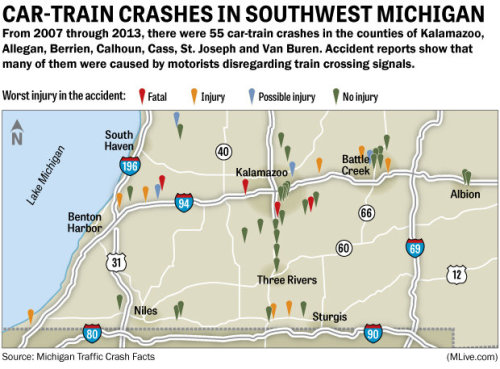
According to statistics from the Michigan Office of Highway Safety Planning, from 2007 through 2013 there were 55 car-train crashes in Kalamazoo, Allegan, Berrien, Calhoun, Cass, St. Joseph and Van Buren counties in Southwest Michigan. Of those, 34 resulted in no injuries, 17 involved injuries and four were fatal.

Accident reports show that many of those crashes were caused by motorists disregarding traffic signals, driving around crossing arms or claiming they didn’t hear bells and whistles.

“It’s almost always the driver’s fault,” Hinz said. “The train is confined to the tracks. It doesn’t get any simpler than that.”

Said Magliari: “Trains rarely can stop in time. Whether it’s going 50, 90 or 110 miles per hour, it’s simply not possible in the law of physics for the train to stop.”

In Tuesday’s crash, the Amtrak train was going about 80 mph and didn’t come to a complete stop until about a mile after striking the van, police said.

Recent fatal crashes in Southwest Michigan are tragic examples of what can happen when drivers aren’t careful near train tracks.

On Sept. 15, 2011, Austin Porter, 21, was killed in a collision with a freight train near Schoolcraft. According to Kalamazoo Gazette archives, investigators said Porter was driving west on U Avenue and failed to yield to a northbound Grand Elk Railroad freight train.

Police said they believed Porter attempted to drive around the lowered crossing arms, realized the train was coming, struck one of the crossing arms as he tried to continue over the track and was unable to make it across before the train hit his Chevrolet Impala.

This came two days after 19-year-old Zachariah Zellmer was killed when, according to police, he drove his 1997 Pontiac Sunfire around crossing arms on 52nd Avenue near County Road 687 in Van Buren County’s Hartford Township and was struck by an Amtrak train. The train’s bells, lights and whistles were all working and the crossing had working lights and control arms, authorities said.

On Sept. 14, 2008, Aubrey Noble, 25, was westbound on McGillen Street in Mattawan when she drove into the path of a westbound Amtrak engine. The train struck Noble’s vehicle, breaking it apart, according to the crash report.

As for Tuesday’s crash, Hinz said investigators are awaiting toxicology results and continuing to interview witnesses to corroborate their statements. Amtrak provided a video recording of the crash that police are reviewing, he said.

Magliari said Amtrak is committed to reducing the number of car-train crashes, working with police agencies to make sure laws are enforced and providing educational materials to motorists about railroad crossing safety.

Meeting Minutes — PORT HURON – November 15, 2014

MINUTES
MICHIGAN ASSOCIATION OF RAILROAD PASSENGERS
MEMBERSHIP MEETING
PORT HURON MUSEUM OF ARTS AND
HISTORY CARNEGIE CENTER

1115 SIXTH STREET, PORT HURON MI 48060
NOVEMBER 15, 2014

Members Present: Larry Krieg, Jim Wallington, Clark Charnetski, Chuck Merckel, Jeanie Merckel, Dan Platz, Bob Tischbein, Jim Hinkins, Richard Pekarek, Tim Backhurst, Clayton Farmer, Steve Sobel, Martha Benedict, Robert Hines, Barb Spaulding-Westcott, Doug Wilson, Roger Morrissett, JaeAnn Burgett, T. J. Gaffney, Steve Vagnozzi, Dan Platz, David Roberts, Cecilia Roberts, Robert Patterson, Diane Patterson, Kim J. Powell, Larry Sobczak, John Guidinger, Marilyn Guidinger

Guests: Anita Ashford, Celeste Shoulders, Paul G. Maxwell, Mark Hellckijaer

Call to Order: The meeting was called to order at 10:00 AM by Chair Larry Krieg.

Membership Meeting Minutes: Minutes of the October 18, 2014 Membership Meeting in Grand Rapids were approved.

Appointment of East-Central Regional Chair: The Executive Committee, by electronic meeting, voted to appoint Steven Vagnozzi to fill the East Central Regional Chair position vacated by Rosemary Horvath’s resignation. The Membership received a biographical sketch of Mr. Vagnozzi at the meeting.

Future Meetings (Jim Wallington): January 10, 2015 at the former Grand Trunk station in Lansing. The February 2015 meeting is tentatively planned for Clara’s Restaurant in Battle Creek. The March 2015 meeting will be at the Kalamazoo Library or the transit authority headquarters in Kalamazoo.

Outreach (Chuck Merckel): Volunteers are needed for events. Mr. Merckel encouraged more members to participate in outreach. Krieg noted that outreach is one of the purposes of MARP as set forth in the Bylaws. The Wheels on Rails show is happening on November 30. Mr. Merckel strongly recommended outreach at shows that are not train-oriented because fewer people who attend are familiar with passenger train availability. He also reported that he is working toward participating with trips for senior citizens, after a successful outreach at the request of MDOT to the annual conference of travel and activity directors at senior housing and care facilities.

A sign-up sheet was circulated. Results of this recruitment effort:
• Delta Rocks: 4 interested
• Maple Syrup Festival: 1 person interested
• Michigan Earth Day: 4-5 people interested
• Fruitport Days: 1-2 people who indicated an interest previously but were not present

Treasurer’s Report: We received five new members and a $1,000 donation from America By Rail since last month’s report. Expenses for the month were $521. The MARP endowment (“Pratt”) fund has been invested as directed by Resolution of the Executive Committee. Acceptance of the report was moved by T. Backhurst and seconded by D. Wilson. The membership accepted the report unanimously.

Michigan Rail News
• Dearborn Station will be opening in December. Detroit Metro Chair Patterson has worked to get MARP invited to the opening ceremony December 15. MARP will have a table there. Trains will actually serve the station starting December 10. Shuttles will run from the old station for a while to assist people who may have parked at the old station before the move.
• Grand Rapids station is now open. MARP presented an award to U. S. Senator Carl Levin at the ceremony, in recognition of his long years of support for passenger rail service.
• The acquisition of Talgo trainsets by MDOT is uncertain at this time.

North America Rail News
• All Aboard Florida is making progress. Ground was broken for the West Palm Beach station; they are contracting with Siemens for the same model of locomotive selected recently by Amtrak.
• Texas Central Railroad is proposing a high speed rail connecting Dallas with Houston, a distance of about 240 miles. They are arranging entirely private financing in cooperation with Central Japan Railway, whose engineering and equipment they expect to utilize. They plan to be able to begin service in 2021.

Introduction of the First Speaker: T. J. Gaffney

Mr. Gaffney is owner of Streamline Historic Services, former Director of the Steam Railroading Institute, author of several books and articles. He served as volunteer curator at the Port Huron Museum, and lives in Capac, near Port Huron.

Presentation 1: Port Huron’s Transportation History

Mr. Gaffney emphasized at the outset how much less access to public transport Port Huron has now than it did 100 years ago in 1914. He gave several detailed examples with copious historic photographs and maps.

The Pere Marquette depot in Croswell is still standing. The PM line passed through Jeddo, Blaine, and Gratiot Center; its roundhouse was on 16th street. The bridge over the Black River still stands, but the one crossing the canal between Lake Huron and the Black River has been removed.

The Grand Trunk Western’s route through Canada and across the St. Clair River for some years served the second-largest number of immigrants to the United States. GTW’s lead to Dunn Paper was once part of the CD&CGT line.

Thomas A. Edison was raised in Port Huron and departed from the Fort Gratiot depot for his job selling newspapers and snacks on the train to Detroit.

In 1913 the Grand Trunk’s main Michigan locomotive servicing shops were destroyed by fire, and the railroad decided to rebuild them in Battle Creek. The Port Huron property was sold to Peerless Cement. When the tunnel was built under the St. Clair River, the old car ferry docks were converted to the Port Huron boat yard.

Introduction of the Second Speaker: Paul G. Maxwell

Mr. Maxwell is Director of the Port Huron Charter Township Downtown Development Authority and previously served in several business and civic capacities.

Presentation 2: “Port Huron Station’s Relocation”

The present-day Amtrak station was built in 1970 to replace the historic Grand Trunk station. Several civic organizations and municipalities have agreed that it would be desirable to relocate the station to a site with more space for parking and the possibility of private enterprise building shops, a restaurant, and even a hotel.

A possible site is adjacent to Canadian National’s Tunnel Yard, which extends from 24th St. to 32nd St. There is support in the area for this location in Port Huron Charter Township because of its convenience to Interstate highways. It is within half a mile of the intersection of I-94 and I-69 (currently being reconstructed), providing convenient access from the west, south, and especially east – where the many Canadians who patronize Amtrak’s Blue Water cross the bridge from Sarnia. And this location also would allow trains to continue through the tunnel to Canada, if that service is ever reestablished.

The station is envisioned to become an intermodal terminal, as local and regional buses come to serve it. A rail trail is planned for one of the abandoned lines near the site, which would add non-motorized access. The relocation is hoped to stimulate economic activity, particularly the tourist industry.

Having built a strong coalition of supporters, the next step would be a feasibility study. That is not likely to be initiated for a while, but Mr. Maxwell said he hoped MARP would help in the effort. Several members, including Chair Krieg, assured Mr. Maxwell of MARP’s best wishes and willingness to help.

Next Membership Meeting: Saturday, January 10, 2015 at 10:00 AM at the Lansing Board of Water and Light (former GTW Depot). The Executive Committee will have a retreat on Saturday, December 13, 2014, 10 AM to 4 PM, to be held at 201 Depot St., Ann Arbor, Michigan.

Adjournment: The meeting was adjourned at 12:00 noon.

Lunch: Lynch’s Irish Tavern, 210 Huron Blvd., Port Huron.

Tour of Port Huron transportation and cultural features:

Mr. Paul Maxwell kindly arranged a tour by “historic trolley” bus of the cultural and transportation highlights of the Port Huron region. This included a visit to the Port Huron and Detroit Railroad Historical Society’s restoration (in progress) of that railroad’s depot on the south side of Tunnel Yard.

Respectfully submitted: Accepted:
________________________________ __________________________________
Clayton Farmer Larry Krieg, Chair
(notes compiled by Larry Krieg)

M-1 Rail selects Czech-based Inekon Group to build Detroit’s streetcars

From M-1 Rail:

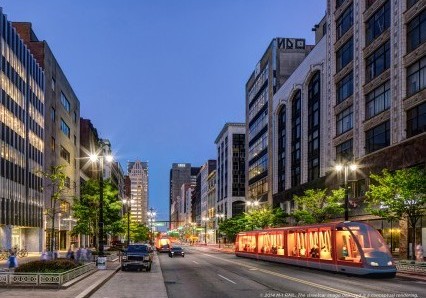
DOWNTOWN1-e1406063122563-426x298M-1 RAIL announced it has selected a vendor and will begin negotiations for the design and build of the individual streetcars, which will run along the Woodward Avenue route beginning in 2016.  The value of the contract is expected to be approximately $30 million for six separate custom coaches that will feature both regulatory compliance and customer comfort.

“M-1 RAIL will negotiate the final terms and conditions with Inekon Group to build our streetcars,” said Paul Childs, chief operating officer of M-1 RAIL.   “Inekon has a strong track record with other streetcar projects in Portland, Seattle, and Washington, D.C., and owns a 40-percent share of U.S.-installed projects.  While Inekon is headquartered in the Czech Republic, our requirements specify that it will be compliant with the U.S. Government’s “Buy America” initiative.”

Childs said that the Buy America provisions ensure that U.S.-based transportation infrastructure projects are built with American-made products.  “We want to assure that materials, parts, labor, manufacturing processes, and final assembly will meet the Buy America requirements.”   Childs said that the M-1 team will announce a final assembly location in the future, but added that several locations in Southeast Michigan are under consideration.  “It’s too early to talk about any sourcing or potential manufacturing locations, but we are committed to the principles of Buy America’s support of U.S.-based suppliers and the families who work for them.”

M-1 RAIL’s streetcars also will be compliant with the Americans with Disabilities Act (ADA), allowing for station-level access for pedestrians, and persons who use mobility assist devices such as wheelchairs.  Vertical bicycle racks will be included in the design to accommodate Detroit’s burgeoning bicycle community, as well as wireless access for busy passengers, and HVAC systems to facilitate the swings in Michigan’s weather.

Each streetcar will be 73 feet long, 8.5 feet wide and 13 feet high, with a vehicle weight of approximately 76,000 pounds.  The cars will be operator-driven, with a double-ended, double-sided configuration.  They will be powered by lithium-ion battery packs, enabling the entire line to run “60 percent off-wire,” said Childs.  “Other streetcar projects utilize overhead wiring for everything from vehicle propulsion to the infrastructure of their maintenance and repair sites. M-1 RAIL will minimize its impact on the aesthetics of Detroit’s iconic Woodward Avenue, and we also will not have the labyrinth of wires overhead at the Penske Technical Center,” he said.  The ‘off-wire’ technology also enhances safety and enables faster maintenance and repair due to safe, but simpler, procedures for technicians.

Other design-build aspects include:  regenerative braking that adds to the efficiency of the line; ability to travel in the same lane at the same speed as bus and vehicle traffic; 100% low-floor, eliminating multi-level trip hazards on-board; and doors in three locations on each car to efficiently manage access and egress.

Childs said the negotiations with Inekon, coming on the heels of the recently-announced contract for the Penske Technical Center, will complete the design, engineering and construction requirements for the M-1 RAIL project.  “Among our next significant activities will be to develop requirements and solicit proposals for the system operator, which will eventually run the entire line.”

Childs said the final design of the streetcars, as well as future contracts with U.S-based or Michigan suppliers will be announced later as the project proceeds.  M-1 RAIL expects to be operational in 2016.

“Among our next significant activities will be to develop requirements and solicit proposals for the system operator, which will eventually run the entire line,” Childs said.

Source: http://m-1rail.com/m-1-rail-announces-vendor-streetcar-build/