Che sorpresa ti aspetta nel vivace casinò lazybar: generosi bonus, giri gratuiti e una selezione di giochi colorati renderanno la tua serata fantastica.
Amtrak is touting an increase in ridership on its trains in fiscal 2014 as lawmakers are debating a funding measure for the company.
Amtrak said Monday that it carried 30.9 million in the fiscal year that ended in September, which the company said was an increase of 0.2 percent over the same period for 2013.
Amtrak Board of Directors Chairman Tony Coscia said the ridership increase showed Congress should increase funding for passenger rail service in the U.S.
“Amtrak is clearly selling a product that is very much in demand,” Coscia said in a statement.
“Achieving strong ridership and revenue despite the challenges with aging infrastructure and freight rail congestion demonstrates Amtrak’s commitment to improving its financial and operating performance, and is a credit to Amtrak’s management and staff,” he continued. “It is now time to leverage Amtrak’s successes in increasing ridership and improving performance by making much-needed investments in our nation’s passenger rail system.”
Amtrak has traditionally received about $1 billion per year for a combination of operations and construction from the federal government since its inception in 1971.
Lawmakers in the House unveiled a measure earlier that would maintain most of the company’s operation budget, but cut Amtrak’s authorization for construction projects by 40 percent.
Amtrak President Joe Boardman said the ridership figures released on Monday showed that congressional spending on rail construction should be increased, not cut.
“As more and more people choose Amtrak for their travel needs, investments must be made in the tracks, tunnels, bridges and other infrastructure used by intercity passenger trains particularly on the Northeast Corridor and in Chicago,” Boardman said in a statement. “Otherwise, we face a future with increased infrastructure-related service disruptions and delays that will hurt local and regional economies and drive passengers away.”
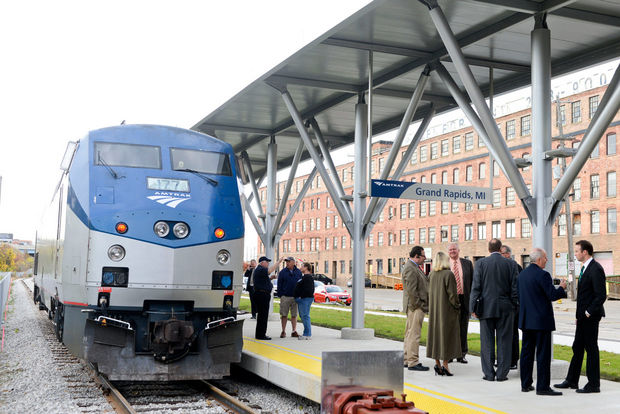
Guests attend the grand opening for the new Vernon J. Ehlers Amtrak Station on Monday, Oct. 27, 2014. Adjacent to the Rapid Central Station, the $6.1 million station will integrate bus and rail transportation system. (Emily Rose Bennett | MLive.com)
Bearing floor-to-ceiling windows to brighten its interior, officials quipped the city no longer is home to an “Amshack” station.
The new Vernon J. Ehlers Amtrak Station ceremoniously replaced its Wealthy Street predecessor early Monday, October, 27, 2014, connecting Grand Rapids to Chicago. Ehlers, the former West Michigan congressman whose name appears on the hub’s façade, could not attend though his statesman-like approach to Congress was highly regarded among those at the station’s grand opening.
Retiring U.S. Sen. Carl Levin, D-Mich., remarked Ehlers had a grasp on the community and fought for its people while serving in the House from 1993-2011. It was Ehlers who worked in Washington, D.C., to secure federal funding for the $6.1 million station.
Ehlers brought no “I” nor selfishness to the job, Levin said, only “we.”
“‘Earmark’ is not a dirty word. … We know our communities more than anyone,” said Levin, referring to Ehlers securing $3.8 million for the station. “The loss of earmarking is a loss of representation for the people.”
Ehlers later would vote against the spending bill that contained appropriation dollars for the station in spring 2009. He said it was irresponsible during a time of crisis — the height of the recession.
Ehlers’ daughter, Marla, spoke on behalf of the family. She said Vern Ehlers used to joke that he served on education and science committees because of his profession.
“… And he served on the (House) Transportation committee because he wished to be reelected,” Marla Ehlers said.
Other guests at the ceremony include U.S. Rep. Fred Upton, R-St. Joseph, Grand Rapids Mayor George Heartwell, plus Michigan Department of Transportation and Amtrak leaders. The Jewel Tones, the City High chorale, entertained guests.
Officials wager passengers not only will enjoy the convenience of the new location near the Rapid bus station, but that the amenities will bring a boost to ridership on the Pere Marquette line. MDOT reports the route carried 109,501 passengers between Grand Rapids and Chicago in 2012 and 102,932 riders in 2013.
About 75,964 passengers have traveled the route so far in 2014, with the previous winter to blame for the dip in ridership, said Amtrak spokesman Marc Magliari.
The new Amtrak station, at 440 Century Ave. SW, only is steps away from The Rapid’s Central Station. That transportation hub serves greater Grand Rapids with at least 20 bus routes and its new bus rapid transit system, Silver Line.
It features at least 115 parking spaces, a covered platform, a larger waiting room and a clock tower paying homage to stations of old, seen from U.S. 131 to the east.
The station’s inaugural riders left on the first train at 7:40 a.m. Monday, which is expected to return at 9:55 p.m. If successful, a second daily trip could run on the line, something Heartwell predicts is on schedule.
“This is the first of many good things to come,” he said.
The Englewood Flyover. Photo courtesy Norfolk Southern Railway.
Federal, state and local officials celebrated in October 2014 the opening of the $142 million Englewood flyover, a major railroad bridge that has eliminated a significant source of train delays on the south side of Chicago and has reduced emissions and noise from idling trains in the neighborhood.
The flyover bridge replaced a crossing between the Metra Rock Island tracks and a set of Norfolk Southern tracks at 63rd and State St. With the completion of this project, 78 weekday Rock Island Line trains are now carried over the busy freight tracks used by approximately 60 freight and Amtrak trains, eliminating conflicts between trains that result in service delays.
The flyover is a major accomplishment of the Chicago Region Environmental and Transportation Efficiency (CREATE) program, a first-of-its-kind partnership between U.S. Department of Transportation, the State of Illinois, City of Chicago, Metra, Amtrak, and the nation’s freight railroads to eliminate railroad bottlenecks in the Chicago area.
“The Englewood flyover is one of the pillars of the CREATE program and helps to strengthen Chicago and Illinois as the transportation hub of North America,” Gov. Pat Quinn said. “Projects like these that invest in our infrastructure are economic engines that create jobs, encourage economic growth and improve the quality of life for residents throughout the region.”
“Chicago has been the rail hub of our nation for more than a century, yet for too long this area was plagued with freight congestion and bottlenecks that hurt productivity and rippled across the system. I’m proud to have played a role securing the funding needed to unsnarl the bottleneck and make the Englewood flyover a reality,” said Sen. Dick Durbin. “Today we’re here to celebrate a project completed with more than 90 percent federal funds that will bring improved Metra and Amtrak service, more efficient freight movement, and economic developments for today and the future.”
“We have been looking forward to this day for a long time,” said Wick Moorman, chairman and CEO of Norfolk Southern. “It’s impossible to overstate the positive impact this project will have on Norfolk Southern’s service, along with Amtrak’s and Metra’s. Not only will this project eliminate many hours in freight and passenger train delays daily, but it frees up additional capacity for all of us to continue to grow our business.”
“Fourteen daily Amtrak trains to and from Chicago have faced delays at this location that are felt in Michigan, Indiana and all the way to the East Coast,” said Tom Carper, Amtrak board member and past chairman. “Delays drive up cost and hold-down ridership, so CREATE projects such as this one are truly of national importance and big wins for Amtrak passengers, Metra commuters and the freight railroads, too.”
“The completion of the Englewood flyover means improvement in the quality of life for area residents,” said U.S. Rep. Dan Lipinski. “The benefits include fewer delays for Metra and Amtrak users, fewer delays for area drivers, better air quality, a reduction in noise from idling trains, and an overall improvement in safety. I am committed to seeing the rest of the much-needed CREATE projects through to completion.”
“The Englewood flyover will ease congestion through this busy rail area, an essential step in maintaining Cook County’s position as the critical intersection for the transportation network that serves America,” said Cook County Board President Toni Preckwinkle. “Unclogging the rails is an important step in ensuring a smooth running transportation system, which in turn will lead to economic growth for our entire region.”
“Metra could not be any happier to have this bridge completed,” said Metra Executive Director/CEO Don Orseno. “Our riders are already enjoying the benefits of passing through this area without experiencing any delays due to conflicts with freight or Amtrak trains. This project would not have come to fruition without the cooperation, funding and support provided by our partners in this project and our federal and state elected officials. It is a prime example of the progress we can make in the region when we all come together.”
The flyover was funded with $126 million in American Recovery and Reinvestment Act High-Speed Rail funds, $4.9 million in other federal money, $8.2 million from the State of Illinois and $3 million from the railroad industry, including Metra.
The Englewood flyover is the first project planned under the CREATE program to reduce conflicts between passenger and freight trains in the Englewood area and prepare the corridor to accommodate high speed rail service. Its completion lays the groundwork for two more CREATE projects. The planned 75th Street Corridor Improvement Project will divert trains on Metra’s Southwest Service to the Rock Island District at a point south of Englewood. The planned Grand Crossing Project will divert six daily Amtrak trains to Norfolk Southern tracks east of Englewood. With the flyover in service, the 75th Street and Grand Crossing projects can move forward without creating further bottlenecks at the busy Englewood interlocker.
The November 15 meeting will take place at the Port Huron Museumof Arts–Carnegie Center. Constructed in 1902, this former Carnegie Library building was saved from demolition by a dedicated group of volunteers and opened on May 3, 1968 as the Museum of Arts & History.
Port Huron, positioned where the St. Clair River flows out of Lake Huron, and just a hockey puck’s throw from Canada, has always been an important maritime and railroad center. T. J. Gaffney, well-known to many of us as a railroad historian, will share his extensive knowledge of how rail and maritime commerce shaped the area.
We will also hear from Paul Maxwell who is the director of the Port Huron Township Downtown Development Authority. Paul is very involved in the preliminary planning for a new Amtrak station in Port Huron. Amtrak’s Blue Water route sees many passengers from Canada and we hope to have a number of our Canadian friends with us for the meeting.
Following the usual no-host lunch at Lynch’s Irish Tavern, Mr. Maxwell has arranged for us to take a Trolley Car Tour of past, present, and future rail sites in the area. The trolley is heated, but you will want to dress for the weather, as we may be outside for parts of the tour.
You might want to think of making a weekend of it, especially if you reside in the western part of the state and seldom travel to the Blue Water shores. See the links below to help with planning.
The Great Lakes Maritime Center(Vantage Point) offers an excellent place to view passing freighters and tale advantage of a variety of opportunities to learn about Great Lakes history and current events on the Lakes. Winter hours daily 8am – 6 pm.
The Ann Arbor Area Transportation Authority has announced the start of a new technical study to determine the feasibility of WALLY commuter rail between Howell and Ann Arbor.
WALLY is short for the “Washtenaw and Livingston Line,” a proposed 27-mile rail service that would use existing freight tracks to carry passengers from Howell into Ann Arbor for work in the morning, and back out to Howell at the end of the work day.
North-south commuter rail is a long-range project being considered as an alternative to ease traffic congestion along US-23.
The new technical study follows an earlier feasibility study that consulting firm RL Banks and Associates conducted in 2008.
The new study is expected to be a more in-depth process looking at model-based ridership estimates, more detailed cost estimates, station locations, train storage and maintenance facility locations, and governance and funding feasibility considerations.
The scope of work also includes a review of possible alternatives, such as express bus service and high-occupancy vehicle lanes on US-23.
The study, which AAATA officials indicated in early January would be starting this year, is being funded by a $650,000 federal grant.
While the grant requires a 20 percent match, funds were collected in advance by the AAATA in partnership with local contributors. AAATA officials said no funds from a new transit tax that voters approved in May are being used for the study.
The study will be led by Smith Group JJR and is expected to take 18 months to complete. It will be managed in cooperation with the Michigan Department of Transportation and will include a large public involvement effort, with plans for general public meetings and focused discussions with local elected officials, businesses, environmental groups, and other interest groups.
AAATA officials said new conditions now exist that were not available for the previous study six years ago, including recently upgraded track north of Ann Arbor, a fleet of 23 refurbished commuter railcars, support from the Friends of WALLY community group, and a change of railroad ownership in the city of Ann Arbor.
The Ann Arbor Railroad, now owned by Watco, has expressed a willingness to consider passenger service on their rail line through the city.
“We are very excited about this next step forward,” Michael Lamb, a Howell resident and Friends of Wally organizer, said in a statement.
“It is nice to see that local governments, both in Livingston and Washtenaw counties, have been working together to obtain the grant that helped make this possible. We look forward to the two counties taking the next steps to make north-south commuter rail a reality — a reality that is needed and wanted by the commuters using US-23.”
In addition to north-south commuter rail, the AAATA has been in talks with MDOT about launching AAATA express bus service along US-23 north of Ann Arbor.
The AAATA previously indicated it planned to meet with the University of Michigan, Ann Arbor Downtown Development Authority, city of Ann Arbor, MDOT and Livingston County to talk about possibilities for funding such a service.
MDOT has indicated it would be willing to purchase land for the AAATA to develop a 250-space park-and-ride lot for US-23 bus service, possibly near 8 Mile Road, which could fit in with a WALLY station for future commuter rail service.

 Amtrak is touting an increase in ridership on its trains in fiscal 2014 as lawmakers are debating a funding measure for the company.