All posts by admin

Che sorpresa ti aspetta nel vivace casinò lazybar: generosi bonus, giri gratuiti e una selezione di giochi colorati renderanno la tua serata fantastica.

Grand opening of the new Grand Rapids Amtrak station is Oct. 27, 2014

Celebrate the grand opening of the Grand Rapid’s Vernon J. Ehlers Amtrak Station at 10 a.m. on Monday, Oct. 27, 2014.

Located at 440 Century SW,  it is adjacent to Rapid Central Station and will integrate bus and rail transportation, offer more passenger amenities and streamline train operations.

The special guest speaker is U.S. Senator Carl Levin.

Light refreshments will be served following the ceremony.

Please RSVP to Ronda Frazer at rfrazer@ridetherapid.org or 616-774-1185.

For bus route information, visit www.ridetherapid.org. Parking is also available at the station.

Click to enlarge.
Click to enlarge.

Ceremony celebrates Troy Transit Center

From The Detroit News:

An Amtrak train arrives at the new Troy Transit Center on Tuesday. (Photo: Daniel Mears , The Detroit News )

More than 200 people witnessed the ribbon-cutting for the new Troy Transit Center Tuesday, including Brian Smiatacz, 36, who had two kids in tow.

Four-year-old Adam, and Grace, 2, came outfitted with train engineer hats.

“They’ve been waiting for a year for this to open,” Smiatacz said. “We were watching it get built. It took a long time for this to happen.”

The $6.3 million facility took 14 years to complete. It replaces a much smaller stop about a quarter mile down the tracks. Located at the southwest corner of Maple and Coolidge, the station provides shelter from the elements, as well as free complimentary short- and long-term parking.

“This is a big day for Troy, and a big day for Oakland County,” Oakland County Executive L. Brooks Patterson said.

Sarah Wodtke, 36, of Rochester, has waited a long time for the center to open. She travels to Chicago every other week for her job.

“It’s the availability and the safe parking,” Wodtke said of the new station. “It’s faster for me to get here — much faster than going downtown.”

The center is a major improvement for the railroad company’s service, which includes six daily trains between Pontiac and Chicago via Troy, Detroit, Dearborn and Ann Arbor, Amtrak officials say.

Amtrak spokesman Marc Magliari said the Troy Transit Center is the first of three new stations opening in Michigan this year. Stations in Grand Rapids and Dearborn will open over the next six weeks. A fourth station is under construction in East Lansing, and talks are underway about new stations proposed for Ann Arbor and Port Huron, Magliari said.

“(The Troy Transit Center) is built for growth, because in the state of Michigan we have plans over the long term to add service,” Magliari said. “We know there’s demand.”

The project overcame numerous hurdles since 2000, when the city initially partnered with the neighboring community of Birmingham to build the center. At that time, real estate developer Grand Sakwa Properties donated the land with the condition that funding for the transit center be secured by 2010. Birmingham backed out a year later.

Troy secured an $8.4 million federal grant, but Grand Sakwa said the money wasn’t acquired before the deadline, meaning the property ownership reverted to the company. The city took the developer to court and offered to pay the company $550,000, based on a 2010 appraisal.

The City Council approved a scaled-down version of the transit center in January 2012. Construction of the 2,000-square-foot center was completed last fall. But Amtrak officials said the company couldn’t sign a lease until the city had title to the property.

In May 2013, an appeals court granted the reversion of the parcel. Troy initiated a condemnation case, allowing the city to buy the site, officials said. Then in February 2014, an Oakland County circuit judge dismissed the city’s lawsuit, affirming Grand Sakwa’s ownership of the land.

Two months ago, an Oakland County circuit judge issued an order transferring title to the property to Troy, on condition that the city pay Grand Sakwa $1.05 million.

Nick Fiorvento, of Shelby Township, came prepared to board the train Tuesday. He was headed back to Albion College, where he’s a junior, carrying a duffel bag, lunch box, umbrella and ample reading materials.

“It’s going to make it a lot easier for me to get home.”

Source: http://www.detroitnews.com/story/news/local/oakland-county/2014/10/14/troy-transit-center-opens/17242603/

Meeting Minutes — Grand Rapids – October 18, 2014

MINUTES
MICHIGAN ASSOCIATION OF RAILROAD PASSENGERS
MEMBERSHIP MEETING
THE RAPID CENTRAL STATION
GRAND RAPIDS, MICHIGAN
OCTOBER 18, 2014

Members Present: Larry Krieg, Warren R. Fritz, Rick Burn, Kathleen Newell, Kay Chase, Jim Wallington, Clark Charnetski, John Langdon, Don Monteith, Chuck Merckel, Jean Merckel, Dan Platz, Roger Marrissett, Ed Heckman, Hugh Gurney, John McKibben, Rosemary Horvath, Tim Hoeffner, Charles Shong, Al Koole, Eric Elliott, Richard A. Horvitz, David Williams, Bob Tischbein and Jim Hinkins.

Guests: Michael Bulthuis (The Rapid), Ronald B. Day, and Adam Tauno Williams.

Call to Order: The meeting was called to order at 10:00 AM by chair Larry Krieg.

Executive Committee Minutes: Minutes of the August 19, 2014 Executive Committee Meeting were approved unanimously.

Membership Meeting Minutes: Minutes of the July 19, 2014 Membership Meeting in Traverse City were approved.

Appointment of New At-Large Executive Committee Member: This would fill a vacancy created when Jim Wallington became Vice Chair.

Resolution: Don Wescott shall be appointed as an Executive Committee Member At-Large with responsibility for coordinating meetings.

Moved by John Langdon and seconded by Jim Wallington.

Motion passed unanimously.

Future Meetings (Jim Wallington): January 10, 2015 at the former Grand Trunk station in Lansing. The February 2015 meeting is tentatively planned for Clara’s Restaurant in Battle Creek. The March 2015 meeting will be at the Kalamazoo Library or the transit authority headquarters in Kalamazoo.

Outreach (Chuck Merckel): Volunteers are needed for events. See sign-up sheets. At events, attendees are encouraged to sign up for on-line editions of “On Track” via e-mail. More than 200 people now receive “On Track” by this method.

Feature Presentation “The Silver line—Michigan’s First Bus Rapid Transit”

Michael Bulthuis, Public Outreach Coordinator for The Rapid, gave a Power Point presentation: “The Silver Line—Michigan’s First Bus Rapid Transit.” From planning to startup has taken more than ten years. Operations commenced on August 25, 2014. The 9.6 mile route starts at a 200-space park and ride lot at 60th Street on the south end of the line, goes north on Division Avenue to the “Medical Mile” on the north end, then west and south past the Amway Grand Plaza Hotel and ends at the Central Station of The Rapid.

Division Avenue was chosen because it is a long street with the most cross-town bus transfer points, and some portions of the route are ripe for economic development. The existing bus Route #1 continues to operate as a local bus on Division. BRT vehicles stop only at stations with high level platforms (14 to 15 inches above the roadway) so that passengers do not have to climb stairs. This speeds up boarding and exiting, and makes life easier for those using wheelchairs and walkers. Lighted platforms are sixty feet long and use ramps for access from sidewalks if necessary. Shelters at each station are either 36 or 48 feet long, depending upon the number of passengers handled and the geometry of the site.

Stations are spaced approximately one-half mile apart, although they are closer together in the downtown area. They are nearly identical in appearance. Each station has heated platforms, ticket vending and validation machines, emergency telephones, benches and bike racks. An electronic sign announces arriving buses and how many minutes until the next one. On-board roving ticket inspectors enforce ticket regulations. The standard fare is $1.50 one way with free transfers.

The ten hybrid vehicles used in Silver Line service have their own unique green paint scheme and are similar to buses used on other routes, except that they do not have fare boxes or the pull cords for requesting stops. Passengers may board either at front or rear doors. All BRT buses stop at all stations. Visual and auditory announcements indicate station approaches. A Traffic Signal Priority system reduces delays at stoplights. During rush hours the right traffic lane is for buses and automobile right turns only. An end to end ride takes just over 30 minutes. Buses run on ten minute headways during rush hour and have 38 seats made by American Seating. Standees give each bus a capacity of 70 passengers.

The capital cost of the Silver Line was $40 million. The Division Avenue Route #1 bus continues to operate as a local bus with separate stops about a quarter mile apart. Ridership on that route is roughly the same as before the Silver Line, but Silver Line patronage is approximately the same as that of Route #1. Therefore transit use on Division Avenue has doubled, though some BRT passengers use the Route #1 buses as feeders to the Silver Line.

The Silver Line gives Southeast Michigan a taste of the three or four RTA bus rapid transit lines proposed for the Metro Detroit area, including Woodward Avenue between Pontiac and Detroit. The Rapid is now studying a second BRT route from Allendale (the home of Grand Valley State University) to Grand Rapids, a distance of 13 miles, to be called the Laker Line. Additional information can be found at www.ridetherapid.org/silver-line.

Trans4m’s Budget-Based Dues Structure: Larry Krieg explained that Trans4m will be instituting a dues structure and is seeking the opinion of members as to whether is should be a flat rate or based upon the size of each member’s budget.

Resolution: MARP shall endorse a budget-based dues structure for Trans4m.

Moved by Hugh Gurney and seconded by David Williams.

The motion passed.

Sharing of Membership Lists by NARP and MARP: Should MARP share membership lists with NARP? Presently MARP states that it will not share member information with any outside party.

Resolution: MARP shall exchange membership data with NARP annually until further notice after informing the membership with the annual membership renewal notice.

Moved by David Williams and seconded by John Langdon.

The motion passed by a vote of 18 to 1.

Treasurer’s Report (Jean Merckel): MARP has gained 8 new members.

The Pratt Fund was discussed by members. Warren Fritz advised that a more diversified investment would be more likely to yield a better return than a single fund and suggested that MARP place the Pratt Fund money into at least two funds Other members indicated that they believed that it is time to transfer the funds as had been previously approved by the Executive Committee and that Mr. Fritz’s suggestion could be implemented at a later time. The previous action of the Executive Committee will be carried out.

FRA Study of Chicago to Detroit/Pontiac Corridor: Written responses to the FRA study are due by December 19, 2014. What shall be the response of MARP?

Resolution: That MARP form a committee of three or more members to draft a written statement to be submitted to the FRA by December 19, 2014, regarding the Chicago to Detroit/Pontiac passenger rail corridor Environmental Impact Statement.

Moved by John Langdon and seconded by Chuck Merckel.

The motion was approved unanimously.

New Grand Rapids Amtrak Station: The station is due to open Sunday evening, October 26, 2014, with a ceremony in November.

New Dearborn Amtrak Station: Due to open on Monday, December 15 2014.

Algoma Central Threat of Discontinuance: Kay Chase reported on her recent trip on the threatened Algoma Central train from Sault Ste. Marie to Hearst. Postcards urging the continuation of train service are still available to be sent to members of Parliament.

Next Meeting: Saturday, November 15, 2014 at 10:00 AM at the Port Huron Museum of Arts and History Carnegie Center, 1115 Sixth Street, Port Huron MI 48060. Phone 810-982-0891.

Adjournment: The meeting was adjourned at 12:25 PM.

Submitted by Clark Charnetski

Tour of New Grand Rapids Amtrak Station:

Following the MARP meeting, members and guests were treated to a preview tour of the new Vernon J. Ehlers Grand Rapids Amtrak station. It is located just south of The Rapids Central Station, thus allowing for easy transfer between modes. It replaces the thirty-year-old “temporary” station on Wealthy Street.

The brick, metal and glass building has an airy feeling with large windows and glass doors facing the train platform on the south side of the station. The platform has a canopy the length of the platform that is 15 inches above top of rail, which is seven inches higher than most other stations in Michigan. It is nearly level to the lower floor of Superliner cars and the new cars on order for Michigan. Grand Rapids is the first Amtrak station in Michigan to have such high platforms, though the new Dearborn station, which is expected to open in December, will also have that height. Grand Rapids is a stub end station with one track and provision for a second.

The automobile and taxi pick up and drop off drive is on the north end of the station which has a clock tower. The 115-space long-term parking lot is between the train station and The Rapid’s Central Station. The heated lobby will be open longer hours than the station itself and will contain a ticket machine. The interior of the station has accessible restrooms and a room for train crews. Its address is 440 Century Avenue SW 49503.

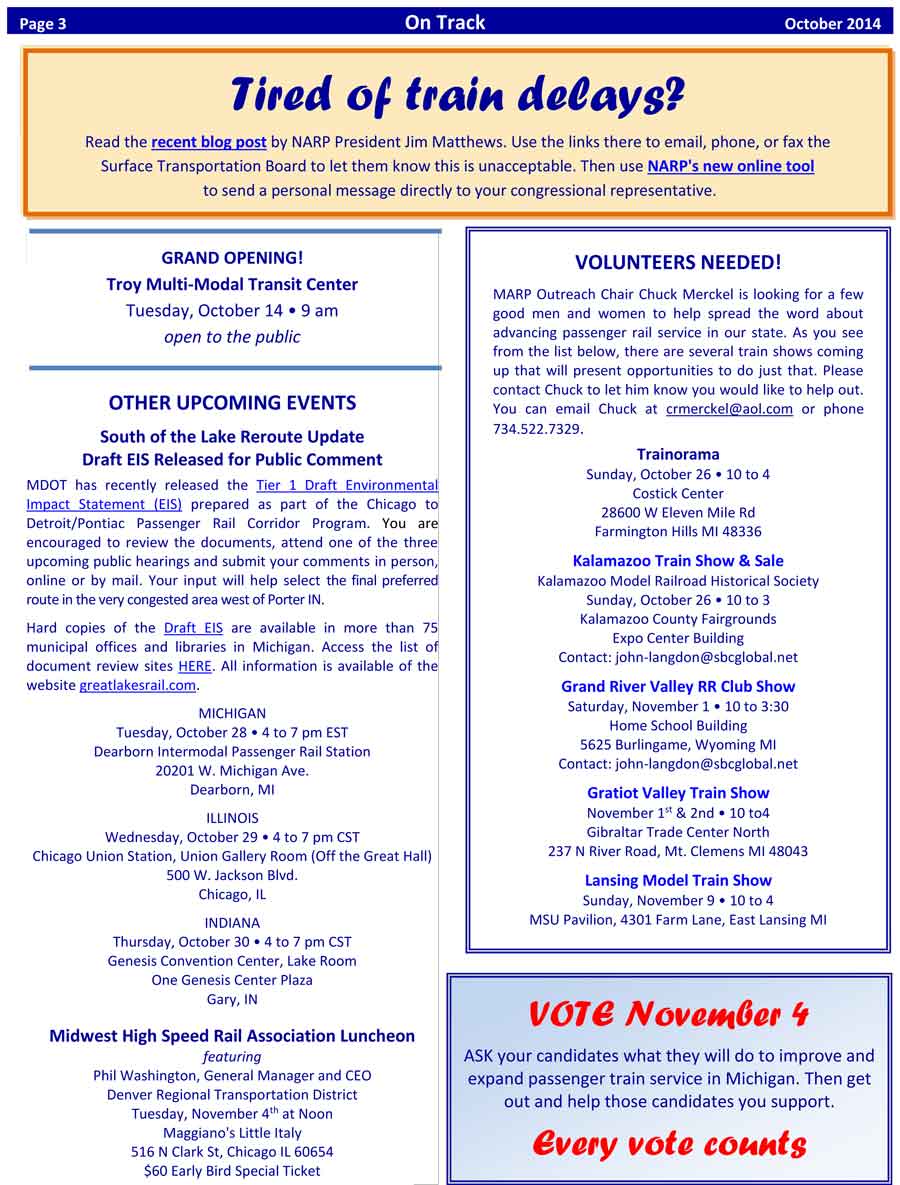
October 2014 edition of On Track

Click here to save this file or to view it as a PDF in full screen.

In this issue:

  • a report on MARP’s 41st Annual Meeting held at Durand Union Station
  • John Guidinger’s notes on the 2nd Michigan Rail Conference where you’ll find out what a bogie is
  • a South-of-the-Lake route update and information on upcoming public hearings – PLEASE PLAN TO ATTEND
  • how to let the STB and your representatives in D.C. know that you want action to improve train on-time-performance
  • recognition for 30 years of service by an Amtrak engineer on the Pere Marquette

We hope you enjoy the issue and that you will let us hear your comments and suggestions. If you would like to write a story or suggest an item to be covered, email us at marprail@yahoo.com

For those without a PDF reader, click on the images below to view them full screen.

Page 1ontrack_37-1

Page 2ontrack_37-2

Page 3ontrack_37-3

Page 4ontrack_37-4

Amtrak trains often trickle into Toledo after rash of delays

From The Toledo Blade:

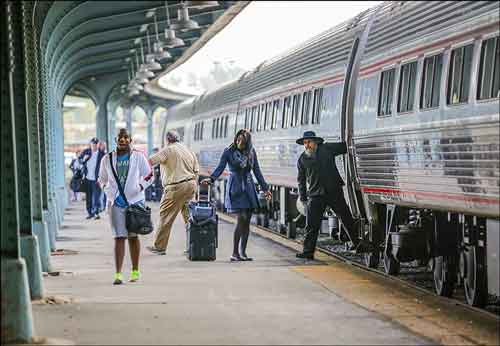
Passengers get off the Amtrak train in Toledo.  THE BLADE/ANDY MORRISON
Passengers get off the Amtrak train in Toledo.
THE BLADE/ANDY MORRISON

Christine Smith boarded Amtrak’s Lake Shore Limited in Chicago on Tuesday night to visit a friend in Toledo.

The train left Chicago two hours late and made it only about 15 miles to Indiana’s northwest corner, where it sat for about three hours, Ms. Smith recalled. By the time it got to Toledo, it was six hours behind schedule.

It was only the latest of a series of late Amtrak trains the Melbourne, Australia, resident said she had encountered since arriving in Los Angeles last month and riding from there to San Francisco, Portland, Ore., Spokane, and Chicago.

Late trains are nothing new for Amtrak, particularly for the overnight, long-distance trains such as those that serve Toledo — the Lake Shore Limited and Capitol Limited. Trains running more than three hours late have become the norm recently, and they have often lost that much or more just on the Chicago-Toledo portion of trips. The Capitol Limited was 12 hours behind schedule on Sunday.

While there have been exceptions, by far the biggest obstacle to Amtrak’s time-keeping across northern Indiana and northern Ohio has been tracks blocked by freight trains belonging to Norfolk Southern, which owns and operates the line Amtrak uses between Chicago and Cleveland.

“It’s absolutely unbelievable what they’re doing to the American people. It’s a fraud,” Ms. Smith said. “Every train I’ve been on has been late leaving and late arriving, and freight trains are given as the reason.”

During the 12 months that ended in August, Capitol Limited trains arrived at their end stations in Chicago or Washington within 30 minutes of schedule only 22.5 percent of the time, while the Lake Shore reached Chicago or New York on time 30.8 percent of the time, according to Amtrak.

But August itself was significantly worse, and September data, when available, is unlikely to show improvement. In August, the best performer was the eastbound Lake Shore, which reached New York within 30 minutes of schedule 6.5 percent of the time — two trips. The westbound was late into Chicago every day of the month, and the Capitol Limiteds arrived on time once in each direction.

Late westbound arrivals in Chicago also translate to late eastbound departures, because Amtrak lacks spare equipment in Chicago to make up replacement trains when equipment arrives late, and it also does not have enough engineers and conductors to always have an extra train crew ready to replace one that has worked the maximum 12-hour shift set by federal regulation.

Marc Magliari, an Amtrak spokesman in Chicago, laid even the late departures from Chicago at Norfolk Southern’s feet.

“If the train is late getting to Chicago, it’s most likely going to be late eastbound while we’re servicing equipment and getting proper rest for our crews,” Mr. Magliari said. “The result is to drive up our costs, dissatisfy our passengers, and create ‘never again’ riders.”

While its ridership pales in comparison to major stations like New York and Chicago, Toledo historically has been Amtrak’s busiest Ohio stop, and its ridership has declined of late.

After peaking at more than 90,000 riders in 2010 and 2011, Toledo’s Amtrak ridership dropped to 87,073 in 2012 and 86,252 last year, according to statistics provided to the Toledo-Lucas County Port Authority, which owns the Toledo station.

During the first seven months of 2014, Amtrak’s Toledo ridership has fallen by another 7 percent, those statistics show.

David Pidgeon, a Norfolk Southern spokesman, said the freight-train backlog is a product of “more trains and capacity challenges in the corridor between Chicago and Cleveland” because the freight traffic exceeds what the company handled before the 2008 recession.

“We generally have a cooperative relationship with Amtrak because we are each other’s landlords,” Mr. Pidgeon said. “We run on their network and they run on ours, so there’s plenty of business and personal incentive to keep the cooperation going.

“We want to keep freight and passenger trains moving, period.”

One of the busiest pieces of railroad in the entire United States, Norfolk Southern’s double-track main has become, to varying degrees, an obstacle course of stopped and slow-moving freight trains.

A particular growth area has been oil shipments from the Bakken oilfields of North Dakota to terminals on the East Coast, rail traffic that simply didn’t exist before 2009 but now accounts for dozens of trains through Toledo each week.

Rail expansion

Norfolk Southern is building a third main track between Chesterton and Gary, Ind., a 30-mile section that is the busiest stretch of the region’s busiest freight railroad. It includes several major junctions and runs through the heart of one of America’s most heavily industrialized areas, the steel mills and a major oil refinery along Lake Michigan’s southern shore. Until that third track is ready for use, its construction is impairing train traffic.

When only one track is open for trains, traffic only goes one way while opposing trains wait. The spot where Ms. Smith’s train stopped is near the west end of the Chesterton-Gary construction zone. LaPorte, Ind. — where the Chicago-bound Amtrak trains from Toledo have often sat for hours in recent weeks — is near the east end.

And not only have passenger trains to and from Toledo been affected by that problem, so too have Amtrak’s five daily round-trip trains between Chicago and Detroit, Grand Rapids, and Port Huron, Mich., which use the same rails west of Chesterton.

The third track in northwest Indiana is one of several capacity-improvement projects under way on Norfolk Southern in the region.

Most prominent among the others is a $160 million expansion of the Bellevue, Ohio, yard, which will double in size when the project is done later this year, easing congestion at other yards, Mr. Pidgeon said.

That “will ease the demand for space in Elkhart and hopefully significantly reduce transit times for our freight trains, keeping us moving and the network fluid,” he said.

Norfolk Southern has 50 new locomotives soon to be delivered and also has bought several hundred used ones in the past year or two to address shortages.

It also is hiring close to 100 new train conductors in the Toledo area and has transferred 120 more from other parts of its system to the Cleveland-Chicago corridor to alleviate crew shortages, Mr. Pidgeon said.

The Ohio Association of Railroad Passengers, an advocacy group, cites another factor in the freight-train delays: An automated dispatching system Norfolk Southern has been introducing on portions of its rail network during the past two years.

The system, called the Auto-Router, is designed to mimic a job human train dispatchers have done for years — deciding which trains run on which tracks at what time. The automated system could supplement that work, allowing the human dispatchers to work larger territories, or eventually it could replace them.

Train dispatching is a job with a lot of variables because freight trains don’t all travel at the same speed. Some are long, heavy, and slow; others are short and, ideally, fast.

Hills, track repairs, and certain trains’ need to stop at yards along the way to pick up or drop off cars also can factor into how trains are dispatched.

Critics of the system including OARP — also known as All Aboard Ohio — and Norfolk Southern sources who spoke on condition of anonymity because they’re not authorized to talk to reporters said the Auto-Router system’s flaws are contributing to the railroad’s congestion.

Passenger complaints

While Amtrak riders interviewed by The Blade said they understand how the passenger trains are at the freight railroads’ mercy, some said the passenger-train operator could handle the situation better, too.

Jean McGraw of Port Clinton, who boarded the Boston-bound Lake Shore in Sandusky in late September to visit a sister in New Hampshire, said she and her travel companion got two emails “in the middle of the night” about train delays but got no updates after that.

And when the bus Ms. McGraw and other Boston-bound passengers rode from Albany got to Boston at 4 a.m. the next day, the station there was locked. The passengers cajoled the bus driver into letting them take shelter in a neighboring bus garage, she said.

“That was it — it was ridiculous,” Ms. McGraw said.

As compensation, Amtrak offered vouchers good toward future train travel. Ms. McGraw said she hopes to use hers once the current problems are resolved, but her companion swore off train travel because of the experience.

Untested is whether Norfolk Southern’s handling of Amtrak violates a 1973 federal law directing the freight railroads to give the passenger trains preferential handling.

A more recent federal law, passed in 2008, directed the Federal Railroad Administration and Amtrak to develop performance standards for Amtrak trains.

However, a later appellate court ruling stalled this. According to the rail passengers association, Amtrak’s overall on-time performance has plummeted since that 2013 ruling, which is the subject of a pending Supreme Court appeal.

Dan McMackin, a United Parcel Service spokesman, said his company has recently changed the train routes it uses to move packages in response to train delays, though he did not confirm that the company specifically removed its cargo from the Norfolk Southern route.

“We have seen some recent lower reliability in several lanes and are adjusting accordingly, with guidance from our rail service partners as to appropriate network corrections,” Mr. McMackin said. “While there have been lanes affected over the last several months, we expect long-term reliability to return and most of our adjustments are seen as temporary.”

But while UPS may be ready to send packages back to the Cleveland-Toledo-Chicago corridor once Norfolk Southern’s problems are resolved, Amtrak could have a harder time winning back Tanya Miller, of Taylor, Mich., one of the riders who boarded the New York-bound train in Toledo on Wednesday morning.

“This is my first time and my very last time taking Amtrak,” she said. “I’m not recommending Amtrak to anyone.”
Read more at http://www.toledoblade.com/local/2014/10/06/Amtrak-trains-often-trickle-into-Toledo-after-rash-of-delays.html#CxCf2dGyodcVf60M.99