All posts by admin

Che sorpresa ti aspetta nel vivace casinò lazybar: generosi bonus, giri gratuiti e una selezione di giochi colorati renderanno la tua serata fantastica.

Why is Detroit Metro Airport moving its Michigan Flyer bus stop?

From M-Live:

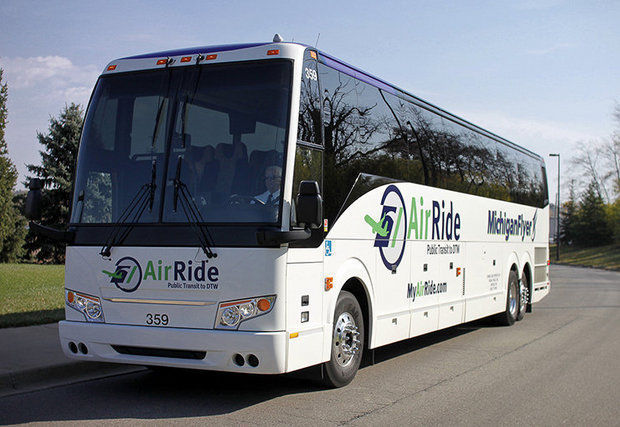
The Michigan Flyer, which makes several runs a day from East Lansing to Ann Arbor and the Detroit airport, must move its DTW stop to a new location Monday - and they aren't happy about it. (File Photo | MLive)
The Michigan Flyer, which makes several runs a day from East Lansing to Ann Arbor and the Detroit airport, must move its DTW stop to a new location Monday – and they aren’t happy about it. (File Photo | MLive)

Michigan Flyer users are riled up after Detroit Metro Airport announced plans to relocate the popular bus service’s stop at McNamara Terminal from curbside to one 500 feet away where passengers must brave the elements.

Michigan Flyer officials say they worry the new stop could hurt their 98 percent on-time record because they can’t load or unload passengers if they can’t find a parking slot at the new stop, located at the Ground Transportation Center. The current stop is located just outside a waiting room for International Arrivals.

The move takes place Monday and affects all Michigan Flyer customers taking flights to or from McNamara Terminal, which serves Delta and Air France passengers.

TRANS4M, an advocacy group for public transportation in Michigan, is also taking a stand against the switch, saying it will hinder seniors and those with disabilities.

Michigan Flyer officials say in an email, “We’re urging DTW to reconsider the move, or at least make it easier on passengers.”

Wayne County Airport Authority officials say the move will increase safety and ease congestion, according to TRANS4M. Michigan Flyer argues it has an “impeccable safety record” at the current location.

MLive is seeking a response from the authority about the new location.

Frequent users of the bus say they haven’t witnessed congestion at the current stop.

“When using the service I have not experienced or seen congestion,” wrote Liz Boyd, political consultant and former spokeswoman for Gov. Jennifer Granholm. “Also, it’s also my understanding the other buses – including the employee bus service – that use the drop-off location 168 times a day — are not being relocated.”

Michigan Flyer in an email lobbied its users to write the Detroit airport to complain about the switch:

Your opinion matters. If you’re so inclined, you can share it in one email to several key people involved in this decision: Thomas Naughton, CEO of the Wayne County Airport Authority; Michael Ford, CEO of the Ann Arbor Area Transportation Authority; Gordon Mackay, CEO of Michigan Flyer; Michigan Governor Rick Snyder; Senator Debbie Stabenow and the Michigan Department of Transportation.Just put “DTW relocation of Michigan Flyer-AirRide” in the subject line of your email, express your thoughts, then copy and paste all of the following addresses into the “To” area and hit Send: thomas.naughton@wcaa.us; airride@theride.org; info@michiganflyer.com ; rick.snyder@michigan.gov; senator@stabenow.senate.gov; mdot-oca@Michigan.gov


Amtrak’s Detroit-Chicago trip to get faster, plusher with upgrades

From The Detroit News:

Passengers at the Royal Oak station board an Amtrak train bound for Chicago Friday afternoon. Michigan transportation officials hope faster service and on-time scheduling build ridership. (John T. Greilick / The Detroit News)

The tracks have been cleared for the state to develop faster, cushier Amtrak service between Detroit and Chicago now that the Michigan Senate has ended its probe of a state passenger rail car purchase.

State transportation officials want to buy two sets of cars and engines, built in the United States by an affiliate of Spanish train maker Talgo Inc., as part of an Amtrak upgrade. The updates would allow trains to reach 110 miles an hour and, in a few years, get passengers from one city to another two hours faster than they can today.

Officials also hope to improve Amtrak’s on-time service, which ranged from as low as 6.5 percent to as high as 52.3 percent among the Detroit-Chicago trains in July. Amtrak’s website reports on-time rates on the route have ranged from 21.5 percent to 39 percent in the last 12 months.

Lawmakers who questioned a one-bid contract awarded to a Spanish firm for “next-generation” passenger cars now are willing to let the deal proceed, said Senate Transportation Committee Chairman John Pappageorge, R-Troy.

The investigation, and a longer than anticipated evaluation process, delayed purchase of the passenger cars with modern amenities.

The $58 million for Michigan’s two train sets is to come from $200 million in federal funds for Amtrak improvements in Michigan and other states, mostly in the Midwest. The move to the faster trains is expected to give a boost to the Detroit-Chicago route, where ridership steadily has been building back toward a 20-year peak of nearly 504,000 passengers in 2010.

Down the road, the state will use additional federal money for more “next-generation” passenger car and engine sets, said Michigan Department of Transportation railroad chief Tim Hoeffner. The state will own the cars and the Michigan rails on the Detroit-Chicago route for now.

Hoeffner said the Talgo car purchase isn’t finalized. An evaluation of the equipment’s suitability for Michigan’s needs is taking longer than expected, so the cars won’t be in service next month as originally proposed, he said.

Bid controversy

The two Talgo sets will replace 30- to 40-year-old Amtrak cars on two of the three daily Detroit-Chicago runs on the route Amtrak calls The Wolverine. Older cars will continue on the other run until the state buys newer equipment in a couple of years.

“The difference between them is like the difference between the car I learned to drive in the 1970s and the cars my kids learn to drive now,” Hoeffner said. Michigan’s passenger trains, he said, gradually will become more like the sleek, modern trains that run in Europe and Asia.

Current aluminum coaches on the route lack modern amenities and are deteriorating because Amtrak has no budget to overhaul them, according to MDOT. They have institutional decor, lack carpeting, contain harsh lighting and lack hot water in restrooms, the department says.

Pappageorge said what “raised red signals” was that Talgo was the sole bidder to supply the cars. The company happened to have newly built train sets sitting at an Amtrak facility in Beech Grove, Indiana, and Michigan needed to act quickly because federal funds were available.

“It was appropriate to look into it because that didn’t look right,” Pappageorge said. “Digging into it, we came to the conclusion that Talgo was the right answer — not a perfect one but adequate.”

In a statement on behalf of her company, U.S. public affairs vice president Nora Friend said Talgo officials “are very pleased that the Senate committee is being respectful of the (bid) process and is allowing the deal to go forward.”

The train sets were built for Wisconsin’s Amtrak routes, before Gov. Scott Walker canceled the deal. They are sitting idle in Indiana while the company and that state battle in court over money Talgo claims Wisconsin still owes it.

The Senate’s inquiry, which lasted through the summer, resulted from a challenge by a competing firm, Chicago-based Corridor Capital, which didn’t bid but claimed the process seemed to favor Talgo. The state’s bid specifications were so narrow only one company could meet them, Corridor Capital said.

The criticism, aired at Senate committee hearings, also came from former U.S. Rep. Joe Schwarz of Battle Creek, a train buff and volunteer adviser to Gov. Rick Snyder on rail issues. He questioned whether Talgo’s equipment can meet Michigan’s needs — a criticism Corridor Capital continues to press.

“They didn’t meet the minimum requirements,” charged Lansing public relations specialist John Truscott, who represents Corridor Capital. “If they did qualify, this would have been an easy decision. We (still) feel it would be just as easy for MDOT to do the right thing and open this back up (for rebidding).”

‘Incremental’ improvements

But Pappageorge said members of the Senate’s Transportation and Appropriations committees found the bid process was handled properly. They also concluded Talgo’s equipment is adequate, based on hours of testimony about train car specifications, he said.

A problem for Corridor Capital was that the company didn’t have train sets ready to go, Hoeffner said. The firm sought a state contract under which it would take over the entire state rail service, not just supply rail cars. It is working on a similar deal with Indiana.

State transportation department analysts believe an “incremental approach” is more prudent for Michigan right now, Hoeffner said. The goal is to continue building ridership on the Detroit-Chicago route, the busiest of its three passenger corridors, through faster service and nicer cars.

“All customers want to know is: When do I leave, when do I arrive and is it convenient?” Hoeffner said.

The trip now takes about 6½ hours most days, but Hoeffner said MDOT’s goal is to reduce the time to 4 hours — about the same amount of time needed to drive the route in a car. The state has purchased the in-state portion of the route and is in the midst of upgrades that should be completed in late 2017 or in 2018.

Annual meeting minutes – Sept. 1, 2014 – Durand

 MINUTES

MICHIGAN ASSOCIATION OF RAILROAD PASSENGERS

                                                41ST ANNUAL MEETING

                                    DURAND UNION STATION, DURAND

                                                SEPTEMBER 13, 2014

Members Present: Barb Spaulding-Westcott, Charles Bonnell, Clark Charnetski, Clayton Farmer, Dan Mitchell, Dan Platz, David Williams, Debby Mills, Diane Patterson, Don Monteith, Don Westcott, Eric Newberg, Hugh Gurney, Jim Hinkins, Jerry Becker, Jim Wallington, John Langdon, J.P. Descamp, Julien Wolfe, Kay Chase, Kaz Fujita, Keith Martin, Kim Powell, Larry Krieg, Larry Sobczak, Martha Benedict, Michael Frezell, Norma Ward, Ren Farley, Richard Pekarek, Richard King, Robert Tischbein, Robert Patterson, Roger Webster, Warren Fritz, Doug Wilson, Tim Fischer

Others Present: Deborah Doyle, Derrick James, Kali Fox, Mary Warner-Stone, Melissa Horste, Ron DeCook, Tim Hoeffner, Tom Carper, Les Schneider, Guest of Eric Newberg

Welcome and Introduction of Guests:  Chairman Tischbein called the meeting to order at 10:34 a.m. Robert Patterson pointed out that each table has a table host to encourage and lead discussion.

Special Guests were welcomed including:

Mary Warner-Stone, Executive Director, Durand Union Station

Deborah Doyle, Mayor, City of Durand

Ben Glardon, State Representative for the Durand area

Kali Fox, Regional Manager for Senator Debbie Stabenow

Melissa Horste, Regional Representative for Senator Carl Levin

Les Schneider, Shiawassee County Commissioner, District 4

Mary Warner-Stone,  Executive Director of Durand Union Station, Incorporated, welcomed all to the beautifully restored facility.  She announced that DUSI now has a professional archivist-

-1

curator, Michael Boudro, who is  organizing the museum’s extensive library and archives, starting on the lower floor and working up to the attic.  Boudro will also be upgrading museum exhibits.  DUSI plans to participate in a study of orphan trains during which 4th graders will be arriving at the station via Amtrak.  Warner-Stone urged all to return during the holidays and enjoy one of several Christmas dinners served amid lavish Christmas decorations.  DUSI is planning an extensive commemoration of its 30th anniversary in 2015.

Melissa Horste, Regional Representative for Senator Carl Levin, stressed the Senator’s strong support of Amtrak.  She highlighted a recent grant of $12.2 million for Detroit’s M-1 Rail in addition to an earlier $25 million grant.   At this point, it looks as though current Amtrak funding will be extended through May, 2015, giving legislators more time to work on reauthorization of MAP 21 and PRIIA.  Clark Charnetski asked Horste to offer MARP’s thanks to Senator Levin for his constant support of rail over the years.

Kali Fox, Regional Manager for Senator Stabenow, voiced Stabenow’s support for public transportation in general, including the East Lansing Transportation Center now under construction and the M-1 Rail project.  The Senator is closely tracking the Railroad Safety Act, currently under review by the Commerce Committee as well as the reauthorization of the Surface Transportation Act.

Others with words of welcome were Durand Mayor Deborah Doyle, State Representative Ben Glardon and Shiawassee County Commissioner Les Schneider.

Video Greetings:  Joseph C. Szabo, Administrator of the Federal Rail Administration, greeted the group by video, noting the upcoming 30th anniversary of the Pere Marquette, the 40th anniversary of the Blue Water, a ridership increase of over 30% on Michigan trains since 2005, higher speeds on the Kalamazoo-Dearborn portion of the Wolverine route in the near future, new stations in Dearborn and Grand Rapids, and the South of the Lake study which promises faster and more reliable service between Chicago and Porter, Indiana.  He urged support for the administration’s transportation bill which includes dedicated funding for passenger rail.

Blue Water 40th Anniversary:  Don Westcott reported that he had been coordinating events as part of the Blue Water 40th Anniversary Commemoration, now scheduled for October 1.  Billboards have been put up along the I-69 corridor and several banners can be checked out for travel shows.  On October 1, each station along the route is planning a ½ hour program.

Chairman’s Report:  Chairman Tischbein reviewed a multitude of projects in which MARP is either an active participant or is closely tracking including the South of the Lake corridor study, the proposed Ann Arbor-Detroit commuter line, the proposed Howell-Ann Arbor commuter

-2-

line(Wally), upgrades to the tracks and signals between Kalamazoo and Dearborn, construction of the new transportation center in East Lansing, restoration of the Jackson depot, pedestrian traffic flow at Chicago Union Station, recertification of steam locomotive 1225, Wi-Fi on Amtrak, state and federal transportation funding, support for continued passenger service on the Algoma Central Railroad, study of proposed passenger rail service between Holland and Detroit, and the M-1 light rail project in Detroit.  MARP is looking for suggestions on how to make it easier for members to participate more actively.

M-1 Rail, Detroit’s Woodward Avenue Streetcar:  As he opened his remarks, Timothy R. Fischer, Chief Administrative Officer for M-1 Rail, displayed a section of old streetcar track unearthed on Woodward Avenue as excavation for M-1 got underway this summer.  Visuals in his power point presentation showed the exact route of the 3.2 mile light rail line and how it ties in with the People Mover on one end and Amtrak and the Crosstown Bus on the other.  The project will have 20 stations, each with shelters, where passengers can purchase tickets at ticket machines.  Each station offers level boarding of the light rail cars.

Construction is underway in the downtown area, with fences between the sidewalks and work areas, as well as covered crosswalks to protect pedestrians.  A portion of the bridge across I-75 has been demolished and will be rebuilt incorporating tracks for the light rail line.  Approximately 40% of all jobs in the city of Detroit and 20% of all jobs in Wayne County are in the Woodward Avenue corridor served by M-1.  Support from numerous foundations and businesses, the City of Detroit, Wayne County, MDOT, and the federal government are making M-1 possible. The cars, powered by electric batteries, and with capacity for both bikes and wheelchairs, will be in operation by the end of 2016 or the beginning of 2017.

Studying the Ridership Demand for Coast- to- Coast Rail:  Elizabeth Treutel, Policy Associate with the Michigan Environmental Council, updated the group on the Coast- to- Coast project, the ultimate goal of which is the restoration of passenger rail service between Detroit, Lansing, Grand Rapids and Holland.   Coast- to- Coast hopes to fulfill one of the objectives of the Michigan By Rail public forums back in 2012 and incorporated into the State Rail Plan.  With support from 52 organizations, Coast-to-Coast has successfully raised the required local match and has secured a $100,000 Service Development and New Technology grant from the federal government to do a Ridership Demand Study.  Treutel urged all present to follow the progress of the study and participate in the planned public engagement process.  Richard King asked that plans for Coast-to-Coast permit a Flint-Grand Rapids connection.


-3-


MARP Business Meeting: 

Minutes of the 40th Annual Meeting, September 14, 2013:  Minutes of the 40th Annual Meeting were distributed and reviewed. David Williams moved approval, seconded by Richard King.  After adding Barb Spaulding-Westcott to the list of those attending, the minutes were approved by the members in attendance.

Treasurer’s Report: The Treasurer’s Report was distributed and reviewed.  As of August 31, 2014, MARP had $33,342.48 in its checking account.  Of this balance, $17,141.26 was earmarked as the Pratt Fund, leaving $16,201.22 for operations.   Wallington thanked America By Rail for a $1,000 donation towards Annual Meeting expenses.  Frezell moved acceptance.   Becker seconded, and the Treasurer’s Report was approved by the members in attendance.

Nominations: After noting the passing of long time member George L Schlaepfer on May 21, 2014 and acknowledging fellow Nominating Committee member Steve Sobel’s efforts, Clark Charnetski, Chair of the Nominating Committee, presented the slate of officers for the period beginning at the conclusion of today’s meeting and serving until the conclusion of the Annual Meeting in 2016:

Chair:              Larry Krieg

Vice Chair       Jim Wallington

Secretary         Open

At Large Executive Committee Members

Kay Chase                    John Langdon

Kathleen Newell          Jim Wallington

Regional Chapter Chairs

Don Monteith, Northern                     Warren Fritz, Western

Robert Patterson, Metro Detroit        East/Central    Open

In accordance with the By Laws, the Treasurer, Jeanie Merkel, is appointed, not elected.  Charnetski urged those interested in the open positions of Secretary and Regional Chair of the East/Central Region to speak with Larry Krieg.

-4-


Tischbein moved acceptance of the slate as presented.  The motion was seconded by Don Westcott and approved by the members present.

Recognition Plaques:  Plaques were presented honoring the services of outgoing Chair  Robert Tischbein and outgoing Secretary Hugh Gurney.

Why?  Incoming Chair Larry Krieg warned that as he takes office, he will frequently ask the question “Why?”  Why do we come to meetings? Why do we educate people on the value of passenger rail and promote rail as a transportation option? Why preserve historic transportation facilities? Why study and recommend improvements to the passenger rail system? He suggested that members take a fresh look at MARP’s Vision of expanded service including connections to Canada and other states.  It is essential that we understand why we do what we do, not just what we do and how we do it.

Krieg vowed to recruit new members and make them feel welcome and comfortable.  He will make sure that MARP is fiscally responsible and that both internal and external communications are the best possible.

Keynote Speaker: Amtrak’s National System: An Engine of Growth for Our Communities?  Thomas C. Carper, former Chair and current member of Amtrak’s Board of Directors, stressed the importance of Amtrak as a tool for economic development.  As a local businessman in Macomb, Illinois, he took Amtrak service for granted until the threat of losing it served as a wakeup call.  Community leaders, mayors and chambers of commerce all across the country see Amtrak as an engine of economic growth.  From the earliest days, when land grants supported construction of the first railroads, public support has always been part of the equation.

In Michigan, Amtrak not only links big cities like Detroit with Chicago, but also connects numerous smaller cities and towns, stimulating employment and economic growth all up and down the lines.  Amtrak itself employs hundreds of people in numerous communities who pay taxes and purchase all sorts of goods locally.

Carper pointed to Memphis, where rejuvenation of the train station has stimulated renewal of the entire city core.  Communities make a long term investment in rail transportation when they build or restore a train station.

Amtrak service is essential, both in the Northeast Corridor, where one out of every six Americans reside, and in more rural areas, where it is often the only public transportation available.  Carper urged all present to encourage mayors, land developers and local business people to speak up in favor of investment in our transportation system.

-5-

Responding to questions, Carper expressed hope that the current suit by Amtrak before the Supreme Court will be successful as all freight railroads will be watching.  Recently, Carper accompanied Amtrak CEO Boardman to North Dakota to work out problems with rail service there.  With cooperation from the freight railroads and strategic investments where major conflict points exist, Carper believes that 90% on time performance is possible within the existing system.

Charnetski stressed to Carper the importance of having one of the East Coast trains pass through Michigan, where it would serve a much larger population base than the present route through Indiana and Ohio.

Michigan Passenger Rail Market Survey:  Ronald K. DeCook, founder of DeCook Governmental Policy and Strategies, discussed his recent study of how the younger, wireless generation in Chicago gets to Michigan now and how they could be persuaded to use the train more frequently in the future. Currently, 87% drive and 5% fly when travelling to Michigan points.  DeCook asserted that more people in Chicago and its western suburbs would use the train if they were more aware of that option, if Amtrak offered more frequencies to current destinations and if rental cars were available at Amtrak stations in Michigan.  DeCook suggested a tie in with local tourism groups and Pure Michigan marketing.

Update on Michigan’s Accelerated Rail Program:  Timothy H. Hoeffner, Director of MDOT’s Office of Rail, updated the group on a number of ongoing projects.  He anticipates that the new Grand Rapids station will open in October and the new Dearborn Transportation Center in late November.  MDOT is working with both consultants and constituents to determine what people really want in a new Detroit rail station and how to deal with parking.  The railroads have finally agreed to the proposed crossover in West Detroit, so that project should be underway in the very near future.  Double tracking between Dearborn and Ypsilanti is scheduled to begin in about a month.  The cutover of signals between Kalamazoo and Battle Creek has been very complicated, but the new train control system should be operational in the near future.  MDOT continues to review the possible purchase of two Talgo train sets.  If accepted the two Talgo train sets will replace Horizon equipment on two of the three daily Wolverine runs.  MDOT expects the delivery of the next generation of rail cars and locomotives sometime in 2017.

Planning for the Ann Arbor-Detroit and Howell-Ann Arbor commuter lines continues.  The move of Michael Ford from the Ann Arbor Area Transportation Authority to the Regional Transportation Authority is a win for everyone, given Ford’s expertise in transit.


-6-


Adjournment:  Keith Martin moved adjournment.  The motion was seconded by Robert Patterson and approved by the members present.

Respectfully Submitted:                                              Accepted:


—————————–                                               ————————————-

Hugh D. Gurney, Secretary                                         Robert Tischbein, Chair

Chicago Union Station plan could bring relief for Metra, Amtrak passengers

From The Chicago Tribune:

The escalators to Canal Street at Union Station. (Zbigniew Bzdak, Chicago Tribune)

For many of the 120,000 rail passengers who pass through each day, Union Station is either a mystifying maze of ramps and escalators, or a perplexing funnel that forces them to navigate perilously narrow platforms.

Commuting challenges include dodging water from leaky roofs and trying not to breathe diesel fumes too deeply.

Officials from the Chicago Department of Transportation, Amtrak, Metra and other agencies have been working since 2010 on a master plan to improve the station and make commuting easier.

In an update Wednesday, officials provided a glimpse of both short-term fixes, mainly better access to CTA buses, and proposals for long-term enhancements. Planners are studying ways to reconfigure the building last remodeled in 1992 by its owner, Amtrak, to accommodate more trains and passengers and improve the flow of foot traffic.

The station is like a “warren of obscure passageways with no natural light,” said Marc Magliari, Amtrak’s manager of media relations.

Jeffrey Sriver, planning director for the Chicago Department of Transportation, said work will be underway in 2015 on two projects that will produce an immediate benefit for commuters.

The first is the addition of dedicated lanes on Canal St. to improve access to CTA buses.

The second will be the construction of an off-street bus terminal on Jackson Blvd. between Canal and Clinton streets. to provide direct, weather-protected connections between the station and CTA buses while also relieving congestion on nearby streets.

Longer-term improvements include converting unused platforms so they can be used by commuters and Amtrak. Tracks would be realigned to accommodate wider platforms and new stairways so passengers can exit without using the concourse.

No major changes are planned for the historic Great Hall, which dates to 1925 and is the site of the iconic stairway scene in the 1987 movie “The Untouchables.”

Amtrak predicts growth in ridership, most immediately from additional trips serving Downstate and the Rockford-Quad Cities area, and from the development of high-speed rail, said Joe Shacter, director of public and intermodal transportation for the Illinois Department of Transportation.

David Kralik, Metra’s head of long-range planning, acknowledged the congestion caused by service disruptions, particularly involving BNSF trains that use the station’s south concourse. The BNSF is the busiest of Metra’s 11 lines.

BNSF commuters experienced another jam-packed evening rush hour Tuesday when signal problems forced Metra to cancel two trains. Crowds extended up the escalators and into the station’s food court level.

To ease the pressure, Metra has tried to encourage passengers to wait in the Great Hall during delays. “There’s just not enough space for everyone,” Kralik said.

As he caught a BNSF train Wednesday afternoon, longtime rider Mark O’Brien, 62, said any changes that would mean wider platforms and eased congestion in the concourse would be a welcome relief.

“When they have train delays, it’s actually dangerous in there,” O’Brien said.

Source: http://www.chicagotribune.com/news/local/breaking/chi-union-station-improvements-20140910-story.html

Grand Rapids bets $40 million on state’s first bus rapid transit system

From The Grand Rapids Press:

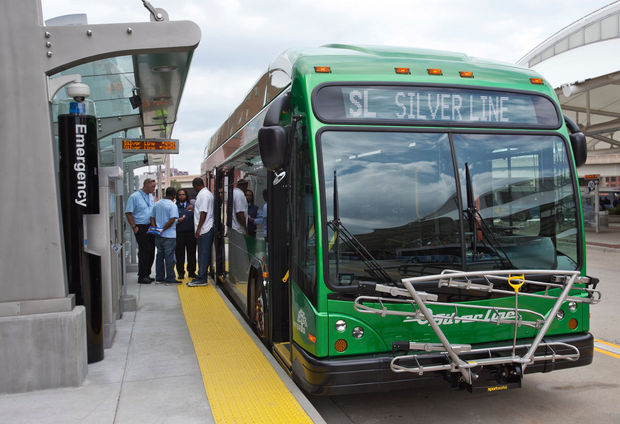
Drivers prepare get on a new Silver Line bus during a training exercise in Grand Rapids Monday, Aug. 18, 2014. (Cory Morse | MLive.com)

From the second-floor of The Rapid’s headquarters in downtown Grand Rapids, Conrad Venema looks out at U.S. 131 cutting through the heart of the city.

The view offers a stark contrast of travel of old — mammoth concrete corridors designed for personal vehicles — against what transportation planners like Venema see as the future with shared rides that reduce potential gridlock and speed movement.

And just as highways helped spur the region’s growth for years, West Michigan leaders are confident this week’s launch of the $40 million Silver Line Bus Rapid Transit system — the first of its kind in Michigan — will play a central role in the next wave of economic, housing and transportation development.

The 9.6-mile line that connects the center city and the Medical Mile with its southern suburbs of Wyoming and Kentwood, supporters say, offers an efficient alternative by cutting a typical 45-minute drive to a 27-minute commute.

“We’ve designed this to attract the choice rider,” Venema said of people who can select their method of moving around the area. “We finally have a transportation mode that’s competing with the car.

“This is part of Grand Rapids growing up. It’s a bigger city, and it’s a bigger project.”

Some aren’t as optimistic and say the route isn’t nearly as transformational as advocates claim.

In fact, Jeff Steinport from the Kent County Taxpayer’s Alliance alleges the Silver Line is a spending boondoggle that duplicates public transportation routes already available through The Rapid’s traditional bus system. He also claims it is unlikely to speed traffic for those on the bus or for those still driving, particularly along Division Avenue, the main corridor of the line.

“A quarter of existing routes are faster…it’s not really that big of an improvement,” Steinport said.

The experiment starts Monday, Aug. 25, with a week’s worth of free rides to entice people to give the Silver Line a try, but the test of the system’s necessity and its ability will be over years, not months.

According to the National Transit Database, The Rapid’s passenger trips for 2012 climbed to 11.9 million, up from 10.8 million rides in 2011 and 9.7 million in 2010. Venema sees those numbers growing with Silver Line serving as an addition and complement to current service, but he admits some of those riders might choose to move within the system.

Steinport doubts Silver Line will make the splash its supporters claim.

“The Rapid’s busiest Route 1 already serves Division, and ridership numbers rose by about 5 percent from September 2011 to 2012 then fell by the same amount the following year. It’s unrealistic, at best, a new bus along an existing route would add development,” Steinport said.

“It seems they’re reaching the point of saturation. You’re going to run into the limit where the route covers.”

Rapid officials insist the service eventually can serve at least 5,000 riders each weekday. According to the agency’s latest figures, April 2014 saw about 2,900 daily passengers on Route 1.

A FUTURE INVESTMENT

Grand Rapids’ system hopes to replicate the success the BRT has in Cleveland, which served as a model and stimulated about $5.8 billion in development since 2008. Officials are certain there will be growth because of the Silver Line, but they note the size of the boon in West Michigan remains uncertain.

“It’s a well-informed bet based off of other bus rapid transit systems across the country and the economic development that has spurred,” said Suzanne Schultz, Grand Rapids’ planning director, pointing to Cleveland’s Euclid Avenue Health Line.

“Cleveland now is a poster child…you have a high concentration of employment and education,” said Schultz, referencing similarities between the cities medical schools and hospitals. “It really serves as the anchor to draw people into the transit system.”

The Silver Line equates to roughly $3.5 million to $4 million per mile of investment, Venema said. Grand Rapids’ Downtown Market, Van Andel Arena, DeVos Place, Grand Rapids Community College and many more housing developments and eateries lie on the route’s northern end and the hope is that the growth spreads southward.

Jerry DeGood, vice president of the Division Avenue Business Association admits there’s more to be desired along the route outside a scattering of fast food restaurants, car lots and thrift stores. He knows the area well, having been an owner of a used car dealership on that stretch for more than 25 years.

He sees the Silver Line as a worthwhile gamble, a bet the community can afford to take.

“The perception is that they’ve done this in other communities, and the positives have outweighed the negatives,” DeGood said. “Businesses have gone up; property values went up; apartment and condos go under construction.

“History has shown in the majority of other BRT projects across the country, it’s worked. We’re just hoping it falls in line, here, and we have our turn at it.”

About $32 million sourced from the federal government — the largest piece of Silver Line funding — in October 2012 turned the project from concept in 2003 to reality more than a decade later.

That amount rests atop about $7.9 million from the state and $15.3 million generated annually from a May 2011 millage, with one-third helping to pay for Silver Line operational costs, including driver salaries and diesel fuel when the buses’ electric motors begin to switch over past 25 mph. That millage was passed by a slim 136-vote margin. At the time, critics complained the tax would be collected from property owners in six cities, but the Silver Line would pass through only three municipalities.

The Rapid CEO Peter Varga said the project’s $40 million total cost is roughly 10 percent under budget, though final calculations still are being determined.

GET THERE FROM HERE

The route begins at the system’s Central Station along Grandville Avenue, weaves its way through downtown’s main corridors of Monroe Avenue and Michigan Street before intersecting Fulton and Wealthy streets. The line will pass down Division Avenue and turn around at 60th Street.

A bus rapid transit service boils down the time of the trip when compared with a traditional bus system and allows riders to be productive while on the go, Venema said. The buses have technology that keeps traffic lights green, enabling the driver and passengers to cruise through intersections. Riders can use Wi-Fi capability — a function that won’t be immediately available due to a vendor snafu — while moving.

Imagine a commute, Varga says, without the worry of being caught in traffic or having to find a parking space. The trip gets faster when rush hour bus-only lanes take traditional traffic out of bus drivers’ sight. The right lanes in some portions of the route will be only for buses, which will stop at each station every 10 minutes. Riders can monitor the system with real-time arrival and departure times.

“When you start putting all these layers on top, that totally separates it from your regular bus,” Venema said. “That’s when you start having that competitive edge.”

A ride on the Silver Line will cost $1.50, the same as a regular bus trip, with options to buy passes for two weeks or a month at a time. Rather than paying a driver or at the central station, passengers will be on an honor system and able to pay for fares at kiosks resembling an ATM at any of the stops.

While the Rapid will have spot fare checks, leaders are confident most will pay. Research by Transit Cooperative Research Program that found nine out of 10 passengers pay when bus drivers aren’t collecting fares upon boarding.

And fare-jumping won’t be cheap with $65 fines for the first offense and higher penalties for additional offenses that quickly climb above $200.

There also are consequences for vehicle drivers who don’t follow the bus-only lane regulations, with a ticket costing a minimum of $110 and adding two points on an operator’s license.

THE FUTURE

The Silver Line, supporters say, is positioned to move people along its route and benefit the communities it serves, though only time will tell how successful it becomes.

While this project is Michigan’s first such BRT line, a 12-mile “Laker Line” between Grand Valley State University and downtown Grand Rapids on Lake Michigan Drive could be its second. Transit officials currently are conducting a $600,000 grant-funded study to determine how much the project would cost and what it ultimately might look like upon completion.

That project combined with the Silver Line could create additional opportunities for the region and help offset a potential traffic crunch, Schultz said.

“Given that Grand Rapids is a regional employer, we have about 50,000 people who are either employees or visitors within a square mile,” she said. “Having everyone drive their own vehicle is not going to be the answer if we’re going to have economic development.

“If we did not do some sort of improvement for transit, bikes and pedestrians, everything comes to a stop.”

Source: http://www.mlive.com/news/grand-rapids/index.ssf/2014/08/striking_gold_with_silver_line.html

More coverage in The Grand Rapids Press/M-Live.com:

http://topics.mlive.com/tag/silver-line/posts.html