All posts by admin

Che sorpresa ti aspetta nel vivace casinò lazybar: generosi bonus, giri gratuiti e una selezione di giochi colorati renderanno la tua serata fantastica.

Comments on Michigan Mobility 2045 State Long Range Transportation Plan

Comments on Michigan Mobility 2045
State Long Range Transportation Plan

submitted by

Michigan Association of Railroad Passengers (MARP)

John Guidinger, Chair
February 4, 2021

The Michigan Association of Railroad Passengers (MARP) is pleased to have this opportunity to comment on the Michigan Mobility 2045 State Long Range Transportation Plan.

Our comments follow the order of the subjects addressed in Item 4 in the agenda for our meeting and interview on this date. They are limited to passenger intercity rail, commuter rail, and Thruway bus matters. We are not addressing the currently severe effect of the virus pandemic on rail passenger service, because we believe this issue will be resolved soon.

OVERALL VISION

MARP wants to see a system of intercity trains that are modern, fast, reliable, and operate on frequent, regular-interval schedules to meet the travel needs of all passengers. On the corridor between Chicago and Detroit/Pontiac departures should be hourly or bi-hourly. The trains should connect all significant population centers in Michigan with other population centers in Michigan and centers throughout the United States and Canada. The system must be closely integrated with other means of public passenger travel to allow seamless transfer from one mode to the other and to promote travel into Michigan. We believe that the reduced dependency on road travel will bring enormous economic benefit to Michigan through the rejuvenation of the downtown areas of our cities, increased tourism, expansion of rail-oriented industry, and a less hectic lifestyle. These important societal advantages will accrue over road travel even when travel times are similar. Other advantages include reducing conflicts with urban and rural land uses, improving human mobility and convenience, reducing road congestion, decreasing the need for costly road expansion, increasing travel safety, conserving energy resources, reduction of impacts to air and water resources, and improving space utilization. We believe Michigan is in a unique position to optimize the return on assets from its ownership and previous investments in rail service, both passenger and freight.

CRITICAL PASSENGER ISSUES

Track and Right-of Way

  1. Continue the development of the Michigan Line Infrastructure and Safety Improvements Program as defined by MDOT. This is essential to develop a reliable, high-speed corridor for rail passengers traveling between Chicago and Detroit/Pontiac and on routes connecting to and from the corridor. We cannot over emphasize the importance of this program.


  1. Make critically needed improvements in two specific problem areas in Michigan in order to prevent delays for passengers traveling on the Chicago-Detroit/Pontiac corridor.
    1. Separate passenger trains and freight trains on the 1.8 mile section of Canadian National railroad at Battle Creek.
    2. Work with host railroads Canadian National and Conrail Shared Assets to reduce freight train interference between Dearborn and Pontiac. Improving fluidity of train movements will benefit both passenger and freight.
  2. Continue to work with Indiana and Illinois, Norfolk Southern, Amtrak, and USDOT to develop the federally designated high-speed corridor between the Michigan border and Chicago. Congestion in this area results in continual, lengthy delays for Michigan passengers. Removing this congestion will not only help rail passengers, but will also help speed rail freight movements and potentially draw trucks and autos off roads.
  3. Install a track connection northeast of New Buffalo to allow trains to/from Grand Rapids access to the high speed corridor and allow these trains to serve New Buffalo.
  4. Continue the ongoing program to separate or protect road/rail grade crossings. This is an important safety issue, especially as passenger train speeds increase. Grade crossings should be closed, grade separated, or protected by devices such as four quadrant gates, skirting/center line barriers, pedestrian barriers, and advanced warning devices.
  5. Fencing and cautioning signage should be installed in appropriate areas to prohibit crossing between station tracks, and reduce trespassing near stations, in yards, and on portions of the right-of-way deemed prone to trespassing.

Stations

  1. Continue to improve, rebuild, or replace passenger stations in order to improve the total passenger experience, consistent with the preservation and adaptive reuse of the remaining historic depot buildings. Provide multimodal facilities that support the complete end-to end journey, including suitable waiting rooms, restrooms, platforms, parking, lighting, multilingual signage, handicapped accessibility, emerging mobility access, and micromobility solutions.
  2. Initiate a program to install level boarding facilities, consistent with FRA and ADA standards, at the busiest stations to enhance the comfort and safety of all passengers as well as help keep trains on time.

Schedules and Frequency

  1. Establish train schedules to provide departures on the corridor between Chicago and Detroit/Pontiac once every hour during prime hours and approximately once every two hours at other travel times.
  2. Ensure that every possible effort is made to adhere to scheduled times of arrival and departure. This is critical to attracting and retaining passengers, particularly business travelers.
  3. Develop the Chicago-Detroit/Pontiac corridor to at least 5-6 round trips before initiating any new routes in Michigan. Once the corridor is running well with large numbers of passengers, support for new routes will be strong.
  4. Schedule at least one train to arrive in Detroit before 11 AM and one train to depart from Detroit after 8 PM. This will require either an overnight train, or trains leaving/arriving at Chicago at inopportune hours, or trains that originate and terminate in Niles, Kalamazoo, or (via Kalamazoo) in Grand Rapids.
  5. Develop train schedules that facilitate connections with other trains, intercity buses, and local transit for maximum passenger convenience.

Equipment

  1. Provide modern, well maintained coaches and improved on-board food service to make for a comfortable travel experience for the passenger. There should be a business class seating option. Provisions must be made for regular maintenance and mid-life upgrades for the new coaches coming online today, as well as planning for replacement of this equipment about 2045.
  2. Provide fast, safe, and reliable Diesel locomotives that meet or exceed evolving emissions standards. Evaluate the use of electrification of the Michigan corridor or the use of emerging power systems, such as hydrogen powered locomotives and multiple units. Provisions must be made for regular maintenance and mid-life upgrades for the new locomotives coming online today, as well as planning for the replacement of this equipment about 2045.

New Services

  1. Initiate through trains between Southeast Michigan and Windsor and between Port Huron and Sarnia to allow convenient and efficient travel between Canada and the U.S.
  2. Initiate Thruway bus services, such as those proposed by MARP between Ann Arbor, Dearborn, Detroit, and Windsor, to provide corridor train connections for Amtrak and Via trains terminating in Detroit and Windsor.
  3. Add service between Chicago and Grand Rapids on a route that operates on the corridor via Kalamazoo.
  4. Add service to the Blue Water route. Terminate at least one new train on this route in Bay City instead of Port Huron.
  5. Complete the required environmental and engineering studies and implement new service connecting Detroit, Ann Arbor, Lansing and Grand Rapids/Holland/Muskegon. Extend this route to Toledo to provide vitally important connections to the rest of the Amtrak system.
  6. Complete studies of the proposed excursion service between Ann Arbor and Traverse City/Petoskey and implement service. Consider the use of a private operator similar to

the operation of the Grand Canyon Railroad in Arizona and the Cumbres and Toltec Railroad in Colorado and New Mexico.

  1. Implement the long sought commuter rail service in Southeast Michigan, including service in the Detroit area, service to Detroit Metro Airport, and service on the Ann Arbor-Howell-Brighton route. MDOT should take the lead in implementing this service by working with all parties involved. In the Detroit area, trains may serve both the existing Amtrak Station and the former Michigan Central Station (MCS), which is currently under restoration by the Ford Motor Company. We strongly encourage study of the idea advanced by Ford that MCS become a multimodal center, an interchange point with rail, bus, streetcar and micro-mobility services and thus a catalyst for rejuvenation of the entire area around MCS.

Northern Michigan

  1. Continue state support for Thruway bus service to points in Northern Michigan and across the Upper Peninsula that make connections to transportation networks in Wisconsin and Minnesota. This will serve the mobility needs of underserved populations in rural areas of the state.

SUGGESTED MM 2045 PLAN CONTENTS AND MARP ASSISTANCE

MARP would like to see Final MM 2045 Plan contain:

  1. Specific goals for expanding existing or initiating new intercity and commuter rail service by 2045. These goals should include completion of all improvement and expansion projects already underway or in the planning process. The goals should also include the new projects listed above or other projects identified by MDOT.
  2. A basic timeline for implementing these projects. The timeline must be based on reasonable assumptions. Regular progress reports should be made to the public.
  3. A list of governmental funding sources to provide funding for these projects. The plan should assume that funding will be provided over the years from existing Federal, State, and local sources. In addition, careful study is needed to identify funding opportunities from existing programs that may not be normally associated with rail transportation and from anticipated future, and as yet undefined, governmental sources.
  4. An assessment of the potential for private funding. Corporate funding providers should be especially attracted to the development of real estate and station facilities as shown by the very successful private development of the new station at New Buffalo, as well as by the interest of Ford Motor Company in developing Michigan Central Station, and by the reported profitability of Amtrak’s Real Estate Division. The potential for other private funding should be explored in areas such as joint operations with private bus operators, providing food services, advertising in stations and in Amtrak printed materials, and in the sale of naming rights. Once the expansion of passenger services causes ridership to increase into the millions, private interest in funding other aspects of rail operations should come willingly, and relieve passenger operators from complete reliance on government funding.

Assistance to the Mission of MARP

  1. Establish an advisory committee within the MDOT Office of Rail. MARP, who represents rail passengers in Michigan, will be happy to participate without compensation. Other members of the committee could represent rail unions, freight interests, shippers, transit, urban planners, equipment suppliers, Thruway bus operators, etc. The committee should meet once or twice a year and make recommendations to MDOT on a variety of rail matters. Face to face meetings such as this should promote understanding between all parties and help MDOT assess the effectiveness of rail office programs.
  2. Keep the public informed of MDOT Office of Rail actions. For example, the Michigan Line Infrastructure and Safety Improvements Program is a major, multi-year project involving hundreds of millions of dollars, and over a hundred miles of railroad. We commonly see Amtrak trucks, equipment, and workers working on the railroad, and we note the large construction office in Jackson. But we see no public statements about the goals of the project or its progress. Attempted conversations with workers indicate that they are not allowed to talk to the “press.” We think MDOT and Amtrak should be proud of their work on this important project. We do not understand why statements from management cannot be given out on a regular basis as to the goals, progress to date, and anticipated future work. MARP suspects that there are other similar projects where at least simple press releases could be issued periodically.

Again, we sincerely appreciate the opportunity to provide our comments and suggestions for the MM 2045 Transportation Plan. Thank you

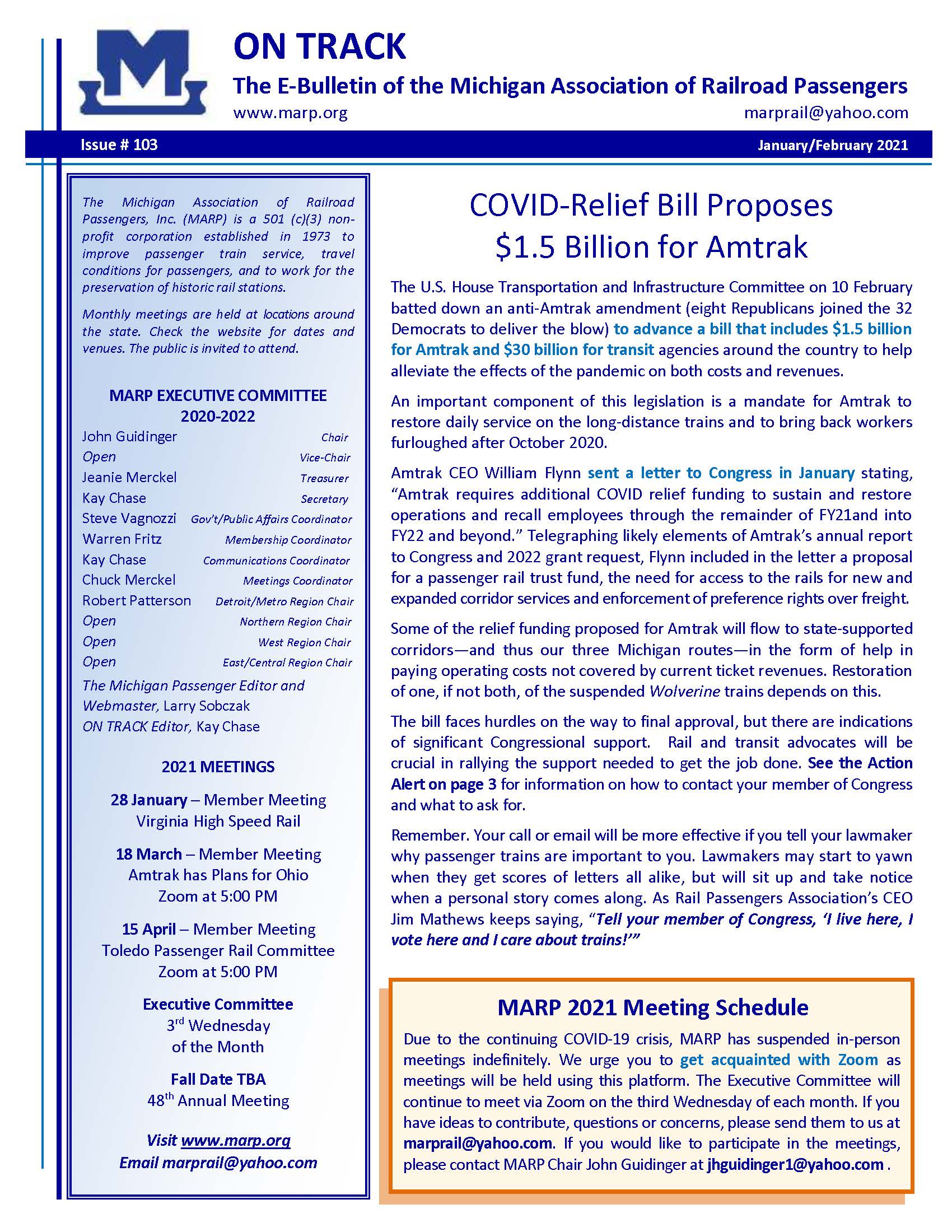
Join Us via Zoom on Jan. 28, 2021– Hear How Virginia is Modernizing Passenger Train Service

MARP Membership Meeting
Thursday, January 28, 2021
Begins at 5:00 pm Eastern Time
See Zoom Link Below

MARP Members and Friends are in for a treat as our guest speaker, Danny Plaugher, shares his enthusiasm about the many very exciting things happening with passenger trains in the Commonwealth of Virginia.

The online meeting via Zoom will begin at 5:00 pm Eastern Time on Thursday, January 28. All members and friends are encouraged to attend. Plan to join the meeting 10-15 minutes before the start time in order to allow time to resolve any problems with getting connected.

Use this link to Join the Zoom Meeting    https://us02web.zoom.us/j/5999785286?pwd=NEFCRm51TitCWDBhekZZWEE0SFU5UT09

Meeting ID:  599 978 5286

Passcode:  ARB351

To Join by Phone:  +1 312 626 6799 US (Chicago)

Our guest speaker is Danny Plaugher, who serves as executive director of Virginians for High Speed Rail (VHSR). He joined VHSR in 2007 and set to work to help create the Virginia Intercity Passenger Rail Operating and Capital Fund (IPROC), making Virginia the first state with a dedicated funding source for passenger rail.

In addition to his work with VHSR, Danny joined the Virginia Transit Association (VTA) in 2019 as deputy director to lead their policy and outreach efforts.

Danny serves on the Transportation Working Group for the Capital Region Collaborative, the board of RVA Rapid Transit, rail advisor for the RVA-757 Collaborative, and as treasurer of the Virginia Rail Policy Institute. He is also a former member and past President of the Rotary Club of Richmond, one of Virginia’s oldest service organizations.

He is a proud graduate of Virginia Commonwealth University (VCU) and was honored by his alma mater in 2016 as one of VCU’s Top 10 Graduates of the Last Decade and, in 2018, was named the first honorary member of VCU’s Pi Sigma Alpha honor society in the society’s 30-year history.

Danny lives in the West End of Henrico, bordering Richmond VA, with his wife Jan, son Benjamin, and two dogs, Jax and Lily.

For Help With Zoom
If you have not yet discovered the world of Zoom, it is a wonderful way to keep in touch with your organizations, friends and family members during this trying time. An excellent video guide to joining a Zoom call for the first time (it’s easier than you think!) is here:
https://www.youtube.com/watch?v=9isp3qPeQ0E

If you have any questions, please send us an email at marprail@yahoo.com .


SEE YOU ON ZOOM!

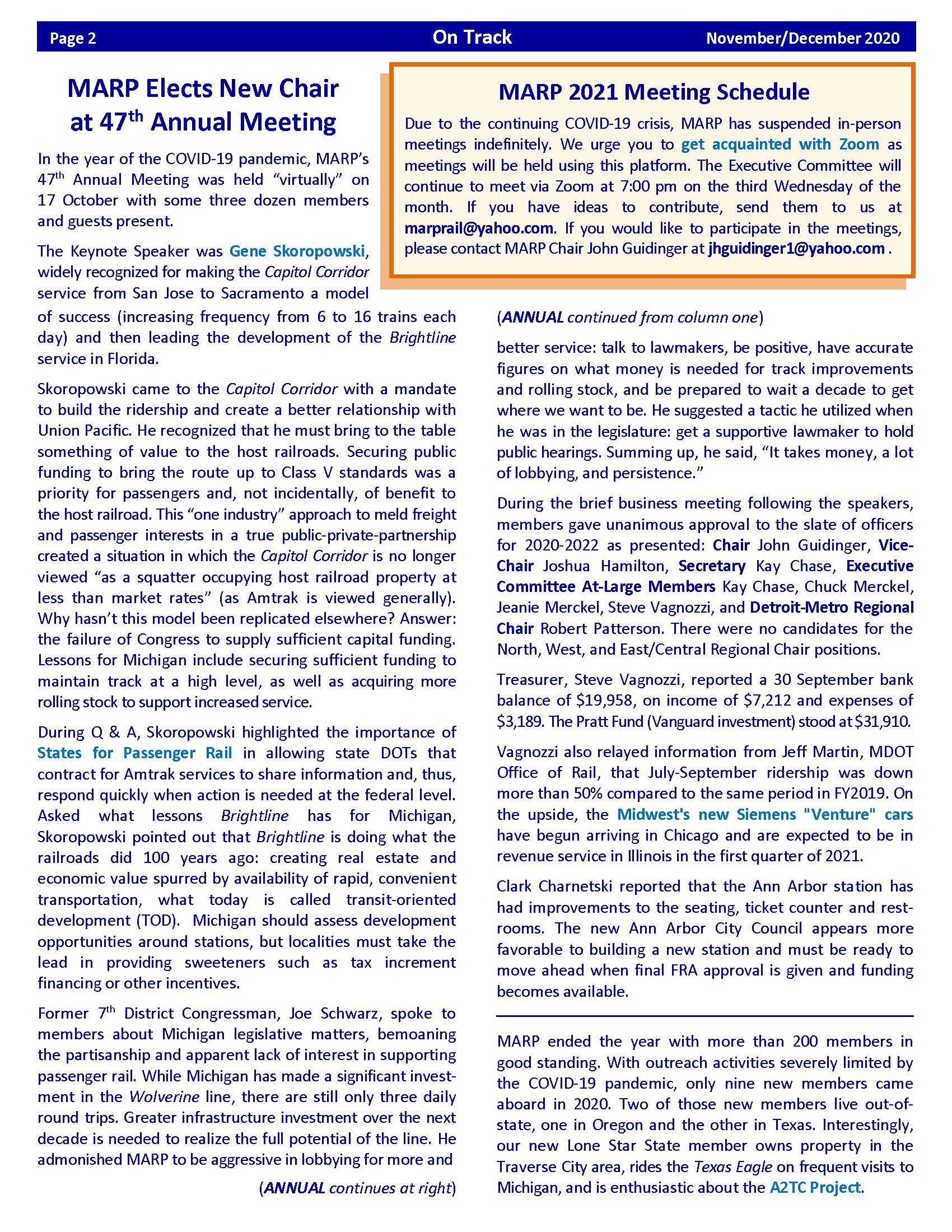
Join us for our 47th Annual Meeting via Zoom on Oct. 17

Michigan Association of Railroad Passengers
47t
h Annual Meeting
S
aturday, October 17, 2020
10
:00 a.m. –Noon

Featuring Gene Skoropowski
Former manager of California’s Capital Corridor
Former Sr. VP of Passenger Rail Development for All Aboard Florida

With the coronavirus still with us, this year’s Annual Meeting will be held “virtually” via Zoom on Saturday, October 17, beginning at 10:00 a.m. We hope you will all plan to be with us for what promises to be an outstanding program.

Our keynote speaker will be Mr. Eugene K. “Gene” Skoropowski who is widely recognized for making the Capitol Corridor service in California one of the best performing trains in Amtrak’s National Network. He recently spoke before the Virginia Rail Policy Institute on “Working Collegially With The Host Railroads”, describing how development of a good working relationship with Union Pacific was key to improving on- time-performance and increasing frequency on the corridor from 4 daily round trips to 16. He later moved to Florida where he led the organization and startup of the Brightline Express, the privately financed high-speed train linking Miami and West Palm Beach, with plans to extend to Orlando.

We will also hear briefly from former Congressman John J.H. “Joe” Schwarz, one of our state’s most enthusiastic supporters of passenger train service. Joe has worked, largely behind the scenes, during the administrations of Governors of both parties to keep our trains running. He will have something to say about how we navigate the perilous times ahead.

You will find information below for accessing the meeting via Zoom.

Following the speakers, we will conduct a short business meeting to elect officers for the

2020-2022 term. Please take a look at the attached minutes of last year’s Annual Meeting. There will also be an opportunity for member comments and discussion of MARP activities in the next year.

Plan to join the meeting a few minutes before 10:00 AM on Oct. 17 by clicking the link below:

https://us02web.zoom.us/j/84978467783?pwd=K1Z2OTF0WGkzcnFRZDVWWWVYcHFjQT09

Passcode: 166060

Webinar ID: 849 7846 7783

Or iPhone one-tap :

+13126266799,,84978467783#   or  +16465588656,,84978467783#

Or Telephone (for higher quality, dial a number based on your current location):

+1 312 626 6799 (Chicago)   or  +1 646 558 8656   or  +1 301 715 8592 or  +1 346 248 7799   or   +1 669 900 9128   or  +1 253 215 8782

International numbers available: https://us02web.zoom.us/u/kd8iZo9xk5

If you are unfamiliar with using Zoom, you will find this short video helpful.

How to Join a Zoom Call for the First Time
https://www.youtube.com/watch?v=9isp3qPeQ0E

The Zoom app will download automatically when you join your first Zoom meeting, and is also available for manual download here.   https://zoom.us/download

If you have questions or would like to request a “practice” session, reply to this email with your question/request.