All posts by admin

Che sorpresa ti aspetta nel vivace casinò lazybar: generosi bonus, giri gratuiti e una selezione di giochi colorati renderanno la tua serata fantastica.

Wayne County panel OKs $3 million for M-1 Rail

From the Detroit Free Press:
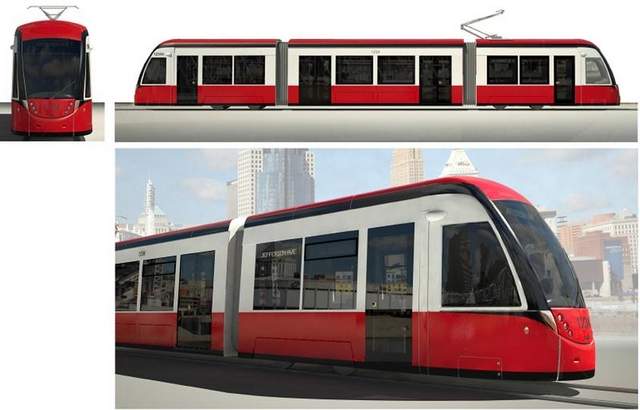
The M-1 RAIL Streetcars will be ADA compliant, have Wi-Fi and storage space for bicycles. The rendering is an example of what the streetcars could look like in Detroit once the system is operating in 2016. M-1 RAIL officials are checking out streetcars among the manufacturers who submitted proposals. . / M-1 Rail

A committee of Wayne County Commissioners approved $3 million in funding for the M-1 Rail project June 3, as construction of the $160-million project should begin within the next 60 days.

The funding, approved by the committee of the whole on a 10-5 vote and set to go before the full commission this week, will be split into $1.5 million coming during the current fiscal year, and $1.5 million during the 2015 fiscal year, which begins Oct. 1. County officials say the money has been earmarked for improvements to Woodward Avenue, where the rail system will run.

“We want it to be the foundation of a regional system,” said Matt Cullen, M-1 Rail’s CEO and president of Rock Ventures. “It’s going to be transformational.”

Project officials gave a little more insight on the specifics of the project today. The line will run on Woodward from downtown to New Center and will have six cars that will hold up to 100 people per car. During peak times, riders should be waiting only about seven to nine minutes for a car, said Sommer Woods, the director of external relations for M-1 Rail.

Officials expect ridership of about 6,000 daily; riders will be able to connect to DDOT and SMART buses, as well as the People Mover and the Amtrak station, which brings people to the city from throughout the region.

Some commissioners had trouble funding the county’s portion of the cost, saying conversations with constituents about road conditions show there are other more pressing transportation problems those dollars could help alleviate.

“They’re constantly being told there’s no money to fix our roads,” said Commissioner Shannon Price, R-Canton. “At the same time, you’re asking us for $3 million to fix a state road.”

Commissioner Martha Scott, D-Detroit, agreed, and said her district is rife with potholes that have not gotten any attention from county workers.

“I can’t support (funding M-1 Rail) … unless you guys get my roads fixed, too,” she said.

Commissioner Diane Webb, D-Dearborn Heights, said she’s received comments from her constituents about deplorable road conditions, but also sees the benefit of funding the M-1 Rail project.

“I think we have a responsibility to the greater good,” she said, adding that one year she would like to see the county address fixingthe worst roads in the townships, including Redford Township, which she represents. “This is going to be a great project for the region,” she said of the rail project.

Source: http://www.freep.com/article/20140603/NEWS02/306030173/Wayne-County-commissioners-M-1-Rail
3 sites under consideration for new Amtrak train station in Ann Arbor

From The Ann Arbor News:

The list of sites being considered for a new Amtrak train station in Ann Arbor has been narrowed from eight to three.

The three locations awaiting further review now include a stretch of track along North Main Street next to Argo Pond, the existing Amtrak site on Depot Street, and a parking lot on Fuller Road in front of the University of Michigan Hospital.

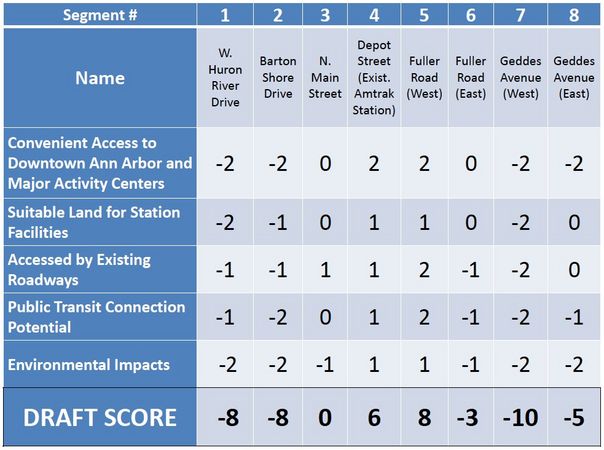
The sites were ranked based on the level of access they provide to downtown and other major activity centers such as the U-M Hospital and Central Campus, and the potential for connecting with other forms of public transit such as Ann Arbor Area Transportation Authority and U-M buses, and Greyhound.

The project team also took into consideration environmental impacts, accessibility from existing roadways, and whether there’s enough land for station facilities.

With those being the key considerations, the Fuller Road site ranked highest with a score of 8 on a scale from -10 to 10.

The Depot Street site had a score of 6, and the North Main site had a score of zero. All other sites had negative scores.

The city has hired consultant URS Corp. for $824,875 to lead the so-called Ann Arbor Station Environmental Review.

Robert Gorski, project manager from URS Corp., said during a public meeting Tuesday night the study is now entering Phase 2, which will include much more detailed analysis of the three sites, as well as conceptual designs. A final recommendation for a specific site, including a conceptual design, is expected by the end of this year.

The project team found that the North Main site is relatively close to downtown, but a station there would require displacement of some local businesses. And while Main Street is a major roadway, the only access to the tracks is Lakeshore Drive, a private road. There has been some talk of redeveloping the North Main corridor.

“There was a lot of discussion about the opportunity to redevelop this area,” Gorski told residents who attended Tuesday night’s meeting.

The existing Amtrak site on Depot Street also is close to downtown and key activity centers, but it might pose challenges in terms of available space, access to key features, and environmental impacts, the project team found.

It has been noted the area is flood-prone and parking is constrained, though the 14-acre former MichCon site next door remains vacant.

The project team found the Fuller Road site near the U-M Hospital is well positioned in the center of the community, but it has potential environmental concerns related to parks and open space impacts since it’s part of Fuller Park. Gorski said there also are some concerns about the topography, but it’s worth looking at it in greater detail.

The City Council voted unanimously in October to proceed with the current phase of work. A little less than $165,000 is coming from funds the city previously budgeted, with the rest covered by a federal rail grant the city accepted in 2012.

The $2.8 million federal rail planning grant also is expected to cover some additional future expenses if the project moves forward.

Final design of a new Amtrak station is identified as a $2.6 million expense in 2015-16 in the city’s Capital Improvement Plan. Construction of the new station is shown as a separate $44.5 million line item that same year.

Mayor John Hieftje has said he expects 80 percent of the funding to come from the federal government with other local partners potentially contributing funds. Ann Arbor residents get to vote on the project before any construction happens.

At the meeting Tuesday night, the city’s consultants talked about train ridership in Ann Arbor, noting there were roughly 155,000 boardings and deboardings at the Ann Arbor station last year, up about 70 percent from 2003.

According to projections shown at the meeting, that could increase to 969,000 by 2035-2040 if the three daily roundtrips are increased to 10 daily roundtrips. There also are projections showing 516,000 boardings and deboardings from future commuter rail service, potentially pushing total annual ridership up to 1.5 million.

The plan is to design a station with the capacity to handle growing ridership, plus allow dedicated space for buses to pick up and drop off passengers. There also are talks of including secure bicycle parking and maybe even a restaurant.

-bf34d327a070517b

Source: http://www.mlive.com/news/ann-arbor/index.ssf/2014/06/3_sites_under_consideration_fo.html

Group unveils design for new Ann Arbor train station on stilts above tracks

From The Ann Arbor News:

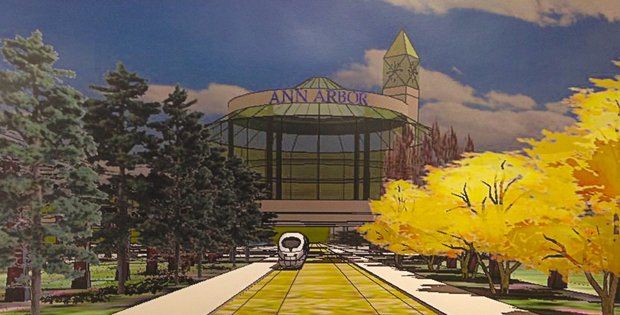
Depot_site_062414_RJS_03.jpg One of the renderings unveiled by Protect A2 Parks during a public meeting Tuesday night. It shows a new train station on stilts above the tracks along Depot Street.
One of the renderings unveiled by Protect A2 Parks during a public meeting. It shows a new train station on stilts above the tracks along Depot Street.

A conceptual design has emerged showing what a new Amtrak station could look like on stilts above the train tracks along Depot Street in Ann Arbor — on the same site as the existing station the city is considering replacing.

A citizens group called Protect A2 Parks, which has been lobbying against building a train station on city parkland on Fuller Road, unveiled a series of renderings during the public commentary portion of a meeting to discuss the project.

Ann Arbor resident Rita Mitchell, a member of Protect A2 Parks, presented the group’s drawings, identifying Mike Forgacs as the architect. The Sierra Club of Huron Valley has endorsed the group’s vision.

“Our goal really is to make sure that we use parks for parks,” Mitchell said, noting her group is opposed to building a train station on any city parkland.

“We want people to use transit, so we’re doing this in support of transit and trains, but we also want to use our parks as parks,” she reiterated.

As city officials have discussed the possibility of building a new Amtrak station for the last five years, a site on Fuller Road in front of the University of Michigan Hospital has been a continual front-runner. If the station goes there, it would take the place of what’s been a surface parking lot leased to the University of Michigan since 1993, though it’s also part of the city’s Fuller Park, and that’s caused some controversy.

“The place that looks like a parking lot right now — and is functioning as a parking lot — was one of the original parks in Ann Arbor,” Mitchell said. “It was actually also some original farmland in Ann Arbor, and it could be repurposed back to park use. You could expand the soccer fields right there. So we see that as a better option.”

City officials didn’t have a formal response to the group’s idea Tuesday night, but all comments that were made are being included in the public record and will be taken into consideration as the city and its consultants continue to evaluate possible sites.

“That is an idea, like many of the great ideas we heard tonight, that we will take with us as we move forward,” said city spokesman Robert Kellar.

In the coming months, the city and its consultants are planning to do further review of the Depot Street site, the Fuller Road site and another site on North Main street.

The conceptual design from Protect A2 Parks includes a new parking lot that also sits on stilts. Mitchell said it’s possible that a portion of the adjacent MichCon site could be purchased from DTE Energy if more land is needed for parking.

She said the renderings aren’t intended to be a fully fleshed-out plan, but rather a rough idea of what might be possible.

“The concept really is to go up and use the footprint that you can, and address some of the problems,” she said, suggesting the raised design offers a solution to concerns about flooding and some of the limits of the site.

The drawings show a building with a lot of glass that would include a ticket office, passenger lobby, restrooms and other amenities.

Regardless of what kind of station gets built or where, if there are going to be double tracks, it’s going to have to go up and over the tracks, Mitchell said.

“The idea of this is to use the existing site to its fullest extent for service of the rail and for some parking that is possibly a little more than is available right now,” she said, “and to incorporate aspects of transit that would allow them to access this site, allow some parking immediately adjacent, and some drop-off service for people.”

Source: http://www.mlive.com/news/ann-arbor/index.ssf/2014/06/group_puts_forward_plan_for_ne.html

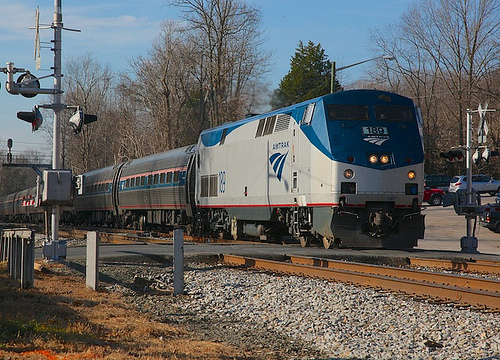
MDOT to study rail line that would connect Grand Rapids, Lansing, Detroit

From the Lansing State Journal:

8245480090_bbeb9f28cdThe Michigan Department of Transportation will study the viability of a passenger railroad line that would connect Holland to Detroit by way of Grand Rapids and Lansing.

The rail line may never materialize, but the study is the first official step by the state to create a new rail line connecting Grand Rapids, Lansing and Detroit. Those cities are currently not directly connected by passenger railroads.

“I would characterize this as the first step to even determine the viability/feasibility of such a service, and by no mean does this mean that we’re going to see rail passenger service running between these communities in any time frame,” said Tim Hoeffner, director of MDOT’s Office of Rail.

The study was mandated in the fiscal 2015 budget approved by lawmakers. The budget requires MDOT to submit a report to lawmakers by May 1, 2015.

Hoeffner said MDOT would likely hire a consultant to study socioeconomics in the communities along the proposed route and how people move between the cities to help determine potential ridership. If the study finds interest, Hoeffner said it would take “many, many years” and an allocation from the Legislature to build the line.

But Dan Sommerville, policy associate at the Michigan Environmental Council, said the route could be a natural choice for people looking for alternatives to road travel.

“Essentially, Detroit and Grand Rapids are the two largest metropolitan areas in the state, and right in the middle of that is our state capitol, and the only mode of transportation between those is a highway,” Sommerville said.

Rail ridership is on the rise. According to MDOT statistics, ridership on Amtrak lines in Michigan had climbed from 589,142 passengers in 1994 to 795,996 passengers last year. So far in 2014, 297,450 passengers have traveled Michigan railways.

The 2014 figures include 74,409 paseengers on the Blue Water line that connects Port Huron to Chicago, with a stop in East Lansing; 37,640 on the The Pere Marquette line that connects Grand Rapids to Chicago; and 185,401 passengers on the Wolverine, which connects to Detroit to Chicago.

Sommerville also said more than a dozen colleges and universities are within walking distance along the proposed route. That’s a potential gold mine of ridership as students travel home from college or travel among schools.

“This could be something that helps stem that brain drain and keep young people here,” along with other economic benefits and the aid to environment by having fewer cars on the highway, Sommerville said.

Hoeffner and Sommerville said residents had shown interest in a Grand Rapids-to-Lansing-to-Detroit line when MDOT sought public comment on its rail plan in 2010 and 2011. The Environmental Council, in partnership with the Michigan Association of Railroad Passengers, helped MDOT gather input through public forums held around the state.

Sommerville said a passenger line operated between Grand Rapids and Detroit, through Lansing, until 1971. He said tracks exist along that route that are currently used by freight trains and those tracks could be upgraded to handle the faster passenger cars.

Sommerville said he’s optimistic the route could be built because “MDOT’s taking an increased interested in passenger rail.” He pointed, for example, to the department’s recent purchase of and upgrades to rail line between Kalamazoo and Dearborn.

Amtrak, which runs passenger rail lines for the state, would be interested in taking on the new line “if it made sense for both of us,” spokesman Marc Magliari said.

Source: http://www.lansingstatejournal.com/apps/pbcs.dll/article?AID=2014306170052