All posts by admin

Che sorpresa ti aspetta nel vivace casinò lazybar: generosi bonus, giri gratuiti e una selezione di giochi colorati renderanno la tua serata fantastica.

Column: Railroads need funding, too

From The Detroit News:
From The Detroit News

We commend Senate Majority Leader Randy Richardville for introducing a plan to increase transportation funds across all platforms in Michigan, including infrastructure repairs to roads and bridges, investment in public transit, and vital improvements to our railroads.

Rail transportation is vital to Michigan’s agricultural economy, which generates more than $96 billion in annual economic activity, and supports one in four jobs.

Farmers need a reliable transportation network for moving their crops to market in a timely and cost-efficient manner. Without rail access, towns aren’t likely to attract major new agricultural facilities — and the jobs associated with them. State support for rail lines and crossings is vital to achieving that goal.

The Michigan Farm Bureau and the Michigan Railroads Association are joining with major business groups — including the Michigan Chamber of Commerce, Business Leaders for Michigan, and regional chambers of commerce including those in Detroit and Lansing — to add our voices to Gov. Rick Snyder’s call for major investment in transportation infrastructure, and to ensure that all aspects of that infrastructure are included.

This type of forward thinking is what we need to compete in an increasingly global economy. Such a plan would meet the needs of our state for years to come; that’s why it’s backed by business groups and environmental and transit organizations that recognize the time is now for funding long overdue structural repairs.

According to the U.S. Department of Agriculture, Michigan ranks 14th nationally in grain and oilseed production, and from 2006-2010 averaged 424 million bushels of crops, primarily corn, soybeans and wheat. Our state ships millions of tons of these crops by rail, saving on transport costs and reducing wear and tear on roads on our crumbling roads.

The math is simple: Failing to invest in our state’s entire transportation infrastructure hurts our ability to be competitive and keep agricultural jobs in Michigan.

We encourage lawmakers to work diligently in the coming days to create a legislative package that will meet our state’s long-term needs. That means major increases in transportation spending — and ensuring that the investment goes toward all of our transportation infrastructure. Such a move has the support of Michigan voters — including the agricultural community, which relies heavily on rail to get products to market.

Andrew Vermeesch is associate legislative council for the Michigan Farm Bureau.
Jon Cool is president of the Michigan Railroads Association.

WALLY group eyes diesel option

From The Livingston Daily Press & Argus:

usrailcarrenderingDiesel multiple-unit rail cars, or DMUs, have been suggested as an alternative to Washtenaw and Livingston Line rail cars, said Michael Benham, strategic planner for the Ann Arbor Transportation Authority, which oversees the WALLY commuter train project.

Benham said DMUs can be less costly to operate, although the cost of having personnel to run them could dash any savings. Only a few diesel rail cars have been approved for use by the Federal Railroad Administration.

The self-propelled, diesel-fueled cars are most common in Europe, Benham said.

“It’s out there as a possibility,” he said, but, “you can’t just put anything on the tracks.”

“As a planner, we need to know about these things. We need to be aware these technologies are out there,” Benham added.

DMUs produce 72 percent less pollution and 75 percent less noise than traditional rail cars and save on purchase and operating costs, according to the FRA’s website.

WALLY, first proposed in 2006, would create a commuter rail line between Howell and Ann Arbor on existing rail.

Source: http://www.livingstondaily.com/article/20140609/NEWS01/306090014/WALLY-group-eyes-diesel-option

Columnist: Gov. Walker’s train gaffe costing Wisconsin big time

From The Capital Times:

In this 2009 file photo, a model of a high-speed train is seen outside of a press conference where Gov. Jim Doyle announced Wisconsin's partnership with the Spanish train manufacturer Talgo. But after he was elected governor, Scott Walker nixed the plan.
In this 2009 file photo, a model of a high-speed train is seen outside of a press conference where Gov. Jim Doyle announced Wisconsin’s partnership with the Spanish train manufacturer Talgo. But after he was elected governor, Scott Walker nixed the plan.

It didn’t get a lot of press — two Milwaukee bloggers noted it — but Talgo, the Spain- and U.S.-based train manufacturer, closed its factory on Milwaukee’s north side last week and moved the last of its train sets out of town. They will probably be sold to Michigan.

The irony is that here was a manufacturing company that was enticed to Wisconsin thanks to a bundle of federal dollars but was chased away by a new governor who professed his main interest was creating jobs and making Wisconsin friendly to business. Yes, go figure.

Instead, he kissed goodbye several hundred jobs that would have been created in one of Milwaukee’s poorer neighborhoods and gave the federal government back $810 million that was to pay for expanding passenger rail service from Milwaukee to Madison and create roughly 4,000 construction jobs to boot.

It is not only one of the biggest financial blunders in the state’s history, but ranks high for its utter cluelessness. And its says volumes about the governor’s judgment.

Talgo is now suing the state for $65 million for the state’s reneging on its Talgo contract, and Wisconsin has to foot the bill for a multimillion-dollar maintenance facility and handicap accessibility upgrade at the Milwaukee station, all of which would have been covered by the $810 million federal grant.

These expenditures would have covered dozens of years of the supposed $6 million annual maintenance cost Gov. Scott Walker used as an excuse to scuttle the rail upgrade. As is the case for so many of his claims, that $6 million was inflated by a factor of 10. The actual cost to the state would have been more like $600,000. But there’s a reason Walker routinely gets “pants on fire” ratings from the fact-checking PolitiFact.

So here we are with a robust passenger rail service restricted between Milwaukee and Chicago and a one-train-a-day Amtrak whose only big-city stops in Wisconsin are in Milwaukee and La Crosse.

Perhaps that wouldn’t be so bad if it weren’t for the trends that are taking hold in the country, apparently unbeknown to those who run our state.

Newspapers around the country devoted nearly a full page to the topic last Sunday under a headline that read: “A love affair on fumes?” The Associated Press story was referring to the fact that America is driving a lot less these days, and where once 16-year-olds couldn’t wait to get their hands on the family car, less than 70 percent of 19-year-olds now have a driver’s license.

Some of the decline — 10 percent since 2004 — is attributed to greater reliance on bicycles, but there’s been an enormous increase in the use of commuter and passenger rail as an alternative to owning cars.

Further, according to the research group WISPIRG, many young people are opting to find jobs where they can get to work without owning a car.

But, no, we’d rather build more highways, spend a billion bucks on Milwaukee’s zoo interchange, and borrow money to pay for it.

That, folks, is a pretty poor plan.

Written by Dave Zweifel who is editor emeritus of The Capital Times. dzweifel@madison.com and @DaveZweifel


Ann Arbor working to narrow down a list of potential train station sites

From The Ann Arbor News:

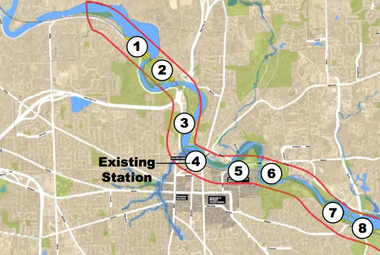
As city officials consider site alternatives for a new train station, eight locations along the east-west tracks that pass through Ann Arbor have been identified as meeting Amtrak's requirement that there be 1,000 feet of straight track.
As city officials consider site alternatives for a new train station, eight locations along the east-west tracks that pass through Ann Arbor have been identified as meeting Amtrak’s requirement that there be 1,000 feet of straight track.

The city of Ann Arbor has held a series of meetings in June to continue a public dialogue about a new Amtrak station in the city.

During the meetings, the city and its consultants presented analysis of eight potential sites being considered for a new train station, and will ask attendees to help narrow down the list and identify preferred sites for further evaluation.

City officials are looking into options for a new station with improved accessibility and accommodations to handle expected increases in passengers as high-speed rail between Detroit and Chicago takes off in the next two to three years and as a long-promised commuter rail service between Detroit and Ann Arbor potentially follows.

One of the sites under consideration is along Fuller Road in front of the University of Michigan Hospital, where the city previously developed a conceptual plan for a train station and a large parking garage for the university.

That plan was scrapped two years ago after funding assumptions changed and U-M moved forward with building a parking garage on Wall Street.

As part of the new site selection process, the city is considering everything from sticking with the existing Amtrak station on Depot Street to redeveloping the Depot Street site or building a new station elsewhere.

The first of the eight rail segments shown on the map is along the south side of Barton Pond. Going east, other sites include where the tracks cut along the north edge of the Barton Nature Area, along Bandemer Park and Argo Pond, the existing Depot Street site, along Fuller Road in front of the U-M Hospital, another stretch of track next to Mitchell Field east of the hospital, and two spots in and adjacent to Gallup Park.

The planning study being done right now is expected to culminate with production of a conceptual design for a new or enhanced train station/intermodal facility in Ann Arbor, as outlined in the city’s 2009 Transportation Plan Update. In the end, city officials said, voters or their representatives will decide whether a new train station or improvements to the existing one on Depot Street is in the city’s best interest.

The project team is expected to work on drafting a conceptual plan in August and September, with more work following from October into December to finalize the concept. Another round of public input sessions will be held at that time.

Additional project information, including notes and presentations from previous meetings, can be found at www.a2gov.org/annarborstation.

Source: http://www.mlive.com/news/ann-arbor/index.ssf/2014/06/city_working_to_narrow_down_li.html

Brand-new passenger trains roll out of Milwaukee

From the Milwaukee Business Journal:


Photo from Talgo.
Photo from Talgo.

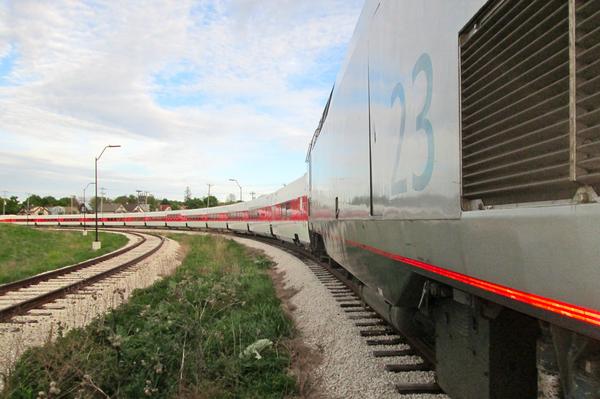
Talgo Inc. recently rolled two passenger trains out of Milwaukee and sent them to the Amtrak Beech Grove facility in Indiana to save money.

The company soon will terminate its lease for a city-owned building that, in 2010, was envisioned to be the hub of Talgo’s U.S. train manufacturing and the anchor to draw more companies to the former Tower Automotive property on Milwaukee’s north side.

“It is regrettable that we have to move out of Wisconsin,” said Nora Friend, Talgo Inc. vice president of public affairs and business development.

The contract between the state and Talgo for those two trains remains the focus of a dispute. The state originally commissioned the trains to run on the Amtrak Hiawatha line between Milwaukee and Chicago. Talgo officials anticipate they will sue the state for damages over that contract, Friend said.

Talgo is moving them to an outdoor facility in Indiana to save money on rent and personnel costs, Friend said. Talgo is trying to sell the trains and is in discussion with several states, she said.

“The ownership of the trains is not in question,” she said. “That is why we are moving the trains out of the state of Wisconsin and are trying to mitigate damages and are basically trying to find a home for the trains.”

Source: http://www.bizjournals.com/milwaukee/news/2014/05/29/talgo-trains-roll-out-of-milwaukee-ending-the.html