Che sorpresa ti aspetta nel vivace casinò lazybar: generosi bonus, giri gratuiti e una selezione di giochi colorati renderanno la tua serata fantastica.
MARP Member Meeting Saturday, June 14, 2014, 10 a.m. – 1:00 p.m. Former GTW Depot, now the REO Town Depot Board of Water & Light 1205 S. Washington Ave Lansing MI 48910
Lansing Mayor Virg Bernero delivered his 2013 State of the City address in the newly restored Grand Trunk Western depot adjacent to BWL’s new REO Town power plant. / Courtesy photo
MARP will be among the first community groups to enjoy the recently completed restoration of the historic Grand Trunk Western Railway Station in Lansing. Built in 1902, this classic Spier & Rohn-designed building hasn’t seen service as a passenger station since 1971 and was 4 years into its life as a restaurant when Gerald Ford dropped by for lunch during a whistle stop campaign tour in 1976.
The building has been painstakingly restored in conjunction with the development of the new Lansing Board of Water & Light cogeneration plant with which it shares the 5.3 acre site in the area known as Reo Town. The depot is listed on the State Register of Historic Sites and the National Register of Historic Places.
The BWL spent more than $2.8 million restoring the depot to serve as the home for board meetings and employee training. From its terra cotta roof to the dark wood ceiling, period light fixtures, windows, walls and wainscoting, the restoration has been described as “stunning”.
Two design firms, Ann Arbor’s Quinn Evans and Cornerstone of Grand Rapids, shared the design work on the restoration. Two Lansing-based companies, Granger Construction and Christman Co., did the exterior and interior work, respectively.
The eye-catching terra cotta roof involved a bit of serendipity. The tiles were 110 years old and needed to be replaced. The original manufacturer — Ludowici Roof Tile Co. of New Lexington, Ohio, a 120-year-old company with roots in Renaissance Rome and still in business — had the original plans for the depot and produced 14,600 new tiles to the original specifications.
Following the meeting, please plan to socialize over lunch at Clara’s Lansing Station, another of Lansing’s historic railway stations, at 637 East Michigan.
Michigan Association of Railroad Passengers
*******
Read the Lansing State Journal article by Steven R. Reed here.
The $182 million-fired REO Town cogeneration plant was completed in mid-2013, producing affordable electricity and steam while significantly reducing the emissions associated with burning coal. BWL’s general manager Peter Lark has said, “We believe we have the cleanest, most efficient electricity-and-steam-producing unit in the country”.
REO Town, just south of Downtown Lansing, is at the core of Lansing’s automotive history and is one of Lansing’s revitalized gems. The commercial corridor and three neighborhoods of Moore’s Park, Fabulous Acres and River Point make up Reo Town. These distinct neighbors surround the former R. E. Olds Motor plant which was the backbone of Capital region labor in the early 1900’s.
The long-delayed Indiana Gateway rail project will be kicked off by Gov. Mike Pence and other officials on Thursday, which will lead to $71.4 million in construction projects during the next two years.
The Indiana Department of Transportation and Federal Railroad Administration on Tuesday confirmed the Indiana Gateway finally has the green light, with some work already underway.
The Federal Railroad Administration, Amtrak and INDOT declined to say much more on Tuesday, saying most details would be forthcoming Thursday at a news conference at the Hammond-Whiting Amtrak station.
The Indiana Gateway project was first announced in January 2010 as part of the Obama administration’s nationwide high-speed rail initiative. In all, $8 billion in funding was announced for projects, including $2.6 billion for Midwest projects centering on Chicago.
One of the larger individual projects within the Indiana Gateway will take place at Porter Junction, where 14 Amtrak trains and 90 freight trains cross paths daily, often leading to long delays, according to the INDOT application for the project.
Materials have been ordered and construction work will start soon at the crossing just south of the small town’s historic downtown. It should be completed next year, said INDOT spokesman Will Wingfield.
The Porter Junction currently stands as a roadblock to instituting high-speed service between Chicago and Detroit, a project that has won hundreds of millions in federal funding.
The Indiana Gateway work was first delayed as Norfolk Southern, Amtrak, the Federal Railroad Administration and INDOT negotiated over the best way to reconfigure tracks. In September 2012 a deal was finally struck, but there has been little construction work done up until now.
The Indiana Gateway was the only Indiana project approved under Obama’s high-speed rail initiative, which was a key part of the administration’s stimulus effort to lift the U.S. economy out of the Great Recession. The project will create some 700 construction jobs, according to INDOT’s application.
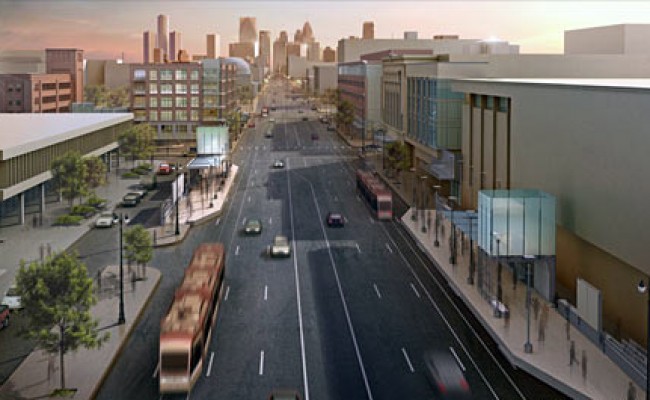
Here’s an artist’s rendition of the proposed streetcar line on Woodward Avenue in Detroit. (From M-! Rail.)
The M-1 Rail project is inching closer to reality, organizers say, with a groundbreaking planned this summer that will rebuild a portion of Woodward Avenue and add sleek streetcars.
Officials won’t reveal when construction will begin — the road will be completely rebuilt from Adams past West Grand Boulevard. But they say they are down to a couple of vendors to build the streetcars and are close to securing the $140 million of mostly philanthropic money needed for the public-private project.
After six years of debate, delays and changes, M-1 Rail officials and others say the 3.3-mile route that once was considered to extend to Eight Mile and connect to other rail lines could be the catalyst to jump-start alternative modes of mass transit and convince a dubious public these types of projects can get done.
“Once it’s up and running, it will be over the top,” said Paul Childs, chief operating officer of the project, which will have 12 stops and 20 stations (at four stops, trains in both directions will share a station). “We’re confident about that.”
Only utility work has been done along the route. And there have been plenty of hiccups — such as scaling back a plan to extend the route to Eight Mile — even with the financial backing of business titans such as Roger Penske and Dan Gilbert.
Pat Baldwin of Detroit said she would use the streetcar to help get to and from work. She has seen many transportation plans start with great interest and then fizzle. She’d love to see the line eventually extend to Eight Mile and beyond.
“I’m sure they’ll build the first phase,” she said. “It kind of reminds me of the People Mover situation. It kind of goes nowhere, but it goes just a little somewhere. And the idea was to have it expanded and it never did. I just don’t want the M-1 Rail to get stuck like that.
“I think some powers that be are resistant to having mass transit,” she added. “I don’t think we can become a true cosmopolitan city without it.”
False starts and challenges
Matthew Cullen, president and CEO of Rock Ventures and a member of the M-1 board of directors, said the project will happen. But he understands how people who have heard much about the M-1 over the years could doubt that streetcars, which once were common in the city, will ever get done.
“I don’t blame people for being skeptical,” Cullen said. “The way you overcome that is to get it done.”
Childs said the goal of the streetcar line was always intended to be shorter, but at some point in the future it could be extended. Along with working with the federal, state and city officials on everything from permits to underground and utility work, M-1 officials have been coalescing residents and business owners in anticipation this project will happen.
“With any project, you always wonder if you’re going to get to the end,” Childs said. “But you come on to a project like this, particularly these public-private partnerships, with the firm belief that your vision’s going to come to fruition.”
The streetcar concept, executed successfully in such cities as Portland, Seattle and Minneapolis, took root in 2007 with business and others leaders who wanted to better connect downtown Detroit with Midtown and prompt business and residential growth along Woodward. The M-1 group was formed in 2008.
The road — or track — to creating this light rail trolley line was paved with challenges. There was support to extend the rail line nine miles to a light rail transit system and millions in federal funding went into the $500 million project.
But in 2011, with the city’s financial struggles and the fact that no regional transit agency was up and running, the effort died. The following year, the shorter streetcar route was revived with strong business backing.
Design hasn’t been chosen
The design of the streetcars has yet to be chosen, but they will be double-ended with doors on both sides with 12 stops through several stations that will be built to fit the aesthetics and historical value of the area. So each station will be sized and shaped differently, organizers said.
At the end of each stop, the trains won’t turn around; rather, the trolley operator will move from one end to the other and drive it the other way. Some parts of the route will stop at stations and run in the center lane of Woodward while other parts will run along the right side of the road.
Megan Owens, the executive director of the nonprofit Transportation Riders United organization that advocates for improved mass transit in Metro Detroit, said there was a lot of doubt the project would see the light of day given all the funding struggles.
She admits “there is a perception of ‘I will believe it when I see it’” out among the public but Owens is “95 percent certain” the rail line will be operational in 2016 and sees it as “transformational” because it will undoubtedly kick start other transit projects.
“There’s still a possibility that something could fall apart but given the smart and powerful people behind it, they have certainly been doing an aggressive job of working through all the problems,” Owens said. “If something were to fall through, it would be really devastating.”
Owens said communication about the project has improved considerably because organizers have hired community liaisons to meet regularly with the public.
Cullen said the financial pieces are nearly in place as they are finalizing the remaining commitments for the money. Money is needed not only to build the rail line and rebuild parts of Woodward, but also to maintain the operation. “There are lots of moving parts, but we really are getting tremendous momentum now,” he said.
Anxious for operation
John Kewish has owned Grace Harper Florist in Midtown for decades. He’s heard the streetcar project talked about for years and never thought it would come to fruition.
Kewish said he’s elated the street will be repaved and other improvements are to be made but he’s worried about increased traffic and disruption during construction.
“I’m a little apprehensive on the whole thing and the real value of it, but I understand it’s going to bring a lot of people downtown,” Kewish said. “I’m well aware of the benefits of it, but I wish they’d make it go all the way to Pontiac.”
Leo Hanifin, a member of the M-1 board who has been studying and pushing for improved mass transit in Metro Detroit for years, said the trolley can give an economic and image boost to a city that has been mired in its own financial struggles.
But Hanifin also sees another potential benefit: selling mass transit to a skeptical region since M-1 is expected to be operational when the Regional Transit Authority plans to seek a funding referendum in Oakland, Macomb, Wayne and Washtenaw counties in 2016.
“If people can get a personal experience on (the M-1 rail) in southeastern Michigan, it will help them to form and develop an appreciation for the systems that people across the country are enjoying and benefiting from,” Hanifin said.
“There’s a different dynamic occurring in the city whereby business leaders and political leaders are cooperating far more than they have in the past and some of that is bearing fruit. And M-1 is a good example of that.”
In order for maintenance crews to accomplish track and signal improvements in the shortest time, Amtrak is temporarily changing schedules. The largest change affects the westbound schedule of Blue Water Train 365, westbound from Port Huron, from May 19 to August 31, 2014, but many other schedules are also modified.
Amtrak is adding additional trains to support travel on Sundays and Mondays this summer in Michigan while improving the infrastructure in West Michigan. The result will be improved reliability and a smoother ride.
As with all transportation modes, passengers should check for delays before heading to their boarding locations. We appreciate your patronage and apologize for any inconvenience. Thank you for traveling with Amtrak.
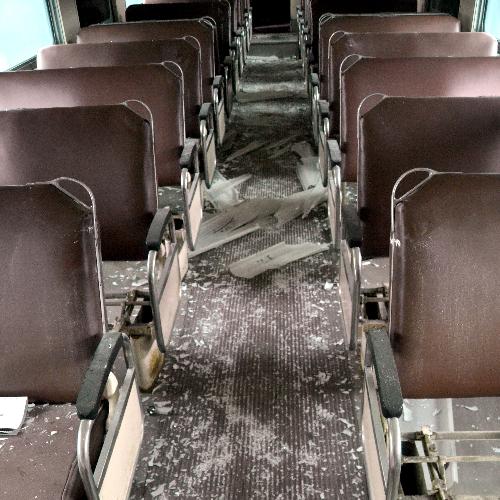
RICK CHARMOLI | CADILLAC NEWS Lights, seats and windows were found broken in the 17 passenger cars on tracks near the corner of North Mitchell Street and 13th Street. The damage was discovered by an employee of Great Lakes Central Railroad.
Railroad passenger cars that have sat for years on tracks in Cadillac have sustained damage amounting to hundreds of thousands of dollars.
Lights were broken and numerous windows and seats were damaged in the tall, silver passenger cars that sit near the corner of North Mitchell Street and 13th Street. A Great Lakes Central Railroad employee who was inspecting the cars noticed the destruction.
The cars were being stored north of 13th Street on tracks that run parallel to North Mitchell Street.
Seventeen passenger cars are stored on the tracks. Most of the lights in each car were smashed. Numerous seats and windows also were damaged.
An unknown number of suspects broke into the locked train cars, the Wexford County Sheriff’s Office reported.
Anyone with information is encouraged to contact the Wexford County Sheriff’s Office, 231-779-9211.