Che sorpresa ti aspetta nel vivace casinò lazybar: generosi bonus, giri gratuiti e una selezione di giochi colorati renderanno la tua serata fantastica.
Note: As it currently stands, trains, transit, and non-motorized travel nodes will receive no increased funding from the $450 million transportation funding package that passed out of the House last week. The bills now go to the Senate, so the time for ACTION is now. If you can’t get to Lansing, please phone in to the number in the message below. There may be a “Go To Meeting” set up online. Contact either of the two people at the bottom of the page. Feel free to forward to others interested in trains, transit, and non-motorized transportation modes
To: Parties interested in MDOT Comprehensive Transportation Funding
Re: Meeting to help advocate for CFT inclusion in current transportation funding package
Michigan Public Transit
Association and the Michigan Environmental Council will host a meeting and conference call/Go To Meeting event for all interested parties at 3:30 p.m. Thursday, May 15th at the offices of the Michigan Municipal League.
The purpose of this meeting is to coordinate advocacy efforts to assure all new transportation money go through the current funding formula. This will ensure that recipients of CTF funds, including public transit, will benefit from the changes being considered in the Legislature.
Gov. Rick Snyder’s office has expressed its support for this concept; now we need to work to make it happen, using our lobbying, grass roots and communications assets. If you cannot attend, you can access the meeting by a conference call at 1-888-812-9637, passcode 548-270-63-22#.
We will be determining whether we need to use the Go To Meeting tools between now and Thursday, so keep an eye open for additional emails on that topic.
The proposed agenda is straightforward. Our goal is to hold this meeting to under 1 hour.
Welcome, discussion of current situation: Clark Harder, MPTA, others.
Desired outcome: Dennis Schornack, Gov. Rick Snyder’s Senior Strategy Advisor
Assets available discussion: David Waymire, Martin Waymire
Assignments: All
If you feel an organization should be included in this email, please feel free to invite them to Thursday’s meeting.
For more information, please contact David Waymire or Jessica Tramontana of Martin Waymire at 517-485-6600.
We hope you enjoy the issue and that you will let us hear your comments and suggestions. If you would like to write a story or suggest an item to be covered, email us at marprail@yahoo.com
For those without a PDF reader, click on the images below to view them full screen.
A More Buses campaign supporter wears a shirt showing his support at Aut Bar in Ann Arbor’s Kerrytown on election night, May 6, 2014. Patrick Record | The Ann Arbor News
“More buses! More places! More often!”
That was the chant that echoed throughout Braun Court in downtown Ann Arbor Tuesday night, as dozens of transit advocates and members of the More Buses campaign celebrated the passage of a 0.7-mill tax increase to expand transit services in Ann Arbor, Ypsilanti and Ypsilanti Township.
The proposal passed in every precinct in Ann Arbor and Ypsilanti, and all but two precincts in Ypsilanti Township.
The final vote count was 13,949 to 5,783, a 71 percent showing of support for the Ann Arbor Area Transportation Authority’s proposal.
“The results are a vote of confidence by the community that we had the right plan,” said AAATA CEO Michael Ford, who said the winners are senior citizens, people with disabilities, workers, students and families who rely on public transit.
Mike Garfield, director of the Ann Arbor-based Ecology Center and one of the leaders of the campaign, declared victory shortly after 10 p.m.
“I think tonight, all of us — Ann Arbor, Ypsi city, Ypsi Township — we are one community,” Garfield said, drawing applause from supporters.
AAATA officials said planning and outreach efforts will begin immediately to inform residents about the introduction of new and expanded services that are scheduled to start in August, coinciding with the start of fall semester classes for local K-12 and college students. The AAATA also will move forward with planning to get additional feedback on the next phases of implementation of the agency’s five-year plan.
“We’re going to continue to engage the public and make sure that we’re informing them of what we’re doing and getting their additional input on some of the fine-tuning that we’ll obviously still need to do,” said AAATA Board Chairman Charles Griffith. “It’s going to be a lot of work, but we’re up for the task.”
The AAATA’s plan calls for expanding hours of bus service on nights and weekends, putting more buses on the road, and implementing new and redesigned routes, along with more frequent trips, improved bus stops, and expanded dial-a-ride services.
The majority of improvements will be phased in over a few years, starting this August with later hours of operation on just about every route, and more frequent trips on some routes. There also will be a new route in the Ypsilanti area this year.
In May 2016, a major redesign of the service in Ypsilanti and on the west side of Ann Arbor, including new and redesigned routes, is to be implemented.
The new tax will cost the owner of a $200,000 home an extra $70 a year for five years and is expected to generate nearly $4.4 million in new annual revenue.
That comes on top of a 2-mill tax Ann Arbor residents already pay and a 1-mill tax Ypsilanti residents already pay for AAATA service.
The AAATA will use the additional funding to increase service by 44 percent, including about 57,000 more service hours for Ann Arbor, nearly 8,500 more service hours for Ypsilanti, and at least 9,400 hours of new service for Ypsilanti Township.
That’s expected to require hiring 60 additional bus drivers and purchasing about 20 new buses, which AAATA officials said could take 18 months to order.
“We have every intention to try to get these services to people as soon as possible,” Griffith said.
Tuesday’s election marked the first time in the AAATA’s history that voters were asked to approve extra funding for public transit services beyond the annual financial support provided through the city charters in Ann Arbor and Ypsilanti.
An opposition group called Better Transit Now, which waged an aggressive campaign against the AAATA’s proposal, did not gather Tuesday night and could not be reached for comment. The opposition, which has characterized the AAATA as a bloated bureaucracy in need of right-sizing, had argued the AAATA could improve services by cutting staff and other costs and operating more efficiently.
But as Tuesday’s results showed, that message didn’t resonate with voters in the way the opposition had hoped.
Supporters of the More Buses campaign who spoke Tuesday night expressed hopes that the increased services would lead to greater connectivity between Ann Arbor, Ypsilanti and Ypsilanti Township and form a more cohesive urban core.
“Today we decided to stand together,” said Ann Arbor City Council Member Chuck Warpehoski. “We are moving forward together.”
Garfield said voters have made an emphatic statement that “we are one community” and that “public transportation connects us together.”
Ypsilanti Township Supervisor Brenda Stumbo said she looks forward to the increased transportation options for residents.
“I think it’s a game-changer,” she said, noting a lot of people commute from the Ypsilanti area to work in Ann Arbor, especially at the University of Michigan.
“It’s going to provide access,” she said of the service expansion. “And it’ll probably continue to grow and expand in the future.”
Ann Arbor Mayor John Hieftje, who did some door-to-door campaigning for the millage, called it a big victory for both transit and regionalism.
“This was probably the single most important action we could take to further the interests of our region,” he said. “I’m hoping the AAATA will continue to grow and Pittsfield Township would naturally be the next group to come in.”
In an email to supporters Tuesday night, Garfield said the plan is to continue to engage other communities such as Pittsfield, Saline and Scio townships. He noted they’re part of the urban core plan, but they still need to decide on their level of participation.
Garfield said Partners for Transit, the group behind the More Buses campaign, will stay engaged in other initiatives to enhance public transportation in the region, including the Ann Arbor Connector and the Southeast Michigan Regional Transit Authority.
The group also plans to monitor the AAATA’s implementation of the urban core expansion plan to make sure it best meets the community’s needs.
Garfield pointed out the millage campaign succeeded in the face of organized opposition and in a low-turnout election. He said the AAATA deserves credit for the extensive research and community input it conducted before placing the proposal on the ballot, and it also helped that dozens of groups and individuals throughout the three communities got behind the campaign, including business and religious leaders, elected officials, environmental organizations and civil rights groups.
Waleed Howrani, a 65-year-old Ann Arbor resident who says he’s proud to say he’s never owned a car in his life, was one of dozens of volunteers who went to work for the campaign. He said he distributed 120 brochures to targeted homes on his bicycle, and he informed many voters about the election while riding the bus.
“I was just making sure they were all aware of the vote. Some of them were not,” he said. “So when they would say, ‘No, I didn’t know about it,’ I would pull one of those fliers and I would give it to them and say think about it.”
Ypsilanti resident Ben Miller, another volunteer for the campaign, said he thinks there’s going to be a notable improvement in service, especially in the Ypsilanti area, and a lot more people choosing to ride the bus as a result.
“Not only is it increasing the frequency and how late the existing routes are running, but I feel like for Ypsi the most exciting part is the completely redesigned local routes, which are going way more places than before,” he said. “It just means a lot. It means Ypsi and Ypsi Township are now more integrated parts of the AAATA system.”
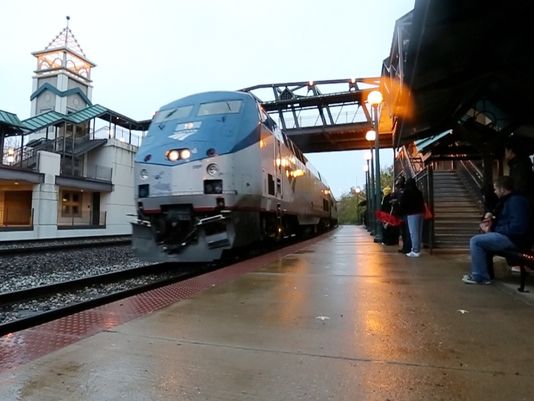
Passengers board the Hoosier State at the Amtrak platform in Lafayette. The state, Tippecanoe County, and the cities of Lafayette, West Lafayette, Crawfordsville, Rensselaer, Indianapolis and Beech Grove advertised for independent companies to submit plans to find efficiencies and close the gap between revenues and operating costs. Four groups submitted offers. (Photo11: File photo/Lafayette Journal & Courier )
The Indiana Department of Transportation has received four proposals to provide services for the Hoosier State Amtrak route between Chicago and Indianapolis.
The proposals were received in response to an open-ended request for proposals issued in early April by INDOT and seven communities that are helping subsidize the four-day per week Amtrak passenger train.
“It is exciting and interesting to receive four proposals that look at the Hoosier State passenger rail service in different ways,” said INDOT chief of staff Troy Woodruff. “This private sector interest opens the door for other states and regions that are supporting passenger rail service.”
The goal of the solicitation is to increase the number of passengers on the train and decrease operating costs by opening the operation of the train to competition from private operators in addition to Amtrak, according to INDOT.
One of those responding to the request was Iowa Pacific Holdings Inc., a company that operates a number of specialty passenger railroads including the Pullman Rail Journeys between Chicago and New Orleans.
Others submitting proposals were Corridor Capital LLC, of Los Angeles; Railmark Holdings Inc., of Wixom, Mich.; and Herzog Transit Services Inc., of Irving, Texas teaming with Passenger Transportation Specialists Inc., of Oklahoma City, Okla.
As the current provider of the service, Amtrak previously submitted its own proposal for 2014-2015, according to INDOT.
INDOT hopes to select a finalist by this summer and begin negotiations that could lead to some sort of public-private partnership, according to INDOT spokesman Will Wingfield.
INDOT was not divulging the contents of the proposals or even their thrusts on Monday. The request put out by the state in early April allowed bidders to submit proposals for everything from operating the train and route in its entirety to simply providing services on the trains like Wi-Fi or food and beverage.
The Hoosier State stops in Dyer and Rensselaer locally. Another Amtrak train operates on the route three days per week and proceeds on from Indianapolis.
INDOT and participating local communities are paying a $2.7 million subsidy to Amtrak to keep the Hoosier State running through this fall. That subsidy came about as a result of the Passenger Rail Investment and Improvement Act, which ended federal support of certain Amtrak routes of less than 750 miles.
INDOT said no disruption in the current service is expected as a result of issuing the request for proposals and tickets can still be bought for the Hoosier State through Amtrak.
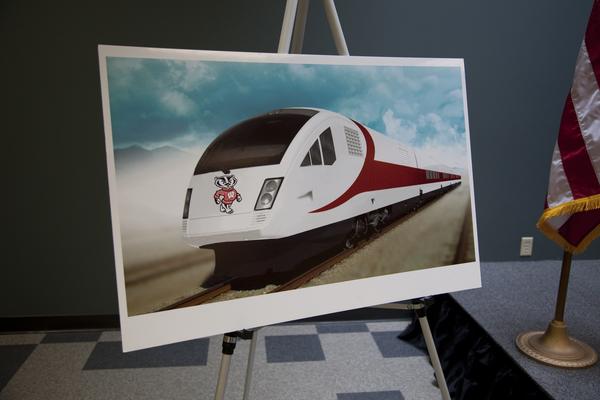
A rendering of Talgo’s Wisconsin high-speed trains
The Wisconsin Claims Board will make a decision by May 20, 2014 on Talgo Inc.’s claim against the state of Wisconsin over two trains the manufacturer will soon move from Milwaukee.
Talgo filed the claim in November 2013 against the state of Wisconsin, arguing it is owed $65.9 million over a disputed 2009 train-manufacturing contract. The trains were to run on Amtrak’s Hiawatha route between Milwaukee and Chicago, but the two parties have been locked in a debate over them since the Legislature denied money to build a maintenance facility for the sets.
The state Claims Board was scheduled to discuss the item in a private closed session today. The board will issue a written decision within 20 days, according to Patti Reardon, program and policy analyst in the Wisconsin Department of Administration Division of Legal Services.
The two trains have been in storage in a city-owned building Talgo is leasing in Milwaukee. The company now plans to move them out of the facility.


 To: Parties interested in MDOT Comprehensive Transportation Funding