All posts by admin

Che sorpresa ti aspetta nel vivace casinò lazybar: generosi bonus, giri gratuiti e una selezione di giochi colorati renderanno la tua serata fantastica.

Clare depot moves to new home

From The Clare County Review:
claredepot140425
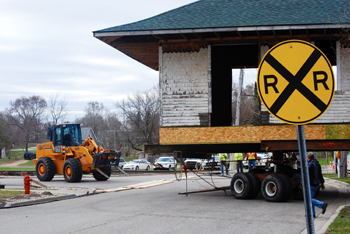
It’s not every day you see a depot going by at a railroad crossing instead of a train. Photo By Steve Landon

The 119-year-old Clare Railroad Depot was picked up off the old site and moved to a new home on April 25, 2014. During the 11 hour process, the building was moved approximately 900 feet east to its new home on Fourth Street across from the Clare Castle.

The Clare Union Depot has an interesting history in the area. It was constructed in 1887; destroyed by a fire in 1894; and rebuilt in 1895 by the Pere Marquette and Ann Arbor Railroads. It was used for passenger service on the Ann Arbor line until 1850 and by the Pere Marquette Line (then a part of the C&O Line) for a few more years and finally as a maintenance and administrative office by the T&SB, which is now The Great Lakes Central Railroad Company.

Efforts to save the depot began in 2005.

MMCAA partnered with the City in developing the Clare Castle, a senior housing development and senior center and that partnership continues in the planning for the development of the railroad-depot plans.
The City has also partnered with the Clare Downtown Development Authority, the Clare City Planning Commission, the Clare Chamber of Commerce, the Clare County Visitors’ Bureau, the Clare County Arts Council, the Clare City Parks and Recreation Department, the Pere-Marquette District Library, the Michigan Department of Transportation and the Clare Area Rail-Trail Committee.

Since 2005, the Clare Railroad Depot Committee has sought to move the building because of access, liability and safety issues associated with its current location on active tracks.” The estimated total cost for phase I of the project is $138,251.

The move is just the first step in what is still a multi-year project that will require at least an additional 500k in funding before the building is completely rehabilitated to become a community resource.”
Future uses planned for the historic building include a public trail-head and information center for the Pere-Marquette Rail Trail (US Bike Route 20); the City’s Chamber of Commerce Office and Clare County Visitor’s Bureau Office; a home for the Clare County Arts Council; and a community railroad museum.

As the primary studios and offices of the Clare County Arts Council, the site will serve as an art education and learning center, as well as an art market, thereby serving the cultural needs of local artists, residents, and visitors. The museum will preserve and display local railroad and logging history and heritage of the region.”

Check out a short video of moving day events.

Check out our album of pictures on the from the depot move on The Clare County Review  Facebook page

Source: http://www.clarecountyreview.com/news/featured-stories/depot-moves-to-new-home/
MegaBus canceling all non-Chicago-Ann Arbor routes

From M-Live.com:

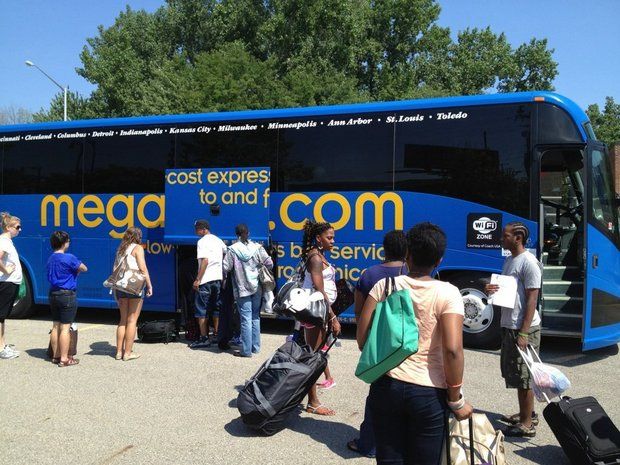
MegaBus is canceling all of its ride services on the Pittsburgh-Cleveland-Toledo-Detroit-Ann Arbor route starting May 6, 2014. (MLive.com File)

While Ann Arbor gained one form of transportation earlier this week with the launch of Uber, another form of intercity and interstate transportation will scale back its services in the coming weeks.

MegaBus, one of the largest privately funded providers of city-to-city bus transportation, announced that it will discontinue its routes going east from Ann Arbor, only continuing its Ann Arbor-to-Chicago route.

On May 6, MegaBus will no longer provide services from Ann Arbor to Detroit, Toledo, Cleveland or Pittsburgh.

Sean Hughes, the associate director of corporate affairs for Coach USA/megabus.com North America, said that ridership has been down on routes heading east from Ann Arbor, and that was the cause for the cancellation of those services.

“Unfortunately, due to insufficient, ridership service on the Pittsburgh-Cleveland-Toledo-Detroit-Ann Arbor route will be discontinued after May 6. Customers in each market will have access to other service routes,” Hughes said in an email.

“In Ann Arbor, customers will continue to have direct service to Chicago. There is always the possibility of resuming service on this route or adding additional service options to/from Ann Arbor in the future if demand allows.”

Hughes said that because of competitive issues, he couldn’t detail specifically how much ridership had decreased since the route between Pittsburgh and Ann Arbor started on March 14, 2012.

MegaBus originally launched its Ann Arbor service in April 2007.

Wayne State to study high-speed rail

360px-TGV_AtlantiqueWayne State University, in partnership with the University of Michigan and Drexel University, has launched a two-and-a-half-year study of the imagination—or l’imaginaire—of high-speed rail (HSR) in America. The study is part of a larger comparative international study piloted by Dr. Max Bergman at the University of Basel and led by French, American, South African, Indian and Chinese research teams that is exploring the role of the “imaginaries” in choices relative to train and rail infrastructures. In other words, the study will examine what motivates decision makers (both leaders and users) in regard to championing or using trains both in and of themselves and within the context of the future of transportation as a whole.

Funded and scientifically supervised by the Mobile Lives Forum, a research and prospective institute created by the National Society of French Railways (SNCF) to prepare the future of mobilities, the nearly $590,000 American study will examine the development and future vision of rail on the East Coast, in the Midwest and on the West Coast.

In America, HSR—which includes trains with top speeds up to 180 miles per hour—has been widely discussed in the four years since President Obama’s 2009 initiative. Some states and regions are planning HSR links, whereas others have rejected or cancelled HSR projects. Elsewhere—notably in France, England, Germany, Spain and China—HSR travel is a daily routine. For example, commuters travel the 200-mile, two-hour trip between Paris and Antwerp every day.

In Michigan, the Michigan Department of Transportation is conducting engineering and environmental studies of improving links between Southeast Michigan (including Detroit and Pontiac) and Chicago, in cooperation with planning authorities in Indiana and Illinois.

In California, advocates, decision makers and opponents at all levels of government await the first shovel of construction dirt to be turned. Numerous imaginaries of high-speed ground travel—including pneumatic tubes and other futuristic devices—have received considerable attention.

The Northeast Corridor—which runs from Washington, D.C., to Boston—is used by 2,100 passenger trains and 50 freight trains daily. Amtrak plans to expand capacity of the rail network to accommodate more trains operating at faster speeds and also develop a vision for the next generation of HSR (220mph). In consultation with stakeholders, a planning process is currently being led by the Federal Railroad Administration.

The study is led by Allen W. Batteau, Ph.D., a cultural anthropologist and associate professor of anthropology in the College of Liberal Arts and Sciences at Wayne State University. Co-investigators are Mimi Sheller, Ph.D., a sociologist at Drexel University and Director of the Center for Mobilities Research and Policy; Susan Zielinski, an urban planner and head of SMART (Sustainable Mobility Access Research and Transformation) at the University of Michigan; and Frederick Gamst, Ph.D., a member of the Brotherhood of Locomotive Engineers and Trainmen and former professor of anthropology at University of Massachusetts Boston.

A parallel study is underway in France, conducted by the Paris Diderot University’s Identités, Cultures et Territoires laboratory and the Passé Présent Mobilité association under the direction of Dr. Arnaud Passalacqua. Similar studies of the imagination of HSR are planned for South Africa and India.

“The motive force of high-speed rail in America is primarily the imagination: imagining that America might catch up with other nations,” said Batteau. “As with any technological breakthrough, the vision drives the engineered reality.”

“Cities all along the Northeast Corridor are aligning their growth plans in the context of expected investment in higher speed rail infrastructure; it remains to be seen whether this will come to pass or not, which makes this the key moment to study how railway futures are shaped,” says Sheller.

“In an urbanizing world,” says Zielinski “the imaginaire of trains (and the decisions we make about them) subsists in an increasingly complex universe of imaginaires not only of trains, but of the future of transportation. And not only of the future of transportation, but of how we want to live.”

Provided by Wayne State University

MDOT confirms its interest in Wisconsin passenger trains idled in legal dispute

From The Detroit News:

Michigan transportation officials are looking to buy or lease new passenger trains sidelined in a legal dispute between their Spanish manufacturer and Wisconsin.

A spokesman for the Michigan Department of Transportation confirmed officials contacted Talgo Inc. with a request for proposal for an undisclosed number of the trains to be used for at least three high-speed routes until state-of-the-art trains the state is buying arrive in 2018.

“We are examining the possibility of buying or leasing new equipment to run on Amtrak lines in Michigan until (we get) the new equipment that we have ordered,” MDOT spokesman Nick Schirripa said.

The trains that Michigan has an interest in sit unused in Milwaukee after Wisconsin officials and Talgo ended an agreement to use the cars. Talgo is suing Wisconsin after state officials accused the company of never completing promised work and suspended payment.

Nora Friend, the vice president of public affairs and business development in Talgo’s office in Seattle, said Wisconsin won’t be blocking the trains’ sale.

“There is no dispute in Wisconsin about who owns the trains and who has title to them,” Friend said in an e-mail to The Detroit News. “Talgo owns them, is free to see them and in fact, the state of Wisconsin will be more than happy if Talgo sells the trains to the state of Michigan or to any other state and entity interest in acquiring them.”

Friend did not say if Michigan is the front-runner to buy the trains or how long the process will take.

Peg Schmitt, a spokeswoman for the Wisconsin Department of Transportation, said “we are in litigation” with Talgo and have no comment about the trains or their sale.

One of the routes the Talgo trains would use would be the Wolverine from Chicago to Pontiac that stops in Detroit.

MDOT officials are looking to save money because federal subsidies to use Amtrak trains have been slashed, raising the state’s cost to operate the Wolverine route from $8 million annually to $25 million. That includes funding for two other routes that break off from the Wolverine.

Michigan is partnering with transportation departments in California, Washington, Missouri and Illinois to buy the new trains.

ACR passenger train has tremendous economic impact, study concludes

From the Sault Star:

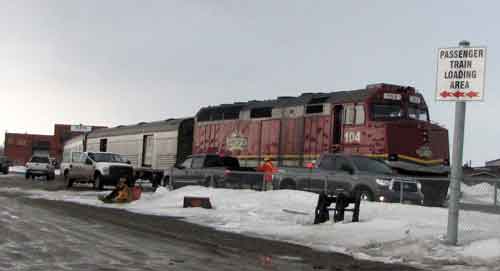
An Algoma Central Railway passenger train loads at Sault Sainte Marie, Ontario. (Photo by Ren Farley)

The ACR passenger service generates at least $38 million in total economic activity, a draft report by BDO Canada concludes.

In fact, the economic impact of the passenger train service between Sault Ste. Marie and Hearst, when including direct, indirect and induced economic impact ranges from $38,136,000 to $48,072,000, stakeholders were told at a meeting at the Civic Centre Thursday.

“This is a significant impact that may not be recognized by those who make the decisions,” said city CAO and chair of the working group Joe Fratesi.

The information from the draft report has already been provided to Transport Canada Minister Lisa Raiit.

Raiit was in Sault Ste. Marie Monday to announce that the federal government will provide a one-year extension to the $2.2 million subsidy it provides to CN to operate the service in order to allow stakeholders time to come up with a long-term solution to save the service.

The BDO Canada study, led by Joe Melisek and Jacob Barton, shows that while the direct impact of the service is somewhat limited at about $2.76 million, the indirect economic impact ranges between $13 to $16.9 million.

The induced impact also has a significant effect ranging between $22.2 to $28 million.

In addition, the service generates 220 jobs and contributes to the delivery of more than $5 million in tax revenue to government coffers annually.

BDO also examined the property values in the rural area and the report shows that the rail line supports more than $60 million in property value and provides immeasurable social benefits to the various group of stakeholders, property owners, users, First Nations and communities.

Melisek said the study was somewhat unique because the ACR provided the hard operational figures and passenger numbers needed and an abundance of surveys from stakeholders compiled the rest of the information needed.

The Economic Development Corp. received almost 500 surveys in the short time frame they had to collect the data and Melisek said that provided very good, reliable data from the broad user base.

At issue is the low ridership that has travelled the passenger train.

In 2013, a low number of 5,166 passengers used the rail service as opposed to a high of 12,640 passengers in 2005, the report indicates.

The government investment in the ACR is equivalent to an average of $425.86 per passenger, based on 2013 ridership numbers, the report states.

However, the report also notes that the $2.2 million federal government financial investment is not unreasonable when compared to other rail line investments in 2011 including Tshiuetin Rail Transportation’s 217 km line ($8.2 million) and the Keewetin Railway Company’s 400 km line ($2 million).

In addition, the study examined the economic impact analysis of property values.

Lodge property values are estimated at $9.3 to $10.3 million and cottage property values at between $51.4 and $56.9 million, resulting in a total economic impact of between $60.8 and $67.2 million.

“This is not a subsidy but really an investment to provide something the market in general is not going to provide us,” Barton told a room full of stakeholders.

While the social impact is hard to quantify, the loss of the rain line will have extreme negative effects on tourism, isolated communities, First Nations, employment and road access.

“The stakeholder group has also indicated that they feel the loss of passenger rail service indicates a negative trend that may contribute to the eventual termination o the Agawa Canyon Tour Train as well as the ACR freight service due to perceived lack of commercial viability,” the report states.

The report concludes that the subsidy is worthwhile of taxpayer funds because the service is crucial to stakeholders, and essential service to provide access to remote areas and provides strong economic benefit.

Fratesi said now is the time for stakeholders to move to the next step and suggest or develop ways that could help the rail line generate more revenue, reduce operational costs, develop partnerships with public-private sector and market its product better to increase the user base.

Stakeholders will be given until the end of the month to provide their specific ideas to the working committee.

Ideas already presented on the floor included combining the ACR with lines to cross Canada, develop a more up-to-date and accurate website and other marketing tools and allow groups to more easily organize and plan specialty trips to encourage ridership.

The working group is confident that CN is receptive to developing a workable solution and in the future, should be included in the group to test various scenarios.

Source: http://www.saultstar.com/2014/04/17/acr-has-tremendous-economic-impact-study-concludes