All posts by admin

Che sorpresa ti aspetta nel vivace casinò lazybar: generosi bonus, giri gratuiti e una selezione di giochi colorati renderanno la tua serata fantastica.

New, unused Talgo trains in Milwaukee could find a new home in Michigan

From the Milwaukee Sentinel Journal:

Two brand new, high-speed passenger trains idling in a north side Milwaukee building that originally were manufactured for the state of Wisconsin by Spanish train-maker Talgo Inc. may soon be put to use.

Michigan’s Department of Transportation issued a request for proposals in March for ready-to-operate trains capable of 110 mph speeds for its Wolverine service between Chicago and Detroit for August delivery. While neither the agency nor Talgo would confirm the train-maker submitted a proposal, there aren’t many companies with fully built trains sitting around.

“The only modern trains available today within that short time frame are the Talgos,” said Rick Harnish, executive director of the Chicago-based Midwest High Speed Rail Association.

Harnish applauded Michigan’s move to acquire modern trains — many of the Amtrak-owned trains operating in the Midwest are aging and have problems when there’s deep snow. He called the Talgo trains “excellent” and said they would be a particularly good fit for the curvy Wolverine route because their light weight and low-slung design would allow them to navigate turns more quickly.

There could be hiccups involved in a sale. The trains are the subject of a lawsuit about who owns the trains. Even if Wisconsin can’t stop Talgo from selling the trains, the unfinished litigation could make them less attractive to a buyer.

After the state of Wisconsin commissioned the trains from Talgo in 2009 for the Hiawatha line between Chicago and Milwaukee and ultimately spent $52 million on them, Gov. Scott Walker and the Republican administration clashed with the company, canceling a maintenance contract and disputing testing costs in 2012. The state halted payments, eventually leading Talgo to end the contract.

Talgo then sued the state in Dane County Circuit Court, asking a judge to declare that it properly terminated its contract. The suit is ongoing, but if Talgo wins, it will keep the trains and the tens of millions of dollars the state already has paid the firm.

However, Lester Pines, Talgo’s attorney, said there was no dispute that Talgo owns the trains, and he expects the lawsuit to be resolved soon. The company has an obligation to try to sell the trains and mitigate its damages from the state’s alleged breach of contract, he said.

“The state breached the contract and doesn’t want the trains,” Pines said. “They’re Talgo’s trains, and Talgo is the damaged party.”

Pines said he thought the state would prefer to settle the issue.

“If Talgo can sell the trains, I think the state of Wisconsin would be happy,” he said.

The Wisconsin attorney general’s office, which represents the state in the lawsuit, had no comment. The Wisconsin Department of Transportation also had no comment regarding the lawsuits or plans for the Talgo trains.

Talgo also filed a claim in November against the state of Wisconsin with the state Claims Board for $65.9 million. The Claims Board anticipates discussing the claim April 30, with a decision to be made within 20 days afterward.

If Talgo prevails, taxpayers would pay Talgo the $65.9 million and still forfeit the trains.

Talgo is still renting half of a 300,000-square-foot building in the Century City development at N. 27th St. and W. Townsend St. that is owned by the City of Milwaukee.

The trains are completed and there are just a small number of employees left, down from dozens, said Jeff Fleming, speaking for the city’s Department of City Development.

“But the power is on, and the trains are ready to pull out of the station,” Fleming said.

Michigan’s Department of Transportation is looking for alternatives to Amtrak trains for its Wolverine service while it waits for the 2018 delivery of a new generation of passenger cars, which are being manufactured for several Midwestern states in Rochelle, Ill. Because of a change in Amtrak’s cost methodology this year, the federal government will no longer pay for the state of Michigan to use Amtrak trains on its Wolverine service. The agency’s annual costs for operating and maintaining trains on its three train routes, including the Wolverine, ballooned from $8 million to $25 million this year.

“We’re trying to find ways to continue the service at a lower operational cost and increase ridership and revenues,” Michigan DOT spokesman Nick Schirripa said.

The Wolverine service operates three times a day on the 304-mile route from Chicago to Detroit to Pontiac, Mich.
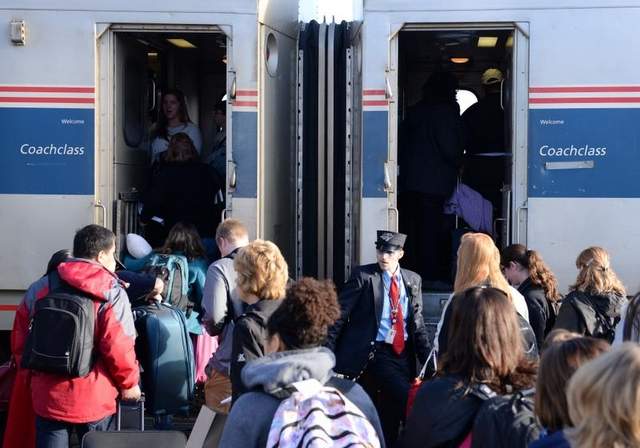
East Lansing rail, bus station to be ‘substantially complete’ in mid-August 2015

Amtrak conductor Greg Papcun helps passengers board the train Friday morning at the Amtrak and bus station on Harrison in East Lansing. / Greg DeRuiter/Lansing State Journal

From The Lansing State Journal:

A new rail and bus station in East Lansing will take longer to build than planned because construction bids came in nearly $2 million over budget.

The $10.5 million project, which would replace the city’s 40-year-old train station near Harrison and Trowbridge roads, will be sent out for new bids after contractors said the work would cost more than the station’s $5 million construction budget, officials said.

Plans have been revised. Officials said they now hope the building will be “substantially complete” by mid-August 2015, said Lori Mullins, East Lansing’s community and economic development administrator.

Demolition of the existing station had been expected to start before the end of 2013, with construction of the new building to start this spring.

The new station will serve as the hub for Amtrak trains and bus service from Greyhound, Megabus and Indian Trails. It will add bus bays and parking spaces for taxis, rental cars and bicycles.

Capital Area Transportation Authority, which manages the station, said adjacent buildings that formerly housed recycling operations for Michigan State University are scheduled to be torn down in mid-July, with construction planned for mid-September.

MSU owns the site and leases it to CATA to manage the station, since the bus agency is the region’s transportation authority.

It will keep a CATA bus stop on Harrison Road, near the train station.

The project already was delayed because grant funds were slow to be released. It’s funded primarily from a federal grant, with matches from Amtrak and the Michigan Department of Transportation. MSU is contributing the site as a long-term lease.

A portion of the grant already has been used for design and engineering work, leaving $5 million available for construction, said Debbie Alexander, CATA’s assistant executive director.

The low bidder, Grand Rapids’ Beckering Construction Inc., said it could do the work for nearly $6.9 million, CATA said.

Two local contractors — Delhi Township-based Laux Construction & Homes and Moore Trosper Construction Co., of Holt — bid $7.5million and $9 million, respectively.

CATA officials adjusted the project to keep costs down, Alexander said. Plans called for demolishing the existing station before building a new one and opening a temporary station for passengers, but CATA officials decided that would have been too costly.

Once the new building is done, Alexander said, the existing building will be demolished and work on the remainder of the site will be completed.

“We want to do the project right,” she said. “It’s a long-lasting facility, and it’s very important to do it correctly. If that means regrouping and making adjustments, that’s what must be done and what we have done.”

New bids are due May 21.

Source: http://www.lansingstatejournal.com/article/20140411/NEWS01/304110035/East-Lansing-rail-bus-station-substantially-complete-mid-August-2015?nclick_check=1


$2.2-million federal subsidy for Algoma Central Railway passenger service extended

From the Sault Star:

Picture from Sault Online

Algoma Central Railway (ACR) passenger rail trains will continue to chug along between Sault Ste. Marie and Hearst — for the time being — due to the extension of a $2.2-million federal subsidy to CN.

But that money dries up next March 31 and, as Transport Minister Lisa Raitt told stakeholders and media in Sault Ste. Marie Monday, the ball is now in others’ court to ensure the service survives.

“What we were asked for was a one-year extension, which made a lot of sense, so people can figure out how to move forward on it,” Raitt told reporters following the official announcement outside council chambers at the Civic Centre.

“But now the focus should be on working with CN and finding other people.”

The federal subsidy breaks down to about $448 per passenger trip, Raitt said.

“That’s a big subsidy that currently goes into it. We have a year-end date of March 31, 2015. I have no other money other than that. I can only gauge for one year at a time.”

Canadian National announced in January it would end passenger service between Sault Ste. Marie and Hearst effective March 30, following the federal government’s decision to cut a $2.2-million subsidy for its operation.

Since 1977, Ottawa has provided CN with financial support to ensure the continued operation of the ACR passenger rail service between the Sault and Hearst under the Regional and Remote Passenger Rail Services Class Contribution Program. In 2013, it became the Remote Passenger Rail Program, with a focus on remote rail services that provide access to established, year-round communities with few or no other transportation options.

“If you look at Hawk Junction, if you look at Hearst, if you look at Sault Ste. Marie, there’s other modes of transportation to get in and out of these communities,” Raitt said.

“That’s true because the passenger levels have really dropped since 2007. It was brought to our attention it was too quick a transition, so we’re going to give another year for transition out.”

The ACR Passenger Service Working Group, chaired by Sault Ste. Marie CAO Joe Fratesi, lobbied the Conservative government to extend funding for one year to give more time to find a solution to keep trains rolling.

Raitt said stakeholders have done an “amazing” job presenting their case to the federal government.

“They’ll work throughout the year, I’m sure,” she added. “But I think our message here is clear. We did discontinue this subsidy, we’re bringing it in for a year to let people get it together in terms of moving forward and I think that’s the best sense. People should focus on finding solutions outside government subsidies, is my best advice.”

The minister said both Sault Ste. Marie MP Bryan Hayes and Carol Hughes, MP for Algoma-Manitoulin-Kapuskasing, emphasized how many small businesses along the line depend on the service and needed time to “figure out how they’re going to move their goods or their services or their people that currently use the ACR.”

“It makes ample sense that we gave people a year and, certainly, the stakeholders did an amazing job of bringing the attention of the effects of the cancellation to our attention,” Raitt said.

“So, I think it’s fair they have a year to work together to try to bring together a private-sector solution.”

Regional stakeholders vowed Monday they’re ready to roll up their sleeves.

“This is now our time to work together to make sure that the needs of this region are very clear to CN, that we don’t come just with hat in hand with problems,” said Sault Mayor Debbie Amaroso.

She pointed to co-operation between Hayes, a Conservative, and Hughes, an NDP member, as well as “commendable” contributions from Fratesi.

“We come with solutions.”

Fratesi said his group had hoped Raitt would grant an interview in Ottawa before the end of April.

“All of us are just delighted that you accommodated us by coming to the Sault before the end of the month and not waiting until the 11th and a half hour,” he said.

Wawa Mayor Linda Nowicki said stakeholders might do well to take a cue or two from Madison Avenue.

“I’m very pleased with the announcement,” she told The Sault Star in an interview following the announcement. “It bodes well for us, but, as we’ve been told, we need to get together over the next year and come up with solutions and promote this service. It’s the only way it’s going to survive. It’s the same old comment … use it or lose it.”

She tags “inconvenient” schedule shifts a number of years ago for the slide in ridership.

“So there are many things that need to be looked at, and promotions (are) one of them,” she added.

The ACR Passenger Service Working Group, made up of municipalities, First Nations, small businesses, outdoor enthusiasts, tourism lodge operators and property owners who use the railway as a means of transportation, enlisted BDO Canada to draft a “socio-economic impact assessment” outlining how the line generates “significant” economic activity, sustaining hundreds of jobs and yielding millions in tax revenue.

That report is worth its weight in gold to Al Errington, lodge owner and Coalition for Algoma Passenger Trains co-chair.

“We have a starting point and we can really talk about what we’ve had in the past as far as economic, employment and tax-generation impacts,” Errington told The Sault Star.

“But, also, it gave us a really good insight into what the potentials are.”

Errington’s Wilderness Island, located on Mile 206 on the ACR, is about a 7.5-hour train ride north of the Sault and is “very dependent” on ACR passenger train service.

“This is what we needed,” said Errington, slated to meet with Hayes Tuesday.

“We needed time to start to work on a better future for the passenger train, to optimize the operations, to expand the passenger train’s economic and employment impact on the region.”

He echoed Nowicki’s argument that schedule changes prompted a passenger decrease, down some 40%, he said, following 2007 amendments.

Errington also argues Ontario, which has a “responsibility” for short lines as it charges train lines property and transportation tax, has not been a prime player in the issue.

“The provincial government really has to become engaged in this whole process,” he added.

Source: http://www.saultstar.com/2014/04/14/22-million-federal-subsidy-for-acr-passenger-rail-service-extended-minister-tells-stakeholders-ball-now-in-their-court

BWL’s train depot restoration draws attention and appreciation from Lansing community

Lansing Mayor Virg Bernero delivered his 2013 State of the City address in the newly restored Grand Trunk Western depot adjacent to BWL's new REO Town power plant. / Courtesy photo
Lansing Mayor Virg Bernero delivered his 2013 State of the City address in the newly restored Grand Trunk Western depot adjacent to BWL’s new REO Town power plant. / Courtesy photo

From The Lansing State Journal:

Beginning in late 2007, J. Peter Lark dedicated almost six years of his life to developing a 21st-century answer to the Board of Water & Light’s need for a power plant that produced affordable electricity and steam while significantly reducing the emissions associated with burning coal.

Almost 10 months into the commercial operation of BWL’s gas-fired REO Town cogeneration plant, BWL’s general manager seems to have succeeded on most counts.

During one of the area’s worst winters in memory, there were days when the coal-fired Eckert Power Station sat idle across Washington Avenue from Lark’s new

office.

“We believe we have the cleanest, most efficient electricity-and-steam-producing unit in the country,” Lark said. “You’d think when I was walking around town people would say, ‘Wow, that’s really neat that you saved us burning 350,000 tons of coal,’ but I don’t hear that.”

Customer discontent about BWL’s ice-storm-outage performance during December 2013 aside, Lark said he has been on the receiving end of positive community reaction — but not for the reason he expected. Most often, people thank Lark for restoring the 112-year-old Grand Trunk Western Rail Station that shares a small fraction of the power plant’s 5.3-acre home.

“Public reaction has centered to a greater extent on the depot than the combined-cycle cogeneration plant,” he said. “That was a little bit surprising to me.”

Lark says longtime residents share “heartfelt memories” of a time when the depot served as a point of departure and return for vacations, military service and education. Some recite its importance to the industrial complex Ransom E. Olds built across the tracks.

But, it hasn’t been used as a train depot since 1971. Almost 38 years have passed since President Gerald R. Ford dropped by during a whistle stop campaign tour in 1976.

By then, the depot was four years into its second life as a restaurant.

Regardless of their age or memories, area residents have welcomed the rescue and restoration of a historically important and architecturally interesting structure. The depot was listed on the State Register of Historic Sites in 1977 and the National Register of Historic Places in 1980.

Nevertheless, the building fell into disrepair after the last of a series of restaurants closed its doors more than a decade ago. The rest of the 5.3 acres was vacant in 2009 when BWL began looking for a site for a new power plant.

“I don’t want to give you the idea we purchased this property so that we could restore the depot,” Lark said. “The overarching reason we selected this particular property was its proximity to both the (existing) steam line and the electric transmission lines. Against that backdrop, this seemed to be the very best property because if we located (the new plant) even one mile away, it would have cost us many millions of dollars more. …

“The fact that a National Historic Register property was on site was not a deterrent and was a welcome addition in that it would give us the ability to invest in restoration that would enhance the Lansing community, particularly the REO Town community.”

In abandonment, the depot was encircled by a chain-link fence that was easily breached. Some windows were covered with plywood but the panes in almost all of the unprotected windows were shattered, opening the building to people, critters and weather. The east side of the depot was a dumping ground for plastic, metal, wood and clothing.

Lark said he nevertheless loved the depot’s exterior at first sight.

“But then we went into the interior,” he said. “I guess the fairest way to say it is there was a lot of detritus. It really was a building in poor repair. I enjoyed the idea that we were going to have such a handsome building as part of our REO Town development, but it wasn’t pretty on that first day. There was a lot there that made the eye wish it was averting its glance. But you could see the bones were good.”

The BWL spent more than $2.8 million restoring the depot to serve as the home for board meetings and employee training. From its terra cotta roof to the dark wood ceiling, period light fixtures, windows, walls and wainscoting, the restoration is stunning.

“Everybody who’s come has registered a ‘wow factor’ about the depot,” said Lark, ticking off a list of dignitaries that has included Mayor Virg Bernero, U.S. Sens. Debbie Stabenow and Carl Levin, U.S. Rep. Mike Rogers and Gov. Rick Snyder. “They’ve all been very impressed.”

Although the depot immediately accommodated board members and political bigwigs, BWL moved slowly in acknowledging public interest and requests for access to the depot.

Almost a year after Bernero used the then-virtually-restored depot as the backdrop for his 2013 State of the City address and six months after the adjacent power plant became operational, the BWL website referred to how the depot would be used once the plant went online.

The depot’s history is summarized on a bronze plaque on an exterior wall, but there is little inside that illustrates the activity that began in 1902. The building was open to the public for four hours on Oct. 9, but BWL doesn’t offer tours.

“We are kind of busy here,” Lark said.

He said he expects BWL to make more historical information available to satisfy visitor curiosity “over the next couple of years.”

Meantime, board meetings are open to the public and BWL recently created an online request form for groups interested in holding an event at the depot.

“It’s still a little bit of a work in progress as to how we’re going to finally deal with expressions of interest and requests for access,” Lark said. “It is a working facility. People can’t assume that it’s always available.

“Proprietary operations such as a for-profit corporation wanting to use it for a holiday party, that’s not what we’re thinking of. We’re not thinking of weddings or for-profit businesses using it at no cost to them. We’re thinking of the REO Town neighborhood, the city of Lansing, community-based efforts to improve the commonwealth.”

Terra cotta serendipity more than a century in the making

Terra cotta serendipity more than a century in the making

The eye-catching terra cotta roof atop the former Grand Trunk Western Rail Station is a product of a serendipitous moment within the $182 million REO Town power plant project the Board of Water & Light completed midway through 2013.

Built in 1902, the depot was in disrepair when BWL acquired the building and the 5.3 acres upon which it sat in January 2011. BWL’s decision to restore the depot to its original state represented $2.8 million of the project’s cost.

“Our original goal was to preserve and re-use as many of the existing tiles as possible and only purchase enough to replace the damaged and missing tiles,” said Pete Kramer, the mechanical engineer BWL hired to manage the parallel construction and restoration projects. “Unfortunately, the tiles that were left were not able to be salvaged in sufficient quantity and needed to be replaced.”

The tiles were 110 years old, but the manufacturer’s name was still legible — Ludowici Roof Tile Co. of New Lexington, Ohio.

“We didn’t think 110 years later that shop would still be in business, but it seemed worth a call,” said J. Peter Lark, general manager of BWL. “Not only were they in business, they were the kinds of people who save all the plans for all of the business they ever did.

“They had the original plans for the depot from 110 years ago. And they shipped us a complete new set of (14,600) terra cotta tiles right off the old plans.”

Their installation in 2012 created what Lark considers “the coolest part of the depot.”

The new roof cost $520,000, of which $298,000 was for the new tiles. They came with a 75-year warranty. Kramer said their life could exceed 100 years because modern installation techniques included use of better-draining material under the tiles.

Source: http://www.lansingstatejournal.com/apps/pbcs.dll/article?AID=/201404130400/NEWS01/304130005&nclick_check=1