Che sorpresa ti aspetta nel vivace casinò lazybar: generosi bonus, giri gratuiti e una selezione di giochi colorati renderanno la tua serata fantastica.
We hope you enjoy the issue and that you will let us hear your comments and suggestions. If you would like to write a story or suggest an item to be covered, email us at marprail@yahoo.com
For those without a PDF reader, click on the images below to view them full screen.
The Macatawa Area Coordinating Council’s Policy Committee this week endorsed the proposal from the Michigan Environmental Council and the Michigan Association of Rail Passengers to have a feasibility study done to see whether a passenger rail corridor could be developed using existing rail lines between the two cities.
John Langdon, a spokesman for the initiative, says if successful, it would probably be at least 10 years before train service could begin.
“This is an opportunity to get started,” Langdon said. “It’s a long-term issue. The feasibility study will only tell us whether it makes sense to move ahead to the next level.”
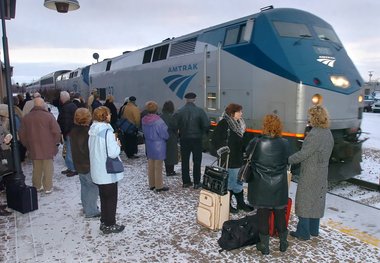
The so-called “Coast to Coast” line would go through Grand Rapids, Lansing and metro Detroit, and could connect major colleges as well as health care organizations such as those along Grand Rapids’ Medical Mile. The line would travel at a speed of 79 mph, compared to the current maximum speed of 65 mph on the Pere Marquette, Langdon said.
Most of the route would run on tracks currently owned by CSX Transportation, Langdon said.
MACC Executive Director Steve Bulthuis says adding a second passenger rail line would be a positive for the Holland area. But he says there’s a lot that has to happen before it’s known whether such a service would be viable.
“If you don’t justify the need for it, you never make it to the next steps in the process,” Bulthuis said. “There’s a lot of work to be done. This is a first step in a long process.”
The Grand Valley Metropolitan Council has not seen the proposal yet, but it’s likely to come before the planning body in the near future, said Mike Zonyk, the agency’s transportation planner.
Want to take the train into Detroit for a day trip or get some work done on your morning commute to Lansing?
Michigan isn’t there yet, but it’s taking the first steps toward passenger rail from Holland to Detroit and points in between with a proposed feasibility study for the project.
“This is really an opportunity to get started. This is a long-term issue,” said John Langdon, governmental and public affairs coordinator with the Michigan Association of Railroad Passengers.
Following the first successful study, more would follow. The project could take 10 or 20 years, Langdon said.
MARP and the Michigan Environmental Council are behind the study and asked the Macatawa Area Coordinating Council for a letter of support and a donation toward the study’s cost. At its Monday meeting, the MACC approved a $500 and sending a letter of support.
The Ann Arbor Area Transportation Authority is the study’s primary sponsor and the agency applying for a Michigan Department of Transportation grant to complete this first stage.
The maximum speed on the Pere Marquette from Holland is 65 mph. This is proposed to travel at 79 mph.
It’s hard to say how long it would take to get to Detroit from Holland, since the route isn’t fully laid out. However, from Holland to Grand Rapids would take about half an hour to 45 minutes, the same as driving — but without the driving.
The planned route largely follows the I-96 corridor.
Michigan’s three largest population centers — Detroit, Grand Rapids and Lansing — would be connected by passenger rail for the first time since 1970. It would connect 19 college campuses, the Grand Rapids Lansing and Detroit airports and a handful of major medical centers in the state.
The planned route would include Detroit, Williamston, East Lansing, Lansing, Grand Ledge, Kentwood, Grand Rapids, Hudsonville Grandville and Holland. Depending on the route selected, stops could also include Livonia, Plymouth, Dearborn, Ypsilanti, Ann Arbor, Hamburg, Whitemore Lake, Genoa, South Lyon and Howell.
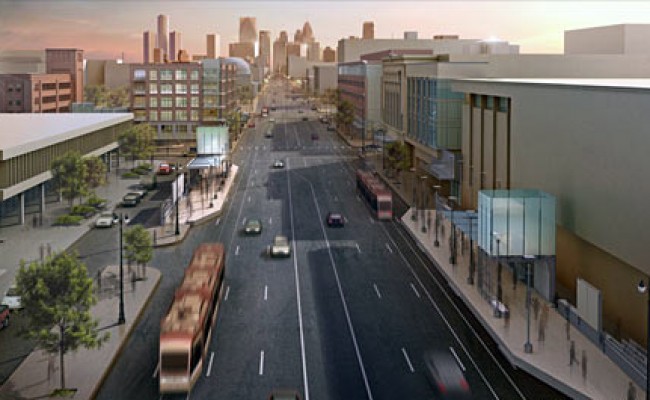
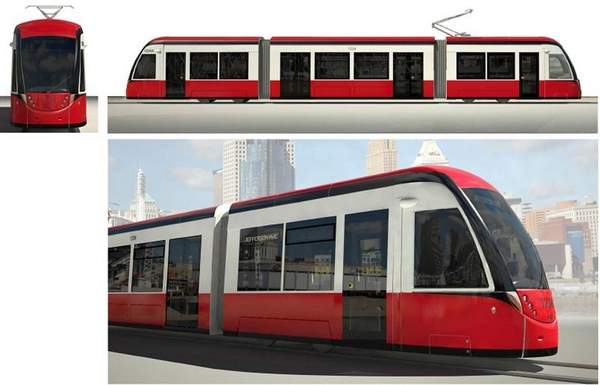
Here’s an artist’s rendition of the proposed streetcar line on Woodward Avenue in Detroit. (From M-! Rail.)
The odds that Detroiters will be riding a Woodward Avenue streetcar line by late 2016 rose Tuesday thanks to a $10-million loan from the state to the planned M-1 Rail line.
The Michigan Strategic Fund, meeting in Detroit, voted Tuesday to approve the $10-million loan to M-1. As part of M-1’s complex, multilayered financing plan, the state money will serve as a sort of bridge loan to help free up some of the money from longer-term pledges.
The MSF supported the state loan in part because of the long-term economic development expected to result from construction of the M-1 line. Jenilyn Norman, the chief financial officer of M-1, told the MSF board Tuesday that the multiplier effect from M-1’s investment could produce more than $2 billion in new development in the Woodward corridor.
“You build density, folks want to live there,” Norman told the MSF board. “It will build new jobs.”
The M-1 project itself will create 41 jobs when the line opens in 2016, the strategic fund staff said.
The term of the loan is 10 years at 2% interest, secured by a reimbursement agreement with Detroit’s Downtown Development Authority.
Michael Finney, president and CEO of the Michigan Economic Development Corp. and chairman of the Michigan Strategic Fund, said the M-1 loan plus $6 million in funding for demolition of Joe Louis Arena also approved by the MSF Tuesday underscores the state’s commitment to Detroit.
“We are very supportive of Detroit, very excited about all the positive things that have been happening in the city for quite some time now,” he said after the meeting at Next Energy in Detroit. “And these commitments are just a further indication of the level of support that we have for the city of Detroit and its resurgence.”
M-1 Rail will create a curbside streetcar line running along Woodward from Jefferson Avenue to Grand Boulevard in the New Center area. Construction is slated to begin this spring and the line would be finished in later 2016 if the groundbreaking occurs on time.
Backers of M-1 rail predict that the three-mile line along Woodward will prove so popular that additional lines known as bus rapid transit will be added to grow into a metropolitan-wide system. Asked by reporters whether M-1 might suffer the same fate as the Detroit People Mover, a system that remained an isolated loop after being built in the 1980s, Finney remained positive.
“I don’t think anything is guaranteed,” he said, then added, “What you see, though, is a very big commitment from the community. The resources that are being committed are phenomenal, and we think it’s important to be a part of that.”s
■ M-1 Rail will offer streetcar services along Woodward Avenue from Jefferson downtown to Grand Boulevard in New Center, running about 3 miles with at least 11 stations.
■ Groundbreaking is in the spring. The first passengers could be riding in fall 2016. The cars will run curbside with the flow of traffic on newly laid track.
■ Financed in part by private businesses including Little Caesars, Quicken Loans, Compuware and Blue Cross Blue Shield of Michigan, the line is touted as essential glue binding together developments taking shape in downtown, Midtown and New Center.
■ A looming question is whether the rail line eventually will expand north and also east and west to serve more people in the region from all walks of life and income levels.
■ The region’s new Regional Transportation Authority, which will work on creating a broader regional transit system, began to organize itself last year with state authorization. But the RTA has yet to hire a CEO or staff, and it lacks a source of funding.
■ The RTA board decided last month to postpone until 2016 a ballot proposal asking for a new tax or fee that could pay for a regional system’s infrastructure and operations.
■ The delay could mean that the greater downtown M-1 line will be up and running before a vote on RTA funding. Transit advocates say that could work in their favor because if the first stretch proves popular, demand might quickly rise to expand it.
M-1 Rail — who’s paying
The M-1 Rail line is funded by a combination of private and public money — making it unique among big-city transit lines. There are more than 20 sources. Here are the main ones and the amount each is giving:
■ $35 million: Kresge Foundation
■ $25 million: U.S. federal transportation grant
■ $9 million: Detroit Downtown Development Authority
■ $6 million: Ilitch Holdings
■ $4 million: Ford Foundation
■ $3 million donors: Blue Cross Blue Shield, Chevrolet division of General Motors, Chrysler Foundation, Compuware, Detroit Medical Center, Henry Ford Health System, Penske Corp., Quicken Loans, Wayne State University
■ $1 million: Hudson-Webber Foundation
A basic walk-up fare is expected be $1.50. There will be drivers on board the streetcars, which are expected to be able to travel the line from end to end in about 15 to 18 minutes. M-1 Rail