All posts by admin

Che sorpresa ti aspetta nel vivace casinò lazybar: generosi bonus, giri gratuiti e una selezione di giochi colorati renderanno la tua serata fantastica.

M-1 Rail groundbreaking nears amid hopes for a broader regional system

From the Detroit Free Press:

DFP-M1-Rail-Update-1A-MAP-webThe long-awaited M-1 Rail project has a new route map, a promised spring groundbreaking and soon, maybe, a new name.

Naming rights will be sold as part of the marketing plan for the $140-million M-1 Rail line — so look for it to be called anything from the Little Caesars Express to the Quicken Loans Choo-Choo.

Naming rights for the urban rail line — like in Cleveland and other cities — could bring $1 million or more to help pay for the line, slated to run 3 miles along Woodward from Jefferson Avenue downtown to Grand Boulevard in New Center. The first passengers could be boarding by fall 2016, said Paul Childs, chief operating officer of M-1.

The broader question remains whether M-1 will run as a limited, stand-alone operation — much as the People Mover has looped around downtown since the 1980s — or lead to the build-out of a regional system that could run north to 8 Mile Road or even Pontiac and include rapid transit buses.

“I think it’s absolutely just the first portion of a regional transit network. I think this really gives us the foundational link people are going to build on,” said Matt Cullen, CEO of M-1 Rail. “We really think it’s the right project at the right time for Detroit. The hard work and the pain will be worth it.”

The broader vision still needs funding. A plan from the new Regional Transit Authority to ask voters for a fee or tax to pay for it was delayed last month until 2016, which could give the public time to experience the M-1 line in action. Depending on what sort of larger system is designed, stretching the line farther north — and east and west — could cost from hundreds of millions of dollars to more than $1 billion.

“I hope that we can move beyond this first phase,” said Harriet Saperstein, chairperson of the nonprofit civic group Woodward Avenue Action Association. “The downtown portion is important, but it’s only one part of the public transportation system we need all along Woodward Avenue.”

So far, the M-1 Rail project has raised about $132 million from a patchwork of corporations, foundations, nonprofit agencies and government sources. It needs another $10 million or so, with potential sources already identified for about $6 million of the gap, said Laura Trudeau, a managing director with Kresge Foundation who works closely with the M-1 effort.

First stop?


For workers and residents of greater downtown, M-1 promises connections among different sites and at least a partial solution to the parking shortage in the increasingly crowded areas. The streetcars will run curbside with the flow of traffic.

Graig Donnelly, director of the Detroit Revitalization Fellows program based in the TechTown building near Wayne State University, is looking forward to riding the line. He said he drives his car to downtown meetings now but will switch to the streetcar when it opens.

“Given where my office is located and how close we’ll be to that amenity, I’ll just hop on the M-1 Rail,” he said. “It’s a no-brainer. It’s a quality-of-life thing.”

Donnelly sees another benefit: greater networking possibilities from running into acquaintances on the new transit line. “I think that those are unplanned things that add richness,” he said.

Supporters hope that richness of experience and other selling points, such as economic development gains for neighborhoods along Woodward, will add up to a compelling case for voters to approve future public funding for a regional system.

The idea over the years has been to use the M-1 Rail as a demonstration project that would win support for a wider network. There are some signs among regional officials that building out a broader system could gain support if it operates as a less-expensive rapid transit bus line, rather than adding more and costly light rail.

Not everyone is a fan of big new public transit systems in metro Detroit. Republican legislators in Lansing have balked at providing any funding, and some neighborhood activists worry that real estate along the M-1 route will grow so pricey that lower-income residents will be forced to move.

But proponents argue that new, higher-priced transit-oriented development is exactly what tax-strapped Detroit needs and a key reason for building M-1 in the first place.

A different path


The M-1 project’s financing and organization are unlike most, or perhaps any other, big city transit systems. M-1 will operate as a private nonprofit, with its operations and maintenance outsourced to a private vendor yet to be chosen. This is in contrast to other systems that are generally administered by city departments of transportation.

Financing, too, is nontraditional, with major backing coming from a mosaic of private business leaders, the Kresge Foundation and other foundations, the city’s Downtown Development Authority and the federal government, along with multiple other sources.

“It’s not an ideal way to build public infrastructure, but it seems to be our best shot at getting transit in the near future,” said Megan Owens, executive director of the nonprofit civic group Transportation Riders United.

The hybrid structure and financing model is a legacy of the tortuous trail M-1 backers have navigated from the beginning.

The project dates to 2008, when John Hertel, a former state legislator and general manager of the suburban SMART bus system, was asked by regional leaders to explore the possibility of a new regional transit system.

Hertel knew metro Detroit had suffered multiple failures during the past 40 years to create such a system due to regional animosities and city-suburban conflicts. So to jump-start a regional system, he recruited the Ilitch family, Compuware founder Peter Karmanos, Super Bowl XL Host Committee Chairman Roger Penske, WSU and other deep-pocketed individuals and institutions to pledge support for a 3.2-mile streetcar line along Woodward Avenue.

■ Related: Roger Penske touts M-1 Rail project as Detroit’s ‘home-run project’

In 2010, the M-1 project was merged into ambitious larger plans to create a faster transit system from Detroit to the city’s border with Oakland County. But those plans fell apart in 2011, and it appeared for a time that the idea of a streetcar on Woodward was dead.

Now led by Cullen, a former General Motors executive who heads up businessman Dan Gilbert’s Rock Ventures, the private and nonprofit investors in M-1 resurrected the original concept of the streetcar line along Woodward for greater downtown. That’s the concept now close to groundbreaking with some initial utility relocation work already begun downtown.

Childs, the project’s COO, said the money already raised will be enough to build and operate M-1 for 10 years. Besides construction funding, money is available for operations through several sources: fares, the naming rights and an operational fund that will benefit from private and public support.

In Cleveland, the city’s bus rapid transit line along Euclid Avenue was named the HealthLine after it received sponsorships from the Cleveland Clinic and University Hospital on the eastern end of the line. In Detroit, Owens of the transit riders group said that sort of name is preferable to a more blatantly commercial sponsorship.

That will be decided sooner rather than later. But whether this long-delayed system, with its unique structure and financing, becomes the first component of a broader regional transit network is a question that will take longer to answer.

Source: http://www.freep.com/article/20140309/BUSINESS06/303090063/M-1-Rail-transit-Detroit-streetcars
MARP meets April 5, 2014 in downtown Detroit

MARP Member Meeting
Saturday, April 5, 2014,
10 a.m. – 1 p.m.
Wayne County Community College
(Downtown Campus, Room 236)
1001 W Fort, Detroit MI 48226
313.496.2600


Map & Directions 


The April 5 general membership meeting will take place at the downtown Detroit campus of Wayne County Community College (WCCCD), 1001 W Fort St, Room 236. Look for the modern building, attractively landscaped, on the south side of Fort Street immediately west of the Lodge Freeway. There is ample off-street parking in 2 lots at the west end of the building.


Dr. Frank Dunbar and his WCCCD colleague Howard Smith, will tell us about new programs at WCCCD that will lead toAssociate of Applied Science degrees in Light Rail Transportation designed to prepare students for employment in the light rail industry developing in Detroit  and other urban areas nationwide. Students may focus on Electromechanical work or on Signaling and Communications.  A  Railroad Rules and Safety Certificate (starting Fall 2014) will support employment in the general railroad industry (freight, intermodal, etc.).  


Dunbar and Smith cite the coming of the M-1 rail line along the Woodward corridor as a driver of jobs in the coming years. They will explain the WCCCD program, why they developed it and what are the hopes and needs for the future.


Dr. Frank Dunbar is Provost, Regional Program Planning, at WCCCD. His varied background includes work as a Landscape Architect, College Professor at three universities,  and Minister.  Model railroads are his hobby.


Howard Smith, WCCCD Instructor, worked his way through Youngstown State University on the Erie Lackawanna RR and continued to work  in both operational and executive level positions in the rail industry from 1971 until his retirement for the General Motors Rail Operations Center in 2006. He is on the Board of Directors of the Adrian and Blissfield Railroads and is the principal at alderley LLC, his rail logistics consulting entity.


Plan to enjoy our usual no-host lunch following the meeting. See below for other ideas on enhancing your visit to Detroit.


If you would like to share a ride to the meeting, please reply to this email. We will do our best to put you in touch with someone driving from your area.


We look forward to seeing you in Detroit!

Michigan Association of Railroad Passengers


#   #   #   #   #


Spend Your Weekend in Detroit


You might think of making a weekend of your visit to Detroit. If you have not been there lately, you may be pleasantly surprised with the variety of places to go and things to see. For several years, I have been telling people that THE place to be on a Friday evening is the Detroit Institue of Arts. Start your evening with a snack or a full dinner at the DIA Café on the lower level. Then wander up to the Rivera Court for live music performance at 7:00 and 8:30 pm. You’ll hear wonderful musicians as you gaze around at the famous Diego Rivera murals celebrating Detroit industry. To cap your evening, the adjoining Detroit Film Theatre will be showing  IN BLOOM on Friday, April 04, and Saturday, April 05, at 9:30 PM. The Inn on Ferry Street is just around the corner when you’re ready to call it a day.


Ten Things to Do in Detroit


Samurai: Beyond the Sword   is the current special exhibition at the DIA


Dine Drink Detroit   by FREEP writer Sylvia Rector highlights smaller spots


Detroit Redwings   On April 4, the Rewings play the Sabres at home.


Detroit Pistons   are away this weekend

Troy Transit Center condemnation lawsuit thrown out

From The Detroit News:

Photo by Larry Sobczak

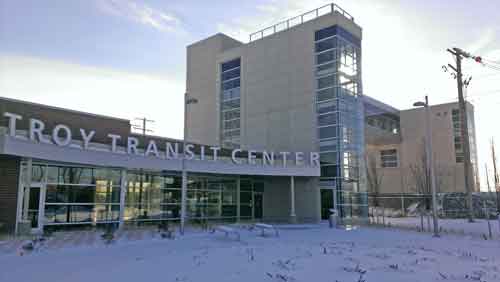
Months after construction was completed on Troy’s new multimodal transit center, passengers hoping to catch a train at the $6.3 million facility are still out in the cold.

On a frigid morning last week, Troy dentist Keith Kelley stood at the outdoor train platform on the Birmingham side of the tracks, waiting to catch a ride to a conference in Chicago. He could look across and see the Troy transit center, but couldn’t go inside.

“I’d love to have it open right now. In fact, I was looking forward to having it open in November,” he said. “It’s unfortunate.”

The transit center was born in controversy and continues to be a headache for Troy years after the City Council approved federal funds to build it.

The center, which was completed last fall behind a shopping center near Maple and Coolidge Highway, remains closed to commuters because, according to a judge’s ruling, the city does not own the land upon which it was built.

In the meantime, commuters who rely on the Amtrak train must use a freestanding shelter on the other side of the train tracks in Birmingham, which provides little protection from the elements.

Riders on SMART bus lines 465 and 475 also have to wait in freestanding shelters along Maple Road, according to the suburban bus service.

“It’s a shame people have to stand outside in the cold when there is a perfectly good building across the tracks,” said Troy Mayor Dane Slater.

The city is committed to gaining control of the land, which the judge ruled belongs to developer Grand/Sakwa Properties, the owner of the Midtown Squareshopping center surrounding the transit center.

Although he never supported building the transit center, Mayor Pro Tem Dave Henderson says the city must get the land somehow, whether that is through an agreement with Grand/Sakwa or through condemning the property.

“I didn’t vote for it, but I’m 100 percent behind it now,” said Henderson. “From a community standpoint, we have to try to do whatever it takes to make it work, because otherwise we will have wasted a lot of money.”

Last month, Oakland County Circuit Judge Leo Bowman dismissed the city’s lawsuit against Grand/Sakwa, affirming the developer’s ownership of the land. It’s the latest setback for the city, which has been trying for more than 13 years to open a transit center on the site.

Troy partnered with Birmingham on the transit project in 2000, when Grand/Sakwa donated the land with the condition that the money for the transit center be secured by 2010. Birmingham later backed out.

The city secured an $8.4 million federal grant, but the developer says the money was not acquired before the deadline, meaning the land reverted back to the developer.

In the lawsuit, the city offered to pay Grand/Sakwa $550,000 for the 2.7-acre site. That amount comes from a 2010 appraisal of the land that was completed before the transit center was built.

In a response filed in court, Grand/Sakwa says its concerns go beyond how much the land is worth.

The developer says Troy has not provided the “resources necessary to properly operate and maintain” the transit center.

“Troy’s (projection) for the transportation center shows 167 buses accessing each day the transportation center by crossing Grand/Sakwa’s parking lot,” the document says. “Troy has not provided any analysis or plan of action as to how this traffic situation would ever function and how it would mitigate the substantial impact and interference with the commercial tenants’ businesses at the shopping center or on the access and use of the shopping center by their customers.”

The next step for Troy, said City Attorney Lori Grigg-Bluhm, will be to conduct a new appraisal of the land. The city voted in November to set aside $1.8 million toward purchasing the land if necessary.

“Every federal grant is done on a reimbursement basis. We pay and they reimburse,” Grigg-Bluhm said in an email. “However, we would have assurances that if we spend the money, there will be a reimbursement.”

If the developer agrees to a deal, the litigation will be settled. If not, the city would file a lawsuit to condemn the land.

“There is no plan to demolish the transit center,” said Grigg-Bluhm. “If necessary, a condemnation case would settle the issue of legal title of the real property.”

The 28,000-square-foot transit center was completed last fall and was meant to replace the Amtrak station just across the tracks in Birmingham.

Amtrak spokesman Marc Magliari said the rail line can’t sign a lease with Troy until the city owns the property.

“We look forward to a resolution and moving into the Troy transportation center,” he said.

According to the company, the Birmingham stop served 23,257 Amtrak riders in 2013 and 19,712 riders in 2012along the Wolverine line, which runs between Pontiac and Chicago.

The transit center almost wasn’t built. At first, the city council rejected it but later approved a scaled-down version in January 2012.

Councilman Wade Fleming cast the deciding vote in favor after getting assurances that taxpayer money wouldn’t be needed to fund the $30,000 in annual maintenance for the center. Grigg-Bluhm said thus far maintenance and utility costs for the center have been a part of “project costs” and fall under the federal grant funds.

Fleming said he hopes the city can strike a deal with Grand/Sakwa to buy the property.

“We absolutely have to move forward,” said Fleming. “You don’t want to overpay. It’s unfortunate we have to pay anything for it because when we made the decision, the land was supposed to be ours.”

Slater, who fought for approval of the center when he was a councilman, said it is in everybody’s best interest to proceed with purchasing it, “as long as it doesn’t cost the taxpayers anything out of our general fund.”

He says it’s a matter of waiting on the new appraisal.

“Once that comes in,” he said, “I’m hopeful that we can resolve this issue and open the doors.”

Amtrak FY 2015 budget: “Something has to change”

From Railway Age:

For its Fiscal Year 2015, which begins Oct. 1, 2014, Amtrak is requesting $1.62 billion in federal capital and operating support, an increase of approximately 16% from FY 2014 federal appropriations. But more important, said Amtrak President and CEO Joe Boardman, fundamental changes are needed in how the U.S. government financially supports intercity passenger rail.

A portion of Amtrak’s annual operating profit on the Northeast Corridor, estimated at $300 million and based upon a ratio of operating revenues to operating expenses (so-called “above the rail” costs), is used to cover some costs of its state-supported and long-distance trains. This has to change, said Boardman, if the NEC is to continue as “vital to the mobility, connectivity, and economy of the entire Northeast region. Continuation of current funding levels leave Northeast Corridor infrastructure vulnerable to a bigger, costlier and far more damaging failure than anything yet seen.”

“Infrastructure deterioration and changes in business patterns have reached a point where something has to change,” said Boardman. “If America wants a modern intercity passenger rail system, the problems of policy and funding must be addressed. The nation cannot afford to let a railroad (the NEC) that carries half of Amtrak’s trains and 80% of the nation’s rail commuters fall apart; the economic consequences would be devastating. A new federal policy and funding arrangement should create a significant and reliable multi-year capital investment program to reverse the decay of NEC infrastructure and support other intercity passenger rail projects. A strong federal commitment will allow Amtrak to plan and implement major multi-year projects such as replacing century-old NEC bridges and tunnels, and make critical capacity improvements such as the Gateway Program between New Jersey and New York.”

“To provide additional funding for NEC improvements, Congress should fully fund the operating and capital needs of the long-distance routes so that NEC revenues can be reinvested in the NEC,” Boardman said. “By dedicating NEC revenue to meet NEC needs, it could be leveraged to pay for debt service on loans to address the most urgent NEC infrastructure issues. It also could be used to finance other funding solutions such as public-private partnerships, grants of assistance, and state and commuter rail agreements.”

Boardman said Amtrak’s long-distance trains have been a core federal responsibility since 1971, and Congress should fulfill its obligation by funding their full cost. “Long-distance trains form the backbone of the Amtrak national system, connect small towns to major cities, support local economic development, deliver passengers to state-supported corridor trains, and conduct interstate trade and commerce,” he said. “They are vital to the communities and people they serve, and are increasingly important as airlines and bus companies abandon significant regions of America. It is clear that Americans wants a national system of intercity passenger rail, and will continue to use it in greater numbers if we can provide it. Our work over the past decade proves this, but to maintain and improve that system will require both an increase in the overall capital levels and a real federal commitment to deliver the needed financing.”

In Amtrak’s FY 2015 budget request to Congress, Boardman pointed to “the work Amtrak has done to maintain our aging rail system and sustain and even improve service in the face of unprecedented natural disasters and a challenging environment. Service disruptions caused by weather and other issues cost us more than 440,000 riders and $42 million in ticket revenue. In spite of that, we set an annual ridership record of 31.6 million passengers and a ticket revenue record of $2.1 billion. That we did this in spite of serious obstacles says a lot about the demand—but the losses we did see are just the first of the challenges we can expect to face if we do not act now to stop the decay of the Amtrak system. While I am very proud of the way the men and women of Amtrak have sustained that system, the time has come for us to do something to reverse this trend so passenger rail can continue to contribute to our national economy.”

“Amtrak has successfully sustained our national system for four decades, thanks to growing ticket revenue, strong freight railroad support, and the federal grants designed to ensure national connectivity,” Boardman said. “Congress stated in Section 228 of PRIIA that the operation of a national system was ‘a vital and necessary part of our national transportation system and economy,’ and that is a sentiment with which I strongly agree.”

Click on table to enlarge

Table 1 (opposite) shows Amtrak’s total FY 2015 request, as well as the divisions of operating and capital need. “Taken as a whole, our FY 2015 request is approximately 16% higher (excluding FRA oversight funding) than our FY 2014 appropriations,” Boardman noted. “We have taken a very careful approach so that we can keep operating costs down, and operating revenues up, resulting in a cost recovery that has continued to rise, reaching 89% in FY 2013, and a projected 91% by FY 2015.

“If Amtrak could obtain access to a multi-year federal funding commitment, it could build and follow through on a capital program that would address our fleet and infrastructure needs. Amtrak has never had a true capital commitment, one that allowed us to sign multiyear contracts, knowing that the money would be there to carry out the work. As a result, we have put off major capital programs to renew aging bridges and tunnels, in some cases for decades. The projects we have been able to undertake have been completed in a manner that is less efficient than it would have been if we could say with certainty that our projects were funded in advance. Our ability to buy in bulk for out years, which saves money, is hindered by our inability to commit money for purchases in coming fiscal years.

“The uncertainty associated with an annual appropriation sometimes means we are left with excess inventory that must be stored or held until a use can be found for it. It is difficult to get industry [suppliers] to respond to orders or proposals if we can’t guarantee large purchases, and it is hard to know when our workforce will be needed, a challenge that is made even harder by the limited work windows that are available on the Northeast Corridor. The process of ‘ramping up’ the organization so that we can effectively invest at a level that will make a difference will take a period of years, as we will have to develop capabilities that are currently scaled to our existing program—both management capabilities, such as project and contractor oversight, and workforce capacity—to accommodate significantly higher levels of funding.

“While we can expand and contract these capabilities to accommodate fluctuating levels of investment, there are significant long term cost savings that will come if we can plan our activities in advance and manage our workforce and inventory in a manner that ensures we obtain the most efficient return for our investment. This would be another efficiency benefit that will flow naturally from access to a committed source of capital support. Such a funding stream would also be important for our long distance services, which enjoy strong support from the states and communities they serve. In addition to the aging fleet, which we have begun to replace, there is a need for investments in the freight network to provide improvements that are needed for passenger service.”

To conduct its operations in FY 2015, Amtrak said the NEC will require no federal operating support, but it will require approximately $445 million in federal capital investment, in addition to other funding provided by commuter authorities in accordance with Section 212 of PRIIA. This investment will be augmented by approximately $290 million in revenue generated by NEC services.

“While this level of investment is far below the amount needed to stabilize and improve the NEC, as called for in the draft Five-Year Northeast Corridor Capital Plan now under development with the Northeast Corridor Commission, it reflects what we believe is a realistic request for funding giving our continued reliance on the annual appropriations process for capital funding,” said Boardman. “The majority of the investment will be spent on infrastructure renewal, which includes stations, rail and safety mandates, and rolling stock. The remaining $34 million will be invested in Amtrak’s most important ongoing investment project, the Gateway Program, designed to build additional track, tunnel and terminal capacity at Amtrak’s most congested point, New York Penn Station and the tunnels connecting it with New Jersey.”

Amtrak’s state-supported services have become a major source of ridership growth, with ridership almost doubling between 1998 and 2013. “Over the course of the past year, we have worked closely with our state partners to implement the cost-sharing mandates established by Section 209 of PRIIA,” Boardman said. “Section 209 requires the states to assume a larger and consistent share of the costs associated with each service, and their willingness to do so has allowed Amtrak to preserve every single state-supported service. While the 209 process has secured state support for the majority of operating expenses, Amtrak will still require approximately $83 million of federal operating support for these trains in FY 2015. While these services as a whole will continue to require some level of state and federal operating support, it should be noted that by the end of FY 2013, preliminary analysis indicates that nine of these routes had reached or exceeded the 90% cost recovery level for the year. In most of these instances, the availability of multiple frequencies, the promise of reliable service, and the additional choices conferred by intercity rail and transit service connectivity have driven this growth—which strongly suggests that the success of our NEC services could be replicated in other corridors, if sufficient levels of capital funding and freight railroad access could be obtained to develop them.”

While Amtrak’s long distance service costs have been offset in recent years by revenues from NEC services, Amtrak is proposing for FY 2015 that the federal government provide for the totality of their operating need, $618 million, as part of its FY 2015 operating need. “Like the Northeast Corridor, these trains will require significant capital investment, with a total identified FY 2015 need of $295 million,” said Boardman. “About $50 million of this cost will be required for ADA compliance at our stations. The purchase of new rolling stock, including the ongoing replacement of our Heritage cars, will require $130 million. Approximately $115 million will be required for overhauls to our fleet, much of which dates to the early 1980s.”

Amtrak-FY2015-Federal-Budget-Request-ATK-14-028,0-10How all this is to be accomplished “is both a policy matter and a financial one,” Boardman said. “The states and our other partners have important roles to play, but investment on the scale required to achieve program goals will have to come from the federal government. It is equally clear that the existing investment model, with its unpredictable timing and funding levels, is incapable of providing financing in a manner that supports the development of major multiyear projects. If America wants a modern intercity passenger rail system, this problem must be addressed – as much to sustain the existing level of service as to develop the capacity Amtrak will need in the years to come. A new and sustainable financing framework is needed for the benefit of the entire nation, as well as the multiple state and regional economies which we do or could serve. Table 2 (lower illustration) will put our FY 2015 need in the context of our needs for the following years, which will, if financed, bring us up to a level that will allow us to make meaningful improvements in our system reliability. The need for investment is pressing, and the gradual process of decapitalization will, if left unchecked, lead to higher costs and worse service, for Amtrak, commuters, and Northeastern freight carriers.”

Source: http://www.railwayage.com/index.php/passenger/intercity/amtrak-fy-2015-budget-something-has-to-change%e2%80%9d.html?channel=41&utm_source=WhatCounts+Publicaster+Edition&utm_medium=email&utm_campaign=RGN+3.19.14&utm_content=Amtrak+FY+2015+budget%3A+%E2%80%9CSomething+has+to+change%E2%80%9D&fb_action_ids=690230376182&fb_action_types=og.likes&fb_source=other_multiline&action_object_map=%5B1417402748511255%5D&action_type_map=%5B%22og.likes%22%5D&action_ref_map=%5B%5D

M-1 Rail hires Fischer and Brown

From an M-1 Light Rail press release:

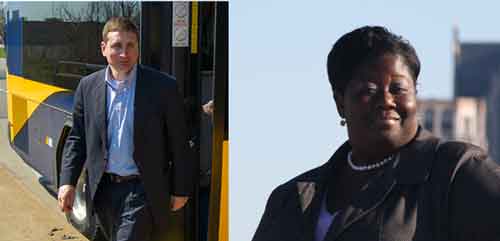
Tim Fischer and Nicole Brown.

As utility relocation work continues and the Streetcar Project moves closer to the start of track construction, M-1 RAIL has increased its staff capacity with two new hires. M-1 RAIL President and CEO Matthew P. Cullen today announced the hiring of Timothy Fischer as Chief Administrative Officer (CAO) and Nicole Brown as Community Relations Manager.

 “We are pleased to welcome Tim and Nicole to the M-1 RAIL team,” said Cullen.  “Each possess a special set of skills that will boost the organization’s expertise in public policy and community outreach while expanding the team’s bandwidth as we continue to advance this important Detroit transportation initiative.”

Both Brown and Fischer have already begun their duties with the organization, bringing the M-1 RAIL staff member total to eight not including Cullen in his voluntary roles as President and CEO.  The eight team members work from the M-1 RAIL office located at 1426 Woodward Avenue in downtown Detroit.

As CAO, Fischer’s responsibilities are to interface and coordinate with the multiple transit agencies on policy issues; assist in strategy development for fundraising and financial activities; and support donor relations.

Fischer joins the M-1 RAIL team from the Michigan Environmental Council (MEC), a statewide environmental and public health organization, where he served as Deputy Policy Director since 2007. A Michigan native, he served as the chair of the Transportation for Michigan Management Team where he led efforts to pass Michigan’s Complete Streets law, establish a Regional Transit Authority and secure public transportation funding.  Fischer is also an advisor to the executive board of the Michigan Association of Railroad Passengers. In addition, he is a member of the State Bar of Michigan.

Brown, a native Detroiter, is responsible for managing the project’s resident, business and visitor engagement efforts. She brings to the M-1 RAIL team extensive experience as a community engagement and marketing communications professional with expertise in the areas of community and economic development.

Most recently, Brown was the Communications and Partnerships Manager for the educational non-profit organization, Excellent Schools Detroit (ESD). Prior to joining ESD, Brown served as the Communications and Outreach Coordinator for the Midtown Detroit, Inc. /Living Cities Integration Initiative Detroit program, Woodward Corridor Initiative.  She began her career in community engagement with regional economic development non-profit, Woodward Avenue Action Association (WA3).

The M-1 RAIL Streetcar, once operational in 2016, will travel 3.3-miles (6.6 miles round-trip) along Woodward Avenue between Downtown and the North End – making stops at 19 stations (three center running and 16 curbside), connecting riders to destinations such as cultural institutions, hospitals, universities, employment centers, stadiums and entertainment venues.