All posts by admin

Che sorpresa ti aspetta nel vivace casinò lazybar: generosi bonus, giri gratuiti e una selezione di giochi colorati renderanno la tua serata fantastica.

Two possible streetcar routes in Grand Rapids: Which is best?

From M-Live.com:

Click to enlarge
Click to enlarge

A group that’s restarting talk about an electric streetcar line in Grand Rapids is fine-tuning the concept and is weighing whether routes should already run where people already are or where the city is developing.

The role pits the streetcars as a catalyst for new investment with being a connector between what already exists, but leaders believe there’s room to fill each objective.

“We have to go where the people are now, but we have to look to the future, too,” said the Rev. Mark Przybysz, a Catholic priest who’s part of a committee refining a 2008 streetcar study.

Initially, however, Grand Rapids may have to choose just one emphasis. A streetcar line will cost tens of millions of dollars and consultants advise settling on the shortest route that can attract federal funding and at the same time meet the community’s goals.

The committee has identified a few possible routes:

  • Monroe Avenue NW from Sixth Street to Fulton Street, where the road turns into Market Avenue SW. The street car route would continue south of Fulton to Bartlett Street, then turn east to Rapid Central Station.
  • Monroe Avenue NW from Sixth Street to Monroe Center, then southeast on Monroe Center to Ionia Avenue where the route would head south on Ionia to the Downtown Market at Logan Street SW.
  • There’s also some desire to have a route on the west side of the Grand River, on Mount Vernon and Turner avenues between Sixth and Fulton streets.

RELATED: $80 million streetcar plan for Grand Rapids back in play

Committee members were divided at a meeting earlier this week. Consultants plan next month to give the committee a closer look at various land uses along the proposed routes.

The Monroe-Market route was identified in a 2008 study. Advocates of a streetcar line think that route might spur new development along the river. But most downtown visitors would prefer a streetcar route down Ionia, said George Aquino, vice president and managing director of the Amway Hotel Collection.

“You’re going to have too many naysayers (on the Market route) saying ‘Why do you want to go here when we really want to go here (to Ionia)?’” he said.

“It’s what you have versus what you would like to have,” said Jerry Kooiman, an assistant dean at Michigan State University’s College of Human Medicine. “If Grand Rapids has a main street, it’s Monroe Center, and why wouldn’t you want to have this down your main street?”

The committee also is looking into funding prospects, which could include a mix of local, federal and private sources. Consultants said streetcar lines elsewhere are often funded partially with federal grants, with local sources including assessments on properties within a few blocks of the line, sales tax within a certain area and parking surcharges.

“If we want to chase federal funds, we could be chasing it for the better part of 10 years,” said John Logie, a former Grand Rapids mayor who is chairing the committee. “It may not be as hard as we think to raise all of it here.”

Source: http://www.mlive.com/news/grand-rapids/index.ssf/2014/02/3_streetcar_routes_in_grand_ra.html
NARP’s Capon moving on; Scott named acting president

Ross Capon
Ross Capon

The National Association of Railroad Passengers (NARP) announced this week that Ross Capon will be moving on from his 39-year career with the organization. Larry Scott will take over as acting president.

Capon joined NARP in 1975 and became its executive director in 1976.

“During Ross’s time at NARP, the association’s recognition and influence significantly increased. That’s reflected not only in the recognition he has received in the industry, but in the growth of passenger rail across the nation,” said NARP Chairman Bob Stewart in a press release.

For his longstanding support of trains, Capon was recognized with the Robert K. Pattison Partnership Award from the Intermodal Passenger Institute in 2000. He had received NARPs Golden Spike Award in 1985.

“I will be working closely with Acting President Larry Scott, and I’m pleased to be able to assist Larry in ensuring the smoothest possible transition in leadership and the continued growth of NARP,” Capon said.

Committee seeks 1-year extension of Algoma passenger rail service

From Soo Today:


Photo from Soo Today

Committed cottagers, land and business owners, and municipal and tourism representatives from across the Algoma district gathered at City Hall last week for the inaugural meeting of the Algoma Central Railway Passenger Service Stakeholder Committee.

The purpose of the meeting was to form a Working Committee that will work toward an agreement with CN and the federal government which would postpone for one year the termination of passenger rail service between Sault Ste. Marie and Hearst.

On Friday, January 24, it was revealed that federal funding for passenger rail service from Sault Ste. Marie to Hearst was cut and CN would discontinue passenger service as a result.

With a number of remote locations, businesses and private cottages situated along this stretch of rail, its cancelation would have a devastating impact on the area’s tourism and recreation sector.

Matt Yukich, whose family owns and operates Ontario North Fishing Adventures in Oba, told SooToday.com that 75 percent of his seasonal visitors reach this destination by train.

Although it is accessible by other means, he said it’s more than eight hours to drive there from Sault Ste. Marie, the last two hours via dirt road.

He expressed frustration over the announcement as he’s unable to book any visitors and he fears many of his regulars will decide to go elsewhere for their vacation.

The original termination date set for Monday, March 31, 2014 by CN has since been extended to Tuesday, April 29, 2014.

The newly formed Working Committee includes, but is not limited to:

  • Joe Fratesi, City of Sault Ste. Marie, Chair
  • Tom Dodds, SSM Economic Development Corporation
  • Linda Nowicki, Representative for Wawa
  • Sylvie Fontaine, Representative for Hearst
  • Councillor Bev Nantel (alternate: Louise Perrier), Representative for Dubreuiville
  • Chief Joe Buckell, Representative for First Nations (tentative)
  • Ian McMillan, Tourism Representative for Sault Ste. Marie
  • Carol Caputo, Tourism Representative for Algoma Region
  • Al Errington, Representative for CAPT
  • Dennis Henderson, Representative for Cottage Owners

The Sault-to-Hearst stretch is the only passenger rail line operated by CN, doing so on the basis that the federal government would subsidize its operation due to the remoteness of certain destinations along the line, Sault Ste. Marie CAO Joe Fratesi told SooToday.com

The government definition of ‘remote’ for the purpose of this funding has changed recently, and if said destination is accessible by road, it no longer qualifies for funding.
“[CN] is a private corporation, and their obligation is not to the taxpayers, they’re obligation is to their shareholders. They will stay in this and lose a little bit of money, but they can’t stay in this and lose a lot of money without their shareholders raising concern about them being involved,” said Fratesi. “I’m confident after having met with them if the subsidy is put back on the table, CN is quite content to operate this piece of passenger rail.”

“It appears to us that Transport Canada made the decision without the benefit of public consultation, without the benefit of an economic impact assessment, on a very specific and narrow view,” said Tom Dodds, CEO of the SSM Economic Development Corporation. “It was all about defining what was going to receive financial support for remote passenger service. I have a definition they’ve provided to me and it seems to me there are communities that fit that definition.”

Linda Savory-Gordon, Coalition for Algoma Passenger Trains (CAPT) board member, explained that many of these ‘roads’ cited as accessibility points by the federal government are often not much more than trails or logging roads, many of them located on private property.

These ‘roads’ may be illegal for the public to access and can be dangerous to traverse due to flooding, downed trees, and the lack of cellular service in the area.

“This is not first time that eligibility according to that program has been called into question, but in the past there were opportunities for the various stakeholders to make a case for why they should still be considered a remote location,” she told us. “Transport Canada did not do their due diligence in our opinion because they didn’t actually come and see the situation as far as alternative forms of transportation into that area. They based their assumptions on very faulty information.”

Should the one-year extension be granted, Fratesi stressed that a permanent solution must be developed and implemented prior to the new deadline.
This could include funding from other sources, an increase in passenger usage fees, and/or demonstrating to the federal government that the passenger rail line is a vital service to the area.

At tonight’s meeting of City Council, it was agreed that up to $50,000 from the City’s Economic Development Fund will be made available to the Algoma Central Railway Working Committee for its quest to obtain this one-year extension.

CAPT invites the public to attend upcoming Town Hall Meetings hosted in Sault Ste. Marie on February 19 at 7:30 p.m. at City Hall, in Wawa on February 20 at 10 a.m. in the Michipicoten Memorial Community Centre, and in Hearst at 8 p.m. in the Companion Hotel.

Harry Gow, president of Transport Action Canada, will be a guest speaker and a short film presentation hosted by Michael Burch, and Joanie and Gary McGuffin will take place.

For additional information about these meetings and other CAPT initiatives, please click here.

Additional SooToday.com coverage of this story

Source: http://www.sootoday.com/content/news/details.asp?c=68609

A Busy Week for Passenger Rail in Algoma

From Sault Online:

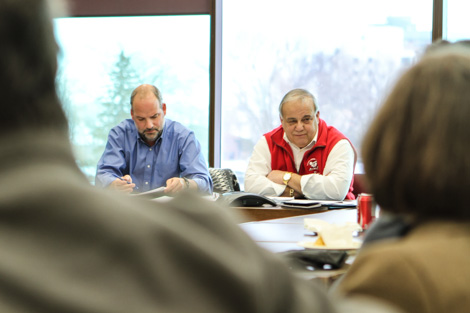
Picture from Sault Online

On February 19th, 2014 the Russ Ramsay board room at the Sault Ste. Marie Civic Centre was filled with people in support of maintaining passenger rail service along the Algoma Central Railway. The evening’s meeting was the first of three town hall meetings hosted by the Coalition for Algoma Passenger Trains, (CAPT).  This highly anticipated meeting brought together many individuals whose livelihoods and history will be destroyed if this train service is discontinued as anticipated at the end of April.

The meeting began with introductions followed by an explanation of the current situation from Al Errington, a local tourist business owner and CAPT member. He went into detail about how Transport Canada has modified their criteria for remote service and how the ACR no longer meets the Federal Government’s criteria for funding. Al also listed the members of the new committee that has been formed to help find a solution for the passenger railway issue.

The meeting continued with a presentation from Harry Gow, Founder of Transport Action Canada, whose mandate is to develop rail passenger services across Canada. The presentation covered many aspects of VIA rail and similarities were drawn between the current ACR situation and the VIA Rail situation. Mr. Gow was very knowledgeable and supportive of our rail service and he related well to his audience. He closed with a motivational, “Be organized. Stay organized and make a lot of noise!”.

The presentation that followed Harry Gow had a way of emphasizing the historical significance of the railway and really depicted a piece of what will be lost if the ACR passenger service is gone. The presentation was about an upcoming documentary along the ACR and the famous Group of Seven. Michael Burtch, Joanie McGuffin and Garry McGuffin have been working on their film for some time and have been on a “treasure hunt” of sorts in the hopes of photographing every location where the Group of Seven painted. It is an amazing project and the room was quite pleased to watch the trailer for their film. Unfortunately their filming is due to continue into the spring and fall of 2014, long after CN Rail’s new deadline of April 30th.

Linda Savory Gordon followed up with a note of support from the Canadian Federation of Students and read a letter to Lisa Raitt from the famous Canadian artist Robert Bateman. His support for passenger railway in the north was clear and the impact of losing such a historical artistic part of our heritage was emphasized further.

Finally, open discussion began and many stories were shared. Among the speakers was Rex Beatty, President of the Teamsters Canada Rail Conference, who speaks on behalf of the union representing CN Rail employees across Canada. He expressed his concern and support of maintaining this service and was shocked to find out that this was happening. CN employees will also be affected by this cut and their union was not informed ahead of time as would be expected in a situation like this. His words clarified that this train cancellation will affect all of Algoma, not only the tourist operators or cottage owners.

Cindy Lebrun of Tatnall Camp on Oba Lake also spoke to the group. Her business has been growing steadily and bringing people to our community for some time and if the train were to stop, her entire investment in her future and community would disappear.

It is hard to picture an entire 300 mile section of Canada suddenly closing its doors. Tourism and recreation are seldom promoted in Northwestern Ontario and yet there is a force of will in the north that seemed to be present at this meeting. For an area that is seldom promoted, there are an awful lot of supporters and this railway is a part of so many lives. It is understandable that the world changes as time passes and most communities need to adapt.

The question remains, how can a community adapt when almost half a province is closed to business, history, heritage and family?

Source: http://saultonline.com/community/a-busy-week-for-passenger-rail-in-algoma

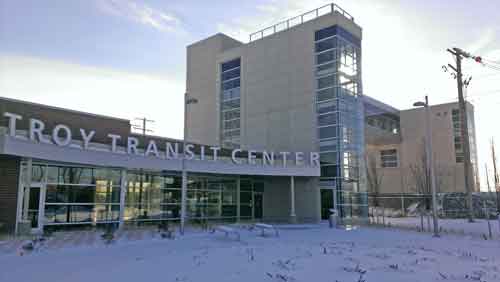
Ruling keeps Troy Transit Center closed, passengers in the cold

From the Detroit Free Press:

Photo by Larry Sobczak

A court ruling Friday added a fresh setback to 13 years of contentious efforts by Troy officials to open a regional transit center.

Oakland County Circuit Judge Leo Bowman denied the city’s request to be awarded immediate possession of the land that sits under the transit center.

Bowman’s ruling states that the land, which is surrounded by a shopping center at the southwest corner of Coolidge and Maple, is still owned by the shopping center’s developer. Now the city must file a new lawsuit, or negotiate directly, to gain ownership of the 2.7 acres from developer Gary Sakwa and his firm, Grand/Sakwa Properties, attorneys on both sides said.

“Everybody wants this center open — everybody I talk to,” Troy Mayor Dane Slater said after hearing of the ruling.

“I wish Mr. Sakwa would work with us in everybody’s best interest. His development there has been a very positive thing, and this transit center is only going to help that,” Slater said. The project was endorsed by Oakland County Executive L. Brooks Patterson and Gov. Rick Snyder, he said.

The center was finished by late fall, but Amtrak won’t sign a lease with Troy until the city owns the land, Troy officials said.

Since 2000, city officials have said that Troy owned the land. But in May, an appeals court unanimously ruled that Troy failed to abide by a court-ordered agreement signed in June 2000 that let Grand/Sakwa Properties build its $100-million shopping and condo complex while giving Troy exactly 10 years to fund its transit project. The court ruled that Troy missed the deadline.

In the lawsuit that Bowman dismissed Friday, the city offered to pay the developer $550,000, a figure arrived at through a 2010 appraisal conducted before the transit center was built, city attorney Lori Grigg Bluhm said. The judge’s ruling requires that the city get a current appraisal before returning to court, Bluhm said.

“I expect that is the course we will take,” she said Friday.

Still, if the city were to make a purchase offer that the developer accepted, the litigation would go away, she said. The Troy City Commission voted in November to set aside $1.8 million in federal grant money, left from the construction of the project, for possible purchase of the land, according to city documents.

Gary Sakwa has declined to comment on the issue for years. But in a 104-page legal response to the city’s lawsuit seeking ownership of the land, the developer’s lawyers at Dykema Gossett contended that the city must pay the developer for providing access drives through the shopping center. They ridiculed the city’s 2010 land appraisal as having been “coincidentally determined during a time of global real estate recession.”

“The city is going to have to go back and do it right — that is, make a good-faith offer,” said Alan Greene, attorney for Grand/Sakwa Properties.

Had the city gained immediate possession of the land on which the $7-million center sits, the center would have soon opened and Amtrak passengers would have been sheltered from the cold while waiting for trains inside the new building, Troy officials said.

For now, and perhaps months to come, Amtrak riders must continue to use a crude bus shelter, largely open to the elements, built on a concrete pad on the Birmingham side of the tracks.

Source: http://www.freep.com/article/20140223/NEWS03/302230053/