MINUTES
MICHIGAN ASSOCIATION OF RAILROAD PASSENGERS
MONTHLY MEMBERSHIP MEETING
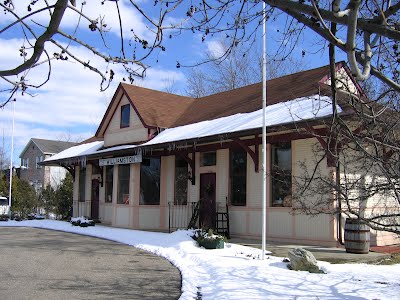
WILLIAMSTON DEPOT MUSEUM, WILLIAMSTON
JANUARY 18, 2014
Members Present: Hugh Gurney, Clark Charnetski, Steve T. Sobel, Rich Vavra-Musser, Larry Krieg, John Langdon, Dick Pekarek, Kazuya Fujita, Chuck Merckel, Jeanie Merckel, Michael Frezell, Charley Bonnell, Kim J. Powell, Dan Platz, Adam Tauno Williams, Doug Wilson, Kathryn Newell, Jared H. Becker, Steve Vagnozzi, Gerry Callison, Don Monteith, Andrew Kent, Diane Patterson, Robert Patterson, Robert Tischbein, Tim Hoeffner, Clayton Farmer
Also Present: Darryl Apps, Debra Alexander, CATA
Call to Order: Vice Chair Krieg called the meeting to order at 10:10 a.m. All present were asked to introduce themselves and their place of residence. Steve Sobel was asked to serve as timekeeper.
Guest Speaker: John Langdon introduced our guest speaker of the day, Debra Alexander, Assistant Executive Director of the Capitol Area Transportation Authority. Alexander then reviewed plans for the new East Lansing Multi-Modal Transportation Gateway designed to serve Amtrak, Indian Trails, Greyhound and Megabus. Talking from a site plan distributed to all, Alexander confirmed that the present East Lansing Transportation Center will be expanded and reconfigured, and will encompass almost all of the area between Harrison Road on the East, the Canadian National Railroad on the North and the CSX Railroad on the South. All but one structure, including the current Amtrak station, will be demolished. The site of the one remaining building closest to the diamond could serve commuter rail on the CSX line in the future.
A successful TIGER grant of $6.2 million will provide the majority of the funding for the $10 million project. Much of the remaining funding comes from the in kind donation by MSU of a long term lease on the property and a grant from MDOT.
The entrance drive off Harrison Road will lead to three areas, the first being a self paid parking lot occupying the northeast quadrant of the property. The lot will be divided into three areas, one for short term parking of 15-30 minutes, a second for 2-3 day parking and a third for parking up to one week. The entrance drive also leads to a drop off loop near the main entrance to the station where passengers can be dropped off and picked up. Thirdly, the entrance drive leads to the drop off and pick up area for taxis and intercity buses. The bus loading area is large enough for four buses to be loading and unloading simultaneously. Additional buses can be parked nearby.
The 8,000 square foot station is a roughly triangular structure adjacent to the CN tracks with seating all around the interior circumference of the building and additional seating outside near the tracks. The Amtrak ticket counter, office and baggage area are in the part of the station closest to the CN tracks. The intercity bus ticket office and baggage area are on the opposite side of the building. Rest rooms and the CATA Emergency Operations Center occupy the center of the facility.
At the three corners of the building are vestibules designed to be accessible when the facility is not staffed. Each of these vestibules has at least minimal seating. Unfortunately, public restrooms remain inaccessible when the building is not staffed.
A canopy around the entire structure offers additional waiting space. The building is all glass, providing excellent sight lines in all directions, mainly as a security measure. There are no hidden alcoves where individuals can lurk. There are no curbs, making the facility fully accessible.
Amtrak will be responsible for the rail platform, scheduled to be rebuilt in the next two years. Amtrak will need to negotiate with CN and FRA on platform features and height.
The fact that the electrical feed for the entire MSU campus passes through the project site complicates matters. Alexander hopes to complete lease agreements with MSU and wrap up negotiations with the prime contractor by March 1, when one of the few windows when power can be cut to the campus occurs. If successful, demolition of the existing buildings can then begin. A depth of 17 feet of peat must then be removed from the site and replaced with solid earth. During construction, a trailer at the Southeast corner of the property will serve as the ticket office and waiting room. About forty parking spaces will be available. Alexander is shooting for a project completion during the spring of 2016.
Recess: The membership meeting was recessed at 10:40 a.m. for the Executive Committee meeting. It resumed at 11:00 a.m.
Chicago Union Station: Krieg reported that he had met on January 3 with Amtrak officials Moe Savoy and Sid Birkett. A number of steps are underway to improve circulation at Chicago Union Station. Unfortunately, funding is not available for more ambitious plans because of the 2013 sequester. This includes funding for relocating the first class lounge. While the rental of the Great Hall brings in $1.5 -$2 million annually, that money goes into the Amtrak General Fund and does not benefit Chicago Union Station directly. The area designated as the coach waiting area continues to have insufficient room for current passengers and there is space for only two lines at any one time. Krieg feels Amtrak Central must be pressured to permit revenue generated by the Great Hall to be used for improvements at Chicago Union Station.
Krieg acknowledged that Vavra-Musser was correct that the Great Hall was used as a passenger waiting area during the Thanksgiving holidays, but added that seating in the Great Hall was very limited.
Chuck Merckel expressed hope that the newly formed Missouri-Illinois Passenger Association could bring pressure to bear.
Hoeffner noted that all affected state Departments of Transportation agree that the waiting areas for passengers are inadequate at Chicago Union Station. He suggested that MARP and other passenger advocacy groups clearly outline to the Chicago Amtrak staff the problems they see and ask them to come up with solutions. Even if clearly designated as recommendations, Amtrak staff in Washington are quick to bristle at written communications
Callison suggested MARP attempt to convince Amtrak to see the station properties they own as valuable real estate as do railroads in Europe and elsewhere. These railroads are making more from their real estate holdings than their rail operations. Valuable square footage at Chicago Union Station goes unused.
Future Meetings: Our next meeting will take place at the University of Detroit Mercy on February 15 with Dr. Leo Hanifin as speaker. We will meet on March 8 at the Herrick District Library in Holland. The planned April meeting in Mount Pleasant has been cancelled as we couldn’t find a Community Conversation partner. Krieg is working on a possible meeting at Wayne County Community College where Dr. Frank Dunbar is developing a course of study in light rail operations and maintenance.
Governmental/Public Affairs: Langdon reported that a morning Amtrak Thruway bus has been added from Grand Rapids to Kalamazoo, where it would connect with both westbound and eastbound Amtrak service. A new Amtrak Thruway person in Washington appears to be far more aggressive in developing new service. Langdon expressed fear that this new service could reduce ridership on the Pere Marquette.
Hoeffner responded that he did not know the new Amtrak Thruway person but supports all new options for public transportation. He is hopeful that this will open up the whole west side of the state for more Thruway buses.
Langdon expressed disappointment at the December ridership figures. In a more positive vein, he noted that the extra Pere Marquette on December 1 demonstrated that a second Pere Marquette with the same equipment was doable.
MDOT Report: As to ridership, MDOT Director of the Office of Rail Tim Hoeffner feels that we turned the corner on ridership in December, with ridership up on both the Wolverine and Blue Water routes. Revenue was up on all Michigan services including $100,000 on the Blue Water and $1.4 million on the Wolverines.
Norfolk Southern crews under contract with MDOT completed three seasons of work on upgrading the Wolverine tracks between Kalamazoo and Dearborn between August and November 21. Work for the year ended prior to the holiday travel season. Hoeffner foresees the new signals between Kalamazoo and Battle Creek becoming operational sometime in 2014.
The Troy Transportation Center is ready to go whenever condemnation actions turn that property over to the City of Troy. Platform construction at Dearborn will begin as soon as double tracking is complete. Hoeffner expects the new Dearborn Transportation Center to open in August and the track connection and PTC work at Grand Rapids to be completed during the first quarter of 2014, permitting that station to open. Planning for a new station in Ann Arbor is underway. The West Detroit crossover will be out for bids during the first quarter of 2014. The State of Indiana and Norfolk Southern are finalizing their agreement for upgrading the tracks between Porter, Indiana and the Illinois State line. Included will be an Amtrak siding just north of the Porter interlock.
Hoeffner will attend a briefing during the week of January 20 to learn the status of the new coaches for Michigan and other states. He is pleased that Siemens has been awarded the contract to build the new locomotives for the Midwest states and California.
For 2014, expect to see some double tracking between Dearborn and Ypsilanti, and progress on grade crossings and Positive Train Control. In the Battle Creek area, Hoeffner foresees an additional track parallel to the CN tracks from Gore to Barron, providing for easier access of passenger trains to the Battle Creek station. In the future, there would be a crossover of the CN tracks at Barron.
Southwest Ontario: Wilson thanked Hoeffner for the excellent presentation he made at a recent meeting in Southwest Ontario and his support for public transportation in that region. With more than 14 million inhabitants now, the Province of Ontario is beginning to see the value of public transportation beyond the Toronto-Hamilton metropolitan area.
Hoeffner responded by saying that Michigan actually has closer bonds with Ontario than with Ohio or Indiana in many ways.
Adjournment: Langdon moved adjournment. The motion was seconded by Vavra-Musser and approved by the members present. The meeting adjourned at 12:07 p.m.
Respectfully submitted: Accepted:
Hugh D. Gurney Robert Tischbein
Secretary Chair