All posts by admin

Che sorpresa ti aspetta nel vivace casinò lazybar: generosi bonus, giri gratuiti e una selezione di giochi colorati renderanno la tua serata fantastica.

Why don’t airlines just add more flights at the holidays?

From NBC News:

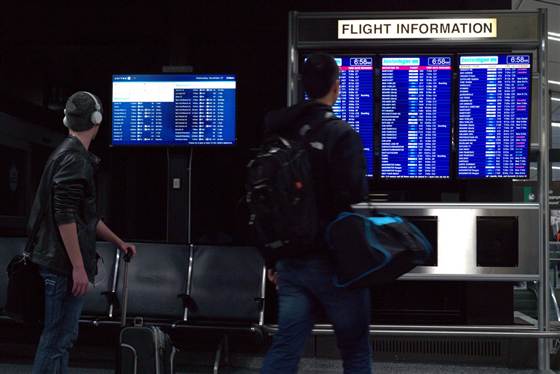
2D9797104-131127_airlines_hmed_0627p_blocks_desktop_mediumThe question is one you may have asked yourself while standing in line at the  airport or when trying not to scream in frustration while sitting on the tarmac  waiting to take off: If airlines know there will be a surge of passengers during  the holidays, why don’t they add capacity in the form of extra flights?

While it makes sense in theory, the reality is far more complicated.

Despite mergers in recent years and the retiring of older, less-efficient  planes, carriers have nowhere to turn for a dozen planes the week before  Thanksgiving.

That’s not how the commercial airline business was set up to operate,  industry experts said.

“It’s not realistic to think airlines could add planes for a few days,” said  Josh Marks, CEO of airline consulting firm masFlight. “The airlines would love  to have the flexibility to add capacity, but the system is not set up for it.”

There’s no Hertz for airlines looking to add a Boeing 737 for a week or  two—leasing companies don’t operate that way. And because airlines have  transformed themselves to be as lean as possible, they don’t keep “extra” planes  sitting around.

Even if the airlines could get their hands on, say, a dozen planes, who would  fly them or serve passengers? Carriers are already fully staffed and have crews  tightly scheduled. Most airlines have recalled all the pilots they furloughed  before the recession.

Even if some idle pilots were available for temporary hire, existing pilots  would be up in arms that “rental crews” were brought in to handle a particular  route.

System stretched to the max

On top of that, airport takeoff and landing slots are already jammed at many  of the busiest airports.

Take LaGuardia Airport in New York. Even if an airline wanted to add three or  four more flights out of the airport on the Tuesday before Thanksgiving, when  would they take off? LaGuardia is already slot-controlled, meaning the Federal  Aviation Administration limits the number of takeoffs and landings per hour, as  is Washington’s Reagan National Airport.

If one airline wanted to add three flights on that Tuesday, its competitors  would want to match it and add flights. Soon, the most congested airspace in the  U.S. would be even more so. You get the picture: Gridlock, raised to a whole new  level.

Increased air travel would mean more users of facilities whose infrastructure  is already threadbare.

“Our airports are so clogged up that we’re going to face Thanksgiving almost  every day in a few years in every airport,” Roger Dow, president and CEO of the  U.S. Travel Association, said recently.

Tighter capacity, higher fares

The argument for adding more planes also ignores one crucial factor to  airlines: profitability.

Keeping  capacity in check in recent years has allowed carriers to turn a profit. They  now fly fewer planes with a higher percentage of passengers. While we may not  like that there are few choices or discounted fares, that’s exactly what the  airlines want.

On the busiest days of the year, like the Sunday after Thanksgiving, airlines  will run their fleets faster and add as many flights as possible. According to  masFlights, Delta Air Lines will run 10.5 percent more flights on Sunday, Dec.  1, than it did on Sunday, Nov. 14.

“When it’s busy, the airlines are at capacity,” Marks said. “There’s no  wiggle room to add more.”

Source: http://www.nbcnews.com/travel/why-dont-airlines-just-add-more-flights-holidays-2D11663461

State Supreme Court denies Troy transit center appeal

From Crain’s Detroit Business:

Troy-transit-center-crainsTroy officials expect to present an offer today to reacquire the city’s transit center site from Farmington Hills-based Grand/Sakwa Properties LLC for $550,000 after the Michigan Supreme Court turned away its latest appeal in the long-running land dispute.

The high court this week denied Troy’s application for leave to appeal a May decision that the 2.7 acres of the transit center property had reverted from city ownership to Grand/Sakwa.

Monday night, the Troy City Council authorized City Attorney Lori Grigg Bluhm to offer $550,000 after obtaining appraisals on the site — and to pursue condemnation should the developer reject that offer. Bluhm said today the city expects to present the offer today, but the company would likely need some time to review and respond to it.

Gary Sakwa, co-founder and managing partner of Grand/Sakwa, did not immediately return phone calls seeking comment. Alan Greene, partner at Dykema Gossett PLLC and attorney for Grand/Sakwa, also could not be immediately reached.

At issue is an agreement for Grand/Sakwa to transfer title in 2001 on 2.7 acres near Maple Road and Coolidge Highway, where most of the transit center construction has been taking place.

The terms of that sale called for the land to revert to Grand/Sakwa in 10 years if the city hadn’t funded a transit center project by then; the city and company had conflicting definitions in court of what that term meant once the deadline came.

Bluhm said the city obtained permission from the Federal Transit Administration earlier today to add the acquisition cost to its budget for the transit center. The FTA previously authorized $1.6 million in funding toward the transit center cost.

“We’re about ready to go forward (with the offer). As of just a few minutes ago, today, we’ve got permission to go ahead with submitting that expense, since all federal funding for the project comes on a reimbursement basis,” she said.

The city hopes to get a response from Grand/Sakwa by early December, Bluhm said. Grand/Sakwa agreed to sell a portion of its 77-acre development for $1 more than a decade ago to develop the transit center, which broke ground last November.

Troy and neighboring Birmingham had secured several funding commitments from federal and other sources for the center, with a preliminary estimated cost of about $8.5 million, which the City Council reduced in 2012 to about $6.4 million.

Birmingham withdrew from the project in 2011. Grand/Sakwa contended that the project didn’t reach full funding in time, as the consent judgment requires, and sought to revert the property.

A three-judge appellate panel overturned the Circuit Court and ruled in Grand/Sakwa’s favor last May, prompting Troy to ask the Supreme Court to review it, but the high court is not legally obligated to hear the case.

Mark Miller, director of economic and community development for Troy, and Bluhm both said the transit center construction was substantially completed earlier this year except for a minor “punch list” of modifications. But the city is still finalizing a lease agreement for the National Railroad Passenger Corp., or Amtrak, to service the transit center.

Source: http://www.crainsdetroit.com/article/20131126/NEWS/131129894/state-supreme-court-denies-troy-transit-center-appeal-city-to-offer

High court rebuffs Troy in transit land case

From the Detroit Free Press:

Detroit Free Press photo

The Michigan Supreme Court apparently put an end to the City of Troy’s fight against having to pay for the land under its new Troy Transit Center.

The ruling, issued Monday but not made public until today, means the city’s multiyear legal battle with a shopping center developer has probably ended, Troy City Attorney Lori Grigg Bluhm said.

“We could ask (the high court) for reconsideration — I’m not sure we’ll do that,” Grigg Bluhm said. Instead, the city is poised to buy the land. On Monday, the Troy City Council voted to submit a purchase offer of $550,000 for the land, its appraised value, Grigg Bluhm said.

Troy officials have said for a dozen years that the city owned the land. But in May, a unanimous state Court of Appeals decision ruled that Troy failed to abide by the provisions of a court-ordered consent agreement, which let Grand/Sakwa Properties start building the $100-million shopping and condo complex that surrounds the center while giving Troy 10 years to fund its project. The court ruled that Troy missed the deadline.

The final price of the plot of land could be driven higher than $550,000 in negotiations with the development firm, or if a judge picks a higher value in an eminent-domain court case the city might file, according to parties on both sides. If so, Troy is ready with $1.8-million cash in the form of federal grant money left from the construction of the project, and approved for the purpose by Monday’s council votes, according to city documents.

This week’s developments are the latest in 12 years of efforts to plan, fund and build the transit hub, praised by Gov. Rick Snyder but the focus of a recall in 2012 against former Troy Mayor Janice Daniels, who vowed to block the project because she said it was a waste of federal tax dollars. No city funds have been directly spent on the project, although city staff have expended numerous hours on it. The center’s star-crossed history has made it a prime example of the contentious path that mass transit often takes in southeast Michigan.

City officials said they hope that Amtrak will be willing to sign a lease agreement with Troy, now that the city has the wherewithal to buy the land. Amtrak officials could not be reached for comment today. The center’s construction is done and “it’s ready to go,” Troy Mayor Dane Slater said Monday, after the council voted.

In the consent agreement, a plot of land behind the center’s stores and adjacent to Amtrak tracks was transferred by Grand/Sakwa Properties to Troy in 2001 for a token $1 for construction of a transit hub, according to the opinion. But the deal contained a key condition: Troy had exactly one decade to fund the center or lose the land.

“They had to do it by June 2010 (and) they didn’t,” Grand/Sakwa Properties attorney Alan Greene said in an August interview. Greene could not be reached today.

Greene said then that Grand/Sakwa Properties sought not only compensation for the land but also money to cover the shopping center’s anticipated costs of wear by transit riders on the access drives through the center’s property, use of its parking spaces by travelers and the added need for security, all linked to the future Amtrak station that borders Birmingham. Shopping center magnate Gary Sakwa is unlikely to give the city a bargain after it forced a court fight in 1999 when he asked to build the Midtown Square shopping center.

City officials have declined to comment on whether Troy is responsible for costs above the purchase price of the land. City Councilman Dave Henderson joined other councilmembers Monday night in emphasizing that no local tax dollars would be spent, only federal grant money administered by the Michigan Department of Transportation, to buy the land.

Source: http://www.freep.com/article/20131126/NEWS03/311260135/Troy-Janice-Daniels-transit-Amtrak-Michigan-Supreme-Court

CSX files to deactivate signals on Michigan line

From Trains News Wire:

CSX signals Photo by Brian Schmidt
CSX signals
Photo by Brian Schmidt

CSX  Transportation has filed with the Federal Railroad Administration to deactivate  the signals on its Saginaw Subdivision in eastern Michigan. The former Pere  Marquette line runs between Mount Morris, just north of Flint, and Plymouth, a  distance of about 55 miles.

The railroad seeks to remove 67  dispatcher-controlled signals, 20 automatic signals. In addition, 28  power-operated track switches will be converted to hand throw operation. It will  install new approach signals at MP CC-27.9, CC-32.9, CC-35.0, CC-49.1, CC-51.5,  and CC-74.9.

Two locations will remain dispatcher-controlled, with  signals remaining in operation. Those locations are at CP South Kearsley, MP  CC-33.54, and at CP Holly, CC-50.42. Both locations are at-grade crossings with  Canadian National rail lines.

In its filing, CSX states that the signal  system “is no longer needed for present-day operations.” If the signal  discontinuance is approved, CSX will operate the line with track warrant  control.

The line once supplied CSX with lucrative automotive and  chemical traffic from Flint and Midland. Now it is operated north of Mount  Morris by Lake States Railway. Lake State has operated that portion since  2005.

Trains News Wire is awaiting comment from CSX.


MARP.ORG editor note: The route described here is one potential route to reestablish passenger service to the Bay City/Saginaw/Flint area and it could be costly to restore the signals necessary for passenger trains once they are deactivated or removed.