Che sorpresa ti aspetta nel vivace casinò lazybar: generosi bonus, giri gratuiti e una selezione di giochi colorati renderanno la tua serata fantastica.
MINUTES MICHIGAN ASSOCIATION OF RAILROAD PASSENGERS EXECUTIVE COMMITTEE MEETING BANGOR AMTRAK STATION, BANGOR OCTOBER 12, 2013
Present: Robert Tischbein, Hugh Gurney, Jim Hinkins, Kay Chase, Jim Wallington, Rosemary Horvath
Also Present: Steve T. Sobel, Marilyn Guidinger, John Guidinger, Dave Vander Bee, Doug Wilson, Kristine Ballard, Jack Kessler, Chuck Merckel, Jeanie Merckel, Clark Charnetski, Dan Platz, J. P. DesCamp, Ron Leatz, Don Westcott, Barb Spaulding-Westcott, Ken Radzlaff, Dianne Patterson, Robert Patterson
Call to Order: Chairman Tischbein called the meeting to order at 2:30 p.m.
Treasurer’s Report: Tischbein reviewed the Treasurer’s Report as submitted by Treasurer Dave Randall. As of September 30, 2013, MARP’s JPMorgan Chase account stood at $34,379.45. Of this, $17,141.26 are Pratt Fund proceeds to be reinvested, leaving $17,238.19 available for current operations. Gurney added that those with questions could call Randall on the phone with their queries.
Chase moved acceptance of the Treasurer’s Report. The motion was seconded by Wallington and approved by the members of the Executive Committee present.
Minutes of the Executive Committee meeting in Manistee on August 10, 2013 were reviewed. Hinkins moved acceptance. The motion was seconded by Wallington and approved by the members of the Executive Committee present.
Detroit Metro Regional Chair: Jim Hinkins asked the be relieved of his duties as Regional Chair of the Detroit Metro Region and replaced by Robert Patterson, who has been serving as Assistant Regional Chair for the last year. Hinkins would assume the role of Assistant Regional Chair.
Chase moved to accept with regret the resignation of Jim Hinkins as Detroit Metro Regional Chair and appoint Robert Patterson to that position until the Annual Meeting in September, 2014. The motion was seconded by Gurney and approved by the members of the Executive Committee present. Wallington expressed the wish that Hinkins remain active so we can call on his knowledge and experience.
Adjournment: Patterson moved adjournment. The motion was seconded by Gurney and approved by the members of the Executive Committee present. The meeting adjourned at 2:45 p.m.
We hope you enjoy the issue and that you will let us hear your comments and suggestions. If you would like to write a story or suggest an item to be covered, email us at marprail@yahoo.com
For those without a PDF reader, click on the images below to view them full screen.
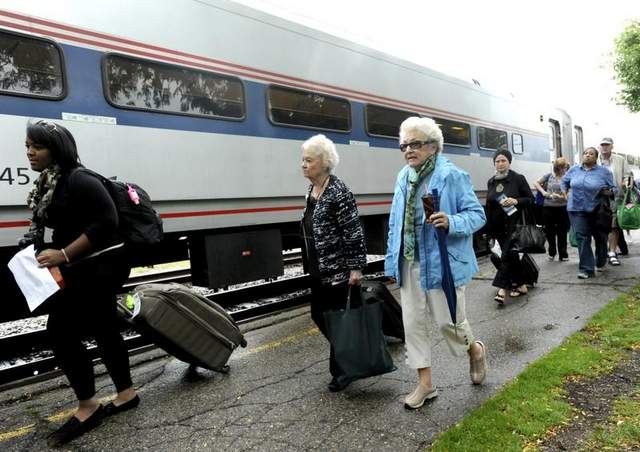
Passengers prepare to board an Amtrak train in East Lansing this month. / Greg DeRuiter/Lansing State Journal
EAST LANSING — “Train 365 westbound, now arriving.”
The announcer’s voice stopped soft chatter outside East Lansing’s Amtrak station as the Friday morning train pulled up to the platform. Passengers destined for a long weekend in Chicago, or points in between, rolled their luggage to the open coach doors. Conductors in dress uniform waved them aboard. Within 10 minutes, the train was moving again, en route to Battle Creek.
Marla Schroeder planned to meet a friend from Kentucky in Chicago. She has taken the train to and from East Lansing since she was in high school. Schroeder, of Lansing, would rather spend the trip leafing through a book than navigating heavy traffic.
“It’s cost-effective, because by the time you drive in and pay the gas and the tolls and the parking, the ticket is free,” she said.
Schroeder doesn’t need to be convinced to travel by rail. But even as ridership in Michigan has tracked upward in recent years, Amtrak, the sole national passenger rail line, is looking for more. The Washington-based railroad and the state plan to invest millions over the next several years to improve service on Michigan’s three passenger train lines.
For a fee, riders now can stow their bicycles on board some trains. Internet service is coming in January. And, upgraded tracks between Kalamazoo and Dearborn will allow trains to travel at higher speeds, leading to shorter trips.
While travelers might find the new amenities appealing, Amtrak and the state of Michigan have a more basic financial goal: Boost ridership and fare revenue so the subsidies the state has been paying since the 1970s drop.
The strategy becomes more important this year because federal legislation approved five years ago requires Michigan to pick up the tab for the third route it hadn’t subsidized — the Wolverine line between Pontiac and Chicago that counts Detroit, Ann Arbor, Jackson, Battle Creek and Kalamazoo among its stops.
Michigan for decades has underwritten the Blue Water line between Port Huron and Chicago — a route that includes the popular stop in East Lansing — and the Pere Marquette between Grand Rapids and Chicago. But the federal law that took effect last week shifted the cost of the Wolverine and other previously federally funded routes to the states in part to bring more uniformity to the way the nation’s passenger rail service is funded.
For Michigan, that means taxpayers will pay more than $25 million for the fiscal year that started Tuesday to operate the three lines — more than triple the roughly $8 million they have been paying the past few years to offset losses on the Blue Water and Pere Marquette routes.
For some, the solution might be not to pay. But with nearly 800,000 riders in Michigan last year, it’s not that simple. After all, the federal government doesn’t require the states to provide passenger rail service the way it mandates, for example, that some cities must have airline service.
“If we don’t pay for any Amtrak service … we have no Amtrak service,” said Tim Hoeffner, the state’s rail director.
But banking on millions of dollars in improvements also won’t lead to a quick payoff. The state — and taxpayers — still will end up backing Amtrak for the foreseeable future. The railroad projected $2.9 billion in nationwide revenue for 2013 in a May budget request. It asked Congress for $2.6 billion in the current fiscal year.
“(Is Amtrak) going to cover all of their operating costs? I think that’s a little bit of a stretch,” Hoeffner said. “Are they going to significantly reduce the amount of state funds that have to go into those operations long-term? I think that’s easily, easily done.”
To do that, Hoeffner said, traveling to Chicago by train needs to be as convenient as driving — if not more so.
A road trip from East Lansing to Chicago can take about four hours — or less, depending on traffic and weather. Amtrak’s online schedules say a direct trip by train is exactly four hours. But because there is only one direct round trip on the Blue Water line each day that departs before 9 a.m., travelers who want to leave later end up taking a commuter bus to the Battle Creek or Kalamazoo stations and connecting on the Wolverine line to Chicago.
That means a longer trip.
To be sure, a four-hour drive to Chicago is not guaranteed — traffic is notoriously heavy in and around the nation’s third-largest city. But Amtrak also is hindered by delays. Its Michigan routes were on schedule just 38 percent of the time in the past year, with most of the delays the result of interference from other trains on freight-owned tracks.
“We have huge traffic volumes on (Interstate) 94,” Hoeffner said. “We just need to have a few of those people move over and we think that we can be very successful.”
To entice passengers to consider rail, Amtrak opened up space for bicycle storage on its Blue Water line. Packing a bike costs a passenger an extra $10.
The Michigan Department of Transportation will spend about $1 million to bring Wi-Fi technology to all three of Amtrak’s lines by January, which will be a free service for riders. The state and Amtrak believe the investment will be recouped after the first year because more people will choose the train — they can’t browse the Internet while driving — although it can’t say how many more riders Amtrak would need to break even.
Perhaps most important in its competition with the car, Hoeffner said, MDOT and Amtrak are working to upgrade a section of state-owned track between Kalamazoo and Dearborn with new signals and smoother rails in order to push trains up to 110 mph. Most passenger trains through Michigan travel at a top speed of 80 mph.
Amtrak owns a 100-mile stretch of track between Kalamazoo and Porter, Ind., 80 miles of which already can handle higher-speed trains. It’s the only place outside of the Northeast where the faster trains run.
The state believes this will most benefit passengers who ride from Pontiac and Detroit to Chicago, a trip that can take as long as 6½ hours by train. The drive typically is about two hours shorter.
MDOT bought the Kalamazoo-to-Dearborn section in December from Norfolk, Va.-based freight operator Norfolk Southern Corp. for $140 million. It received close to $350 million in federal funds to buy and improve the track and will contribute $37.5 million in state funds. Work already has started this year.
Upgraded service, however, doesn’t come free.
Since the 1990s, the state has steadily paid more to Amtrak out of a general transportation fund, even though more people are boarding its trains. Ridership reached a high of nearly 793,000 passengers in 2012, the same year MDOT funding topped $8 million.
In 1994, by comparison, Amtrak carried more than 589,000 passengers and MDOT paid just $965,000 — $1.5 million when adjusted for inflation.
MDOT’s current subsidy amounts to about half of Amtrak’s total revenue for its Michigan service, Hoeffner said. None of the state’s three Amtrak routes are profitable.
In a report issued in March, the Brookings Institution, an independent policy research firm based in the nation’s capital, found that Amtrak’s shortest-distance routes made up 80 percent of the railroad’s total ridership in 2012. But those same routes — those under 400 miles, a group that includes the Blue Water, Pere Marquette and Wolverine lines — also relied heavily on state aid. Together, funding from states cut their collective operating loss in 2011 by more than half, to $166.1 million.
Congress formed Amtrak in the 1970s after freight companies, which also provided passenger service, began to drop routes to avoid bankruptcy or otherwise cut their costs. Federal and state governments began to subsidize passenger rail service that same decade because revenue from riders wasn’t proving enough to cover its costs.
MDOT contracts with Amtrak to provide passenger service in Michigan. The state has supported the Blue Water and Pere Marquette lines since they were formed in 1974 and 1984, respectively.
Until last week, the Wolverine line that passes through Detroit en route to Chicago had been federally funded. But the 2008 federal law that just went into effect created requires states to pick up any operating losses not covered by riders on specific routes outside of the Northeast that are shorter than 750 miles.
Amtrak spokesman Marc Magliari said passenger rail service is an economic boost for communities that have stations. Government funding of Amtrak is no different than funding of roads, he said, adding that road maintenance relies partly on gasoline taxes that are insufficient to pay for the total operation.
“The fact is, without an operating agreement and the cost, and the contract to pay for the cost, there won’t be service,” Magliari said. “The more people that are on the train paying a higher price, the more passengers are paying the fixed costs of operating the trains.”
About the services
Amtrak runs three routes through Michigan to Chicago — the Blue Water, which departs from Port Huron; the Pere Marquette, which leaves from Grand Rapids; and the Wolverine, which starts in Pontiac and passes through Detroit.
Blue Water
Number of daily round trips: 1
Cost (2011): $14 million
State subsidy (2011): $5.4 million
Other revenue (2011): $6.3 million
Pere Marquette
Number of daily round trips: 1
Cost (2011): $6.8 million
State subsidy (2011): $2.6 million
Other revenue (2011): $3.4 million
Wolverine
Number of daily round trips: 3
Cost (2011): $37.2 million
State subsidy (2011): None
Other revenue (2011): $20.2 million
Source: The Brookings Institution
Annual state subsidy
Below, the amount of the Michigan Department of Transportation has contributed to run Amtrak service in Michigan.
Fiscal Year*
Subsidy
1994
$965,000
1995
$1.1 million
1996
$1.9 million
1997
$2.1 million
1998
$2.1 million
1999
$2.1 million
2000
$2.1 million
2001
$5.7 million
2002
$5.7 million
2003
$5.7 million
2004
$7.1 million
2005
$7.1 million
2006
$7.1 million
2007
$6.2 million
2008
$6.1 million
2009
$6.4 million
2010
$7.6 million
2011
$8.2 million
2012
$8.1 million
2013
$8 million
2014**
$25.2 million
*Michigan’s fiscal year runs Oct. 1 to Sept. 30 annually **Starts Oct. 1
Source: Michigan Department of Transportation
Passenger counts
Below, ridership counts from selected stations on the three lines.
Station
2013*
2012
2011
2010
2009
2008
2007
Port Huron
21,588
26,763
24,073
18,707
13,162
14,584
12,619
East Lansing
43,533
64,975
66,400
62,241
51,280
51,161
48,025
Battle Creek**
33,004
50,178
48,767
51,671
48,417
56,401
53,426
Detroit
47,523
67,140
66,378
70,747
58,169
59,799
56,494
Grand Rapids
34,350
55,068
55,125
52,282
49,196
56,281
53,546
*Year to date **Battle Creek contains ridership numbers from Blue Water and Wolverine lines
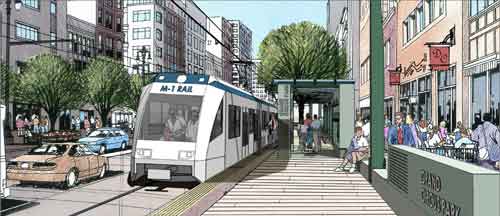
Here’s an artist’s depiction of the light rail project. (From the M-1 Light Rail Group.)
City of Detroit officials have awarded a contract to Parsons Brinckerhoff for design review and construction quality assurance services for the Woodward Avenue Streetcar project.
The firm will assist the city with reviews of the project’s design plans, criteria manual and specifications, Parsons Brinckerhoff officials said in a press release. Also, the firm will serve as the city’s quality assurance representative during the project.
The 3.2-mile line is designed and will be built by M-1 Rail, a consortium of businesses, institutions and foundations that are working in partnership with the city and Michigan Department of Transportation.
Construction is expected to start later this month, with completion slated for fall 2015.
The November 2 MARP meeting will be held in Chicago Union Station where we will be treated to tours of behind-the-scenes locations within the station, including the fascinating Control Center which guides the movement of all trains within the adjoining yard. You will also have a chance to observe situations that have been addressed by the Chicago Union Station Passenger Action Taskforce (CUSPAT) headed by Larry Krieg.
The meeting will begin at 11:30 following the arrivals of Wolverine #351 c. 10:47 a.m. and Pere Marquette #371 c. 10:38 a.m. Taking the Blue Water is not recommended since it does not arrive in Chicago until almost noon.
If you do not qualify for the usual 10% or 15% discounts (MARP, Senior, Military, AAA), you may request a Convention Fare Discount Code (10% discount) by SENDING AN EMAIL TO marprail@yahoo.com . We’ll email the information you need to obtain this fare.
For overnight lodging, one of our members has found a reasonable rate at the Embassy Suites Chicago, 1445 Lake Cook Rd, Deerfield, IL 60015. The hotel offers complimentary drinks Friday and Saturday evenings, a full breakfast in the morning, and a shuttle to the nearby Lake Cook Road Metra station. See below for instructions for finding and booking a room.
If you have questions or need more information, EMAIL US AT marprail@yahoo.com .
Click on the senior citizen or AARP or AAA line on the left side of the screen
You will get several options and pricing – note that the cheapest gives you no refund if you cancel; it might be worth it if you are 100% sure you are going; the next cheapest are the senior / AARP rates.
Click to make your choice. Be sure you have your credit card handy.