All posts by admin

Che sorpresa ti aspetta nel vivace casinò lazybar: generosi bonus, giri gratuiti e una selezione di giochi colorati renderanno la tua serata fantastica.

Modified schedules affect some weekday Wolverine trains beginning Sept. 9, 2013

Mondays through Thursdays,
Only September 9-12, 16-19 and 23-26, 2013

amtrakskedchange

The first of three phases of a Michigan track improvement project for the 2013 construction season begins on September 9. While it will cause some service and schedule changes, the result will be improved ride quality and more reliable service for the Wolverine Service and Blue Water trains. These improvements are part of the Accelerated Rail Program being carried out by Amtrak for the Michigan Department of Transportation (MDOT).

Eastbound Train 350: Mondays through Thursdays

• Train 350 will terminate at Jackson. Bus service will be provided between Jackson, Pontiac and all intermediate stations. The bus will operate according to the train’s schedules

• In addition, Train 350 will depart all from Chicago 20 minutes earlier (at 7:00 a.m.), and will operate 20 minutes earlier Jackson and all intermediate stations.

Westbound Train 351: Mondays through Thursdays

Train 351 will depart Pontiac 45 minutes earlier (at 5:00 a.m.), and will operate 45 minutes earlier to Chicago and all intermediate stations.

Westbound Train 353: Mondays through Thursdays

• Train 353 will originate at Jackson and operate to Chicago and all intermediate stations.

• Bus service will be provided between Pontiac, Jackson and all intermediate stations. The bus will depart all stations 30 minutes earlier than the published train times.

Trains 352, 354 and 355: Possible Delays

Trains 352, 354 and 355 will operate as scheduled, but may encounter delays of approximately 30 minutes.

Weekend Service – Possible Delays: All Wolverine Service trains will operate as scheduled on Fridays, Saturdays and Sundays, but may encounter delays of approximately 30 minutes.

MDOT is leading a three-state effort to improve the 300-mile corridor from Pontiac and Detroit across Michigan, through northwest Indiana and to Chicago. The result of these and future infrastructure improvements will allow Amtrak trains in mid-Michigan to operate at speeds up to 110 miles per hour, as they do now for 80 miles in Western Michigan and part of Indiana. This is currently the longest stretch of higher-speeds in the Midwest, with the Wolverine Service and Blue Water trains carrying passengers at the highest U.S. speeds available outside the Northeast.

Reservation and train status information is available on Amtrak.com, Amtrak’s  free mobile apps and at 1-800-USA-RAIL (1-800-872-7245).

Michigan Railroad History Conference to be held in Bay City on Oct. 5, 2013

The 12th Michigan Railroad History Conference will take place at the Doubletree by Hilton Hotel, in downtown Bay City on Oct. 5, 2013. Registration begins at 8:00 a.m. The program begins at 8:30 a.m. and lasts until 5:00 p.m. There will be an Afterglow (location announced at conference) with an opportunity for informal discussions about Michigan railroad history after the conference.

Field trips will be caravan style with no additional cost if attending the conference. RSVP necessary to attend (trips may be canceled due to low attendance). Field guides will be handed out at point of embarkation. The DBC&W field trip will start at 9:00 a.m. on Friday, October 4th and run from Bay City to the east. The Interurban field trip will start at 9:00 a.m. on Sunday, October 6th and run from Bay City to the south. Field trip participants will be contacted with the assembly points.

The Saginaw Valley Railroad Historical Society will have their museum facilities open for tour Friday afternoon and evening October 4th. Highlights of the museum include the Hemlock depot and the Mershon Tower. The museum is located at 900 Maple Street in Saginaw. A map to the museum can be obtained by emailing the conference chair.

Poster presentations are still accepted until August 15, 2013; contact conference chairperson if interested in exhibiting a poster. Poster presentations are static visual presentations to be exhibited in the areas around the presentation room. They should be able to communicate the story of the subject without the poster presenter being present and be of reasonable size.

Check for conference updates on www.MichiganRailroadHistory.org or the Michigan Railroad Calendar at www.MichiganRailroads.com, a major source for contemporary and historic railroad information.

For questions, contact the MRHC Chairperson, Mark Worrall, at markxworrall@hotmail.com (preferred) or at 616-881-1375 and for hotel rooms blocked for discounted price..

Directions to the Hilton: From Interstate I-75, Exit 162A East (M-25) for 2 miles. Hotel is just over the bridge on the left along the Saginaw River. After crossing the bridge, turn left at the first light which is Saginaw Street. Drive two blocks, turn left on 6th Street. Entry is straight ahead. In the heart of downtown Bay City between 6th and 7th streets on the East bank of the Saginaw River.

Click on this image for a printable registration form.

Column: Whatever happened to the gloriously refurbished train station for downtown Jackson?

BY Brad Flory on m-live.com:
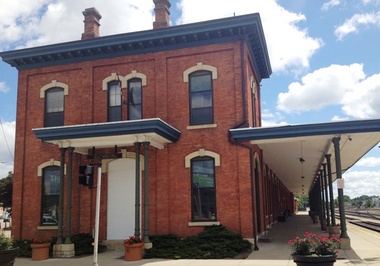
13328395-largeThis city sometimes seems more skilled at tearing down what’s left of its assets than at building them up.

The Sheraton Hotel, Jackson’s main fruit of 1960s urban renewal, was ripped down in the spring, after a generation of civic efforts failed to deliver new life to the building.

The former Consumers Energy headquarters was marketed by City Hall for office and commercial redevelopment, but that failed, too. Now the building is being knocked down in an exceptionally slow and fire-prone demolition project.

One asset purportedly being built up is Jackson’s vintage train station.

Whatever happened to that?

Dignitaries gathered in Jackson on April 9, 2009, to announce $930,000 in federal “stimulus” money would fix up the train station built in 1873.

Ultimately, it was said, about $15 million more would be sought to transform the station into an “intermodal” hub with buses, taxi stands, shops and restaurants.

“I think things will move fast,” an architect predicted. He was wrong.

Four years later, little has changed at the train station to meet the eye.

Amtrak cut hours of operation last year, so the station is locked after 2:30 p.m. Passengers arriving or departing on later trains cannot go inside to use the bathroom or sit down.

“What a welcome to our town for any first-time arrival,” a friend said in disgust.

If the “intermodal hub” ever pans out, the station could at least stay open when Amtrak does not staff its ticket counter.

The best I have been able to learn, about $300,000 was spent on asbestos removal at the station. Drainage and masonry work will begin this month. So something is happening.

A Michigan Department of Transportation spokesman said the goal of an intermodal hub remains alive, but first the structural integrity of the building must be addressed.

That makes sense, but four and a half years seems a long time to address it.

My impression – and it could be wrong – is this project is complicated by ownership issues. City and state government dreamed up the intermodal project, but they don’t own the train station. Amtrak owns it.

An Amtrak spokesman suggested my impression of slow progress is faulty. Work has proceeded right along, he said.

Jackson has either the oldest or second-oldest train station still used for passenger service in the United States. That should be kind of a big deal.

Historic appeal aside, those old brick railroad buildings are cool when refurbished. Look at the Wendy’s a few hundred yards from the station.

This is one Jackson asset that still begs to be built up.

Source:  http://www.mlive.com/opinion/jackson/index.ssf/2013/08/whatever_happened_to_the_glori.html#incart_river_default

Bikes allowed on Port Huron-Lansing-Chicago route beginning Sept. 6.

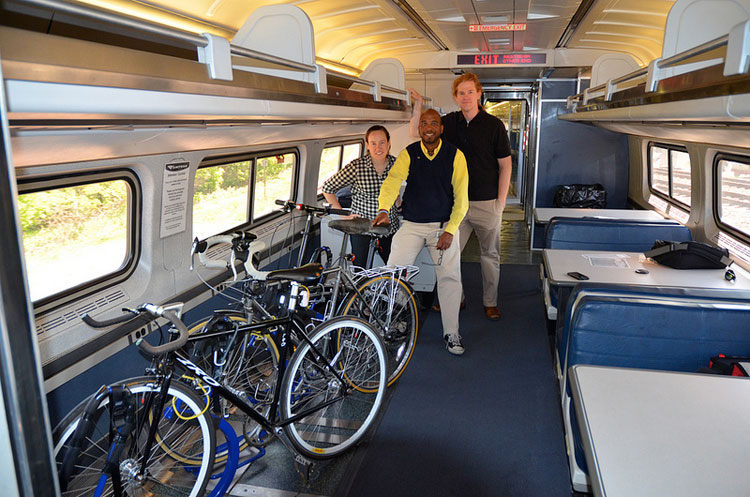
Rory Neuner, LMB's Board Vice Chair and John Lindenmayer, LMB's Advocacy & Policy Director with Derrick James, Director, Government Affairs - Central Amtrak during the May 15th bikes on trains demonstration ride. (Photo courtesy the Michigan League of Bicyclists)
Rory Neuner, LMB’s Board Vice Chair and John Lindenmayer, LMB’s Advocacy & Policy Director with Derrick James, Director, Government Affairs – Central Amtrak during the May 15th bikes on trains demonstration ride. (Photo courtesy the League of Michigan Bicyclists)

Starting Sept. 6, bicycles will be accepted aboard the Amtrak Blue Water (Trains 364 & 365), a service sponsored by the Michigan Department of Transportation (MDOT) that operates daily between Port Huron and Chicago via East Lansing and Kalamazoo.

Uniquely in the Midwest, railcars on the Blue Water have been modified to create an area to securely carry up to four bikes per train on a popular route that serves two large state universities (Michigan State and Western Michigan) and several bicycle-friendly communities. There is a $10 charge for transporting a bike, in addition to the railfare, and cyclists are encouraged to lock their bikes onto the brackets mounted in the café cars when they walk their bicycles on the trains.

“We’ve worked with the cycling community to modify these railcars so bikes can be secured without disassembly,” said Derrick James, Amtrak Director of Government Affairs-Central and an avid cyclist who is one of the Amtrak liaisons to the cycling community. “We look forward to measuring the success of this service with an eye to expansion to additional routes across our national network.”

“Bicycle travel and tourism is important in the state of Michigan,” said Tim Hoeffner, director of the MDOT Office of Rail. “Amtrak inclusion of bike service on Blue Water trains is beneficial for Michigan travelers.”

Amtrak services in the Chicago Hub also welcome walk-on bikes on routes in Illinois and Missouri in unmodified railcars. For more information, visit Amtrak.com.