All posts by admin

Che sorpresa ti aspetta nel vivace casinò lazybar: generosi bonus, giri gratuiti e una selezione di giochi colorati renderanno la tua serata fantastica.

Group pushes for railway expansion in Canada

From The Toronto Sun:
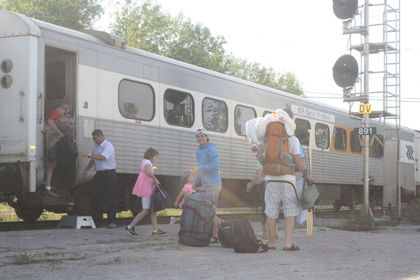
About a dozen passengers arrived on the Ontario Northlander train at the Washago, Ont., station on Aug. 30, 2012, from Cochrane. (QMI Agency file photo)

Around the world there is a quiet revolution brewing. Everywhere except Canada, that is.

It’s based on shared principles and cuts across all political divides by uniting disparate communities through a single, common goal.

No, it’s not a religion, faith or creed.

It wants a return to railways as an efficient way to move people and produce as modern roads and skies become more crowded by the day.

You can find new railways being built in Africa and Asia, Europe and the United States. Some are for fast passenger movement and more and more involve dedicated freight lines.

If this transport revolution is ever to reach critical mass here in Canada, a country that has lost more than 10,000 kilometres of track since 1990 in places as far apart as Vancouver Island and Quebec, it will need to start in the heavily populated province of Ontario.

The Northern & Eastern Ontario Rail Network (NEORN) is a lobby group dedicated to that goal.

It launched a major push Monday to reawaken Canadians to the benefit of rail transport.

Members say concern about rising fuel and road maintenance costs, the need to dramatically reduce carbon emissions and provide the transportation infrastructure necessary for economic development, drives their call for policy makers to return to the values of 100 years ago when steel rails pulled the nation together as one.

“Look back to early last century and Canada was a world leader in rail development,” said Dr. Linda Savory Gordon, Professor Emerita at Algoma University and NEORN member.

“This is a huge country that could only be made to work by binding it together with steel ties. We seem to have lost that vision. Maybe it is time to catch up with the rest of the world and start renewing our rail infrastructure.”

Savory Gordon singles out Ontario as a growing province, rich in population density and major cities, that is counter intuitively closing down rail lines at an unprecedented rate.

As recently as March 2012, the Ontario government announced it was divesting the Ontario Northland Transportation Commission. The Northlander, a six-days-a-week passenger train service connecting Cochrane to Toronto, was discontinued six months later.

Pressure is building to close more lines and switch investment dollars to freeways. This is despite the fact that rail transport is anywhere from 1.9 to 5.5 times more fuel efficient than truck transport and a single train can move as much as 280 trucks.

NEORN claims neglect of rail in Ontario has erected barriers to social and economic opportunity while delivering a substantial over-investment of taxes into road repair and expansion. It points to a Leger poll taken in 2009 that showed significant public support (87%) for government investment in rail.

“We live in an era of concern about rising fuel and road maintenance costs,” Savory Gordon said, “and we have the desperate need to dramatically reduce carbon emissions.

“Rail addresses those concerns. It is a real alternative to more public money being sunk into roads and there is ample evidence that planners across the globe believe in that.”

The South African province of Gauteng is a case in point.

It hosts two major cities in Johannesburg and Pretoria and with an almost identical population base and geographic spread as Ontario, has launched a transport master plan which aims to make rail the ‘backbone’ of the region’s public transport network.

Gauteng has released a 25-year plan for a more integrated approach to transport planning, ensuring that residential and commercial development takes place along the province’s main passenger rail corridors.

It also stipulates general aims to modernize all existing rail networks and set future performance targets.

The report states that: “Due to under-investment during the past number of decades, passenger rail transport is not playing its appropriate role in Gauteng.

“There are indications that metropolitan transport planners do not consider the service levels on the rail transport system as sufficiently reliable to form the backbone of an integrated public transport network.”

If that sounds familiar, then replace the word ‘Guateng” with `Canada’ and you see why NEORN wants Canada to start thinking creatively and use steel rails as a starting point.

Source: http://www.torontosun.com/2013/08/24/group-pushes-for-railway-expansion-in-canada
Michigan Amtrak trains to get Wi-Fi

From M-Live.com:

amtrak-connect-logoAmtrak passengers will be able to catch up on email and surf the web while riding trains through Michigan starting next year.

The Michigan Department of Transportation is spending about $1 million to install Wi-Fi by January. MDOT anticipates the service will lead to increased ridership and revenues that should more than offset the cost, said spokesman Nick Schirripa.

Amtrak, which receives state and federal subsidies, has three routes in Michigan: The Blue Water stops in East Lansing, Kalamazoo and seven other cities on its way from Port Huron to Chicago; the Pere Marquette runs from Grand Rapids to Chicago; and the Wolverine travels through Pontiac, Detroit Ann Arbor, Jackson, Kalamazoo and several other cities on its way to Chicago.

“The installation of Wi-Fi service on Amtrak trains in Michigan makes passenger rail travel more attractive, efficient and productive throughout the state,” Tim Hoeffner, director of the Michigan’s rail office, said in a statement. “We are proud Michigan is the first Midwestern state to offer Wi-Fi service on all its Amtrak lines.”

Passengers will be restricted from streaming videos and downloading files larger than 10MB in order to maintain service for all users.

About 75 percent of Amtrak passengers already have access to free Wi-Fi, and more service should be added in the coming months.

Michigan’s funding for Amtrak is slated to increase to $25.2 million in the fiscal year starting Oct. 1, up from $8 million this fiscal year, according to Bridge Magazine. The $1 million for Wi-Fi is coming from the rail portion of the 2013 comprehensive transportation fund, not the 2014 budget.

A record-setting 793,000 people traveled on Amtrak’s three routes in Michigan last year, while revenue grew to $27.8 million.

Amtrak board member Tom Carper spoke about the rail service at the Michigan Rail Conference at Lansing Community College’s West Campus on Tuesday.

“The demand for service is greater than it’s ever been,” he said, noting factors such as teenagers aren’t rushing to get their driver’s licenses like they used to do.

Source:  http://www.mlive.com/business/index.ssf/2013/08/michigan_amtrak_trains_to_get.html

M1 Rail streetcar RFPs in the works, will be issued by October

From Crain’s Detroit Business:

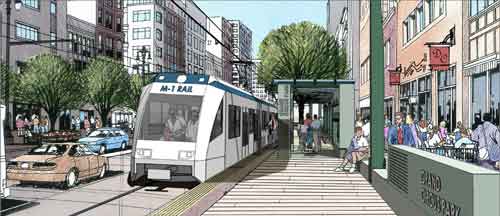
Here's an artist's depiction of the light rail project. (From the M-1 Light Rail Group.)
Here’s an artist’s depiction of the light rail project. (From the M-1 Light Rail Group.)

The nonprofit M1 Rail effort said this week it tentatively plans to issue a request for proposals by no later than the end of October for streetcars to operate on the $137 million Woodward Avenue line in Detroit.

M1 CAO Heather Carmona told attendees at the Michigan Rail Conference in Lansing on Tuesday that the streetcar RFP is in the works, and that the goal is to have it issued by the end of October. An M1 spokesman later confirmed the RFP goal, and added that it could come sooner.

M1 executives in the past have told Crain’s they are looking at both off-the-shelf purchase of six streetcars or attaching themselves to another system’s order, which is a common practice in the transit industry because it can reduce turnaround time and cost.

Portland, Seattle, Tucson, Salt Lake City and Cincinnati are cities M1 had previously said it has looked at that have rail vehicle orders in process.

M1 didn’t provide any additional details about the RFP, so it’s unclear if interest in those systems remains.

M1 took a special interest in Cincinnati’s $20 million procurement of five streetcars for its $110 million plan to install a 3.8-mile downtown line using a blend of bonds, taxes and private donations. Groundbreaking on the project took place in February 2012, and the line is supposed to be running by 2014.

In April 2012, Cincinnati selected Elmira, N.Y.-based CAF USA, a subsidiary of Spain’s Construcciones y Auxiliar de Ferrocarriles S.A., as its preferred vendor to manufacture the five streetcars, with an option for up to 25 more cars. Delivery is expected to take 18 months.

Cincinnati’s streetcars are very similar to what Detroit is seeking.

The model used in an M1 report to the federal government was the Siemens S-70 Ultrashort, manufactured by Germany’s Siemens AG.

The cars are double-ended, with operating controls at both ends and passenger doors on either side, and are powered by aerial electrical lines.

The low-floor cars allow passengers to step directly onto the trams from elevated boarding platforms alongside the trains. Each seats 60 people, with room for 120 more standing.

The streetcars are expected to be powered, for at least a portion of the Woodward route, by aerial power lines over the vehicles.

Under “Buy America” requirements triggered by the use of federal money, the streetcars for the Detroit and Cincinnati projects must be at least 60 percent manufactured domestically.

Streetcars typically cost between $2 million and $6 million apiece, depending on size and options, and multi-vehicle orders usually include payment for spare parts and other ancillary costs.

The city of Tucson in 2010 gave Clackamas, Ore.-based manufacturer United Streetcar LLC a $26 million contract for seven 180-passenger streetcars to operate on its 3.9-mile, $196 million line known as the Sun Link. An eighth streetcar was added to the order last year for $3.6 million.

Streetcar RFP the latest contract move

The M1 streetcar RFP represents the latest step in a series of major contracts that will be awarded to make the light rail line a reality.

Other M1 project bids already awarded include San Francisco-based URS Corp. to do design work and Kansas City-based HNTB Corp. to act as owner’s representative on the project.

On July 30, Alameda, Calif.-based civil construction firm Stacy and Witbeck Inc., which has built 17 transit systems, was awarded the project’s construction manager and general contractor bids from a pool of five companies.

Detroit-based White Construction Co. has been subcontracted by Stacy and Witbeck to work on the project.

Because engineering is still underway, a maximum contract price hasn’t been determined for Stacy and Witbeck, M1 said.

Future M1 bids will include an estimated $9.5 million for construction of a vehicle storage and maintenance facility, and a contract for a private-sector vendor to operate and maintain the streetcar system at an estimated $5.5 million annually.

Work on Woodward is expected to begin this fall between Larned and Adams streets, and M1’s goal is to be operating by the fourth quarter of 2015.

M1’s plan is a mostly curbside-running, fixed-rail streetcar circulator system, co-mingled with traffic, with 11 stops between Grand Boulevard and Congress Street. It will run in the median at its north and south ends.

M1 Rail is a nonprofit using a blend of public and private funding to finance the rail line on 3.3 miles of Woodward Avenue.

The streetcar loop – with a predicted 3 million yearly users – will cost an estimated $5.1 million annually to operate, rising to $6.5 million by 2022, according to project organizers.

M1, which launched in 2007, has said it will endow a $10 million fund to operate and maintain the system for up to 10 years, until 2025, at which point the group plans to donate the project assets and operating responsibility to the regional transit authority.

M1 Rail is led by Penske Corp. founder Roger Penske and Quicken Loans Inc. founder Dan Gilbert, the project’s co-chairman; Peter Karmanos Jr., founder of Detroit-based Compuware Corp.; and the Ilitch family, owners of the Detroit Tigers, Detroit Red Wings and Little Caesar Enterprises Inc.

Major construction commitments of $3 million have been secured from Wayne State University, Quicken Loans, the Ilitch companies, Penske Corp., Compuware, Chevrolet, Chrysler Group, Blue Cross Blue Shield of Michigan, the Detroit Medical Center, Henry Ford Health System, Wayne County government, the Ford Foundation and the W.K. Kellogg Foundation. The Hudson Webber Foundation has pledged $1 million.

The $3 million commitments are for the display advertising rights to a station along the route. The Troy-based Kresge Foundation has pledged $35.1 million, part of which already has been spent, and it gave an additional $3 million as a “backstop” grant.

The Detroit Downtown Development Authority has earmarked $9 million for M1. Another $16 million is from federal New Market Tax Credits, which have to be sought annually. Plans also include a $22 million commercial loan.

Source: http://www.crainsdetroit.com/article/20130828/NEWS/130829862/m1-rail-streetcar-rfps-in-the-works-will-be-issued-by-october

MARK YOUR CALENDAR – MARP’s 40th Annual Meeting is Sept. 14, 2013

It’s Our Birthday!

imagesCA6TE8WKThis fall the Michigan Association of Railroad Passengers is celebrating 40 years of providing assistance to passengers, advocating for expanded and improved passenger train services in Michigan, and supporting preservation of historic railroad stations.
To mark this milestone, a number of special presentations are scheduled for our 40th Annual Meeting on Saturday, September 14, 2013, at Durand Union Station, 10:30am – 2:30 pm.

A postcard announcement of the meeting will arrive in your postal mailbox in a few days. Prompt return of the postcard, enclosed in an envelope along with your check, will be greatly appreciated. This will assure that a lunch is ordered for you and for any guests you plan to bring with you.

All who have enjoyed TRAINS Magazine over the years will be enlightened and entertained by our keynote speaker, Kevin P. Keefe. Mr. Keefe has his roots in Michigan and has played a key role in the success of Kalmbach Publishing’s TRAINS Magazine, where he serves as Vice President-Editorial.

John DeLora, who assembled a group of like-minded individuals back in 1973 to found The Michigan Association of Railroad Passengers, is rifling through his slides and papers to give us a look back at the challenges and successes of these four decades of MARP and passenger trains in Michigan.

Tim Hoeffner, head of Michigan’s Office of Rail, has been invited to update us on the exciting projects that are moving us forward into the next four decades.

Thinking big, we have also invited Joseph C. Szabo who heads the Federal Railroad Administration. We’ve been told, he looks forward to opportunities to meet with folks near his Midwest home.

Remember, too, that we are collecting your stories and any artifacts, memorabilia, or photographs that document MARP’s activities over the years. Let us know what you have and we’ll figure out a way to display and share it at the meeting. Reply to marprail@yahoo.com if you have something to share.

Wishing Us All A Happy Birthday!

Michigan Association of Railroad Passengers

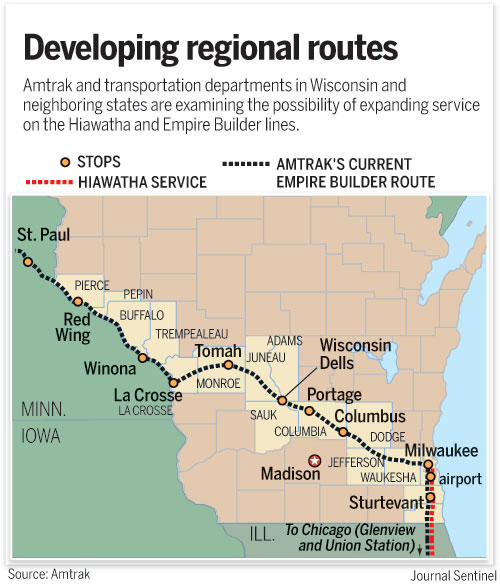
Amtrak considers expanding Hiawatha and Empire Builder lines

From the Milwaukee Journal Sentinel:

AMTRAK19GTrains from Milwaukee to Chicago and St. Paul, Minn., may be faster and more frequent in the near future, as Amtrak and transportation departments in Wisconsin and neighboring states study the possibility of expanding service on regional routes.

Encouraged by ridership that has doubled over the past decade and standing-room-only conditions on some trains, the Wisconsin Department of Transportation has plans to add three express trains to the Hiawatha route, boosting the number of trips a day from seven to 10.

The express trains would skip local stops, serving only Union Station in Chicago, Mitchell International Airport and downtown Milwaukee, and reach a maximum speed of 90 miles per hour, compared with 79 mph now, decreasing travel times by 11 minutes.

“The department really feels that people are becoming aware of the Hiawatha service and its convenience, and are looking for alternative modes of transportation,” said DOT spokesman Brock Bergey.

Bergey said the DOT expects demand to continue to increase.

“The Hiawatha service continues to grow, and the department is very interested in making sure we can meet the needs and desires of the traveling public,” he said.

In a 2011 survey by the Texas Transportation Institute, more than half of Hiawatha passengers on weekdays were commuting or making a business trip, while about three in four weekend passengers were visiting family or taking a trip for fun. A significant number of passengers, 14%, said that if the train weren’t available, they would not have made a trip. Avoiding highway congestion was the primary reason people took the train.

A recently completed project has paved the way for added trains by making it easier for passenger and freight trains to bypass one another on the tracks and stay on time, Bergey said. New crossovers, which allow trains to switch tracks, and other infrastructure went into operation in January, according to Canadian Pacific Railway Ltd., a publicly traded freight company that owns the tracks.

The Hiawatha expansion project is in its early stages. A study developing a service plan and assessing environmental factors — such as noise, erosion and wildlife effect of added trains — is underway, Bergey said, and a draft could be ready in a few months. Cost estimates weren’t yet available.

Two public hearings will be scheduled in Wisconsin and Illinois, after which a final plan will be submitted to the Federal Railroad Administration. If approved, the proposal will move to design and construction phases.

Ridership growth is also driving plans for a second daily train on the Empire Builder route, which grew by 16% from 2011 to 2012, that links Chicago, Milwaukee, the Twin Cities and stops to the west, including Seattle, Amtrak spokesman Marc Magliari said. Amtrak is conducting the study.

“A second round-trip is a significant improvement for passengers by providing more same-day trips without overnight stays and by making it more likely our scheduled arrivals and departure times meet their travel needs,” Magliari said.

A draft of a feasibility study should be available in December, and would focus on adding a second train at current speeds, 79 mph. It would terminate in St. Cloud, Minn., instead of continuing on to Seattle as the existing route does.

While stops east of St. Paul would be the same as the Empire Builder route, stops west of St. Paul could travel to St. Cloud via Fridley or Minneapolis, said Praveena Pidaparthi, Minnesota DOT’s passenger rail planning director. The study is analyzing schedules, infrastructure requirements and operating costs, and developing ridership and revenue forecasts.

“It’s the first baby step we’re taking on increasing service on this corridor,” Pidaparthi said.

If a second Empire Builder train is feasible, there will be a more detailed analysis, and representatives from Minnesota, Wisconsin and Illinois would have to come to a cost-sharing agreement for capital and operation costs before the project could proceed, Pidaparthi said. States are responsible for portions of costs on routes less than 500 miles, she said.

The study on a second train is separate from Minnesota’s continued pursuit of a high-speed rail line from Chicago to the Twin Cities, a project that Gov. Scott Walker opted out of when he became governor, rejecting $800 million in federal money. Minnesota’s high-speed rail study is in the first phase of analyzing the environmental impact, with completion expected in 2015, and considers the existing Empire Builder route.

Several groups in favor of expanding the Hiawatha and Empire Builder routes say both lines have had proven success and would be a boon for the economy.

The added trips on the Hiawatha, in particular, would be positive for economic development, strengthening a vision of southeastern Wisconsin, Chicago and northwestern Indiana as one mega-metro area, said Metropolitan Milwaukee Association of Commerce spokeswoman Julie Granger.

“The stronger connections we have to what is a huge thriving city can only benefit the region,” Granger said.

All Aboard Wisconsin, a group that advocates for transit, is drafting a bill officials hope is offered in the Legislature this fall that would establish a rail plan asking for state financial support for expanding the Hiawatha and Empire Builder, said spokesman Gary Goyke, a former state senator. Goyke said rail expansion would help the economy and tourism as well.

Source: http://www.jsonline.com/news/wisconsin/amtrak-considers-expanding-regional-routes-b9977124z1-220133441.html