Category Archives: News

Che sorpresa ti aspetta nel vivace casinò lazybar: generosi bonus, giri gratuiti e una selezione di giochi colorati renderanno la tua serata fantastica.

Plan to rebuild Chicago Union Station finally starts to roll

chicago-union-station-renovation-plan-launched.jpg


After years of studies and collective hand-wringing, a coalition of local government units and Amtrak today is announcing the first real steps to finally rebuild the crowded and outmoded Union Station.

On tap immediately are a new passenger lounge and repairs to the stately but leaky 219-foot-long skylight that covers the building’s Great Hall.

But more much more expansive work, especially widening train platforms, providing better street-level access and opening a direct connection to the Chicago Transit Authority’s Blue Line, aren’t yet funded, though Amtrak is moving to lease potentially lucrative air rights for high-rise office development.

“Chicago Union Station is an enormous asset to Amtrak as well as the city of Chicago,” Amtrak Vice President and Chief of Business Development Stephen Gardner said in a statement in advance of today’s announcement. “Amtrak is committed to working in partnership with our stakeholders to . . . deliver value for the company and help realize the full vision of a vibrant transportation hub interwoven within an integrated mixed urban district.”

chicago-union-station-set-for-renovation.jpg

Photo by clarkmaxwell/Flickr.com

Union Station is the third-busiest rail terminal in the country, home to not only Amtrak’s mid-continent operations but dozens of Metra trains each day, noted Mayor Rahm Emanuel. “Modernizing Union Station is a positive development for residents, travelers and businesses across the city.”

The new activity—which seems to have the city, Amtrak, Metra, CTA and Regional Transportation Authority all on the same page—will come in phases, some fast and some slow.

The quickest is the announcement today that Amtrak will use $14 million of its own money to build a new lounge that will double the space for sleeping-car and business-class passengers at concourse levels, restore the skylight, upgrade heating and create banquet and event space. Those projects are to be completed by the next year.

Officials including U.S. Sen. Mark Kirk, R-Ill., also will officially unveil the restored grand staircase, of “Untouchables” movie fame.

Second, Amtrak et al. will issue a request for proposals for a firm to plan and do preliminary engineering on 13 high-priority improvements.

Included on that list are 13 fixes identified in a prior master plan, including expanding the lobby and giving it much improved direct access to Canal Street, new entrances at Adams, Madison and Jackson, widening two platforms with the addition of elevators and escalators, construction of a tunnel to the nearby Ogilvie station, renovation and expansion of retail space and opening of a tunnel to the Clinton Blue Line station.

The agencies have agreed to share about $5 million in costs for the preliminary engineering, but no source yet has been identified of needed funds, which easily could pass $100 million. The preliminary design work is scheduled to be done in 2017.

Finally, Amtrak also is announcing it’s issuing a request for information for a master developer who could design, build and finance “expansion opportunities”—including air rights over Union Station, use of vacant space in the facility, and construction in nearby property on the Near West Side.

Amtrak says it will use the same process to try to cash in on the value of its real estate holdings in other cities.

Officials also are seeking federal loan funds. As previously reported, Emanuel recently was in Washington in search of such money, and Sens. Kirk and Dick Durbin, D-Ill., are pushing to tap a federal low-interest loan pot of more than $30 billion.

More: http://www.chicagobusiness.com/article/20151016/BLOGS02/151019878/plan-to-rebuild-union-station-finally-starts-to-roll

VIA restores early Saturday train to Windsor Oct. 31

From the Southwestern Ontario Transportation Alliance:

VIA6420_20150507_Chatham-1024x768VIA Rail Canada is reinstating the early morning train from Windsor and Chatham to Toronto on Saturdays starting on Oct. 31, 2015. The early evening service from Toronto to Windsor on Fridays will also be reinstated, providing extra capacity at this peak travel time.

Both services had been suspended since 2012 as part of a series of austerity measures to cope with a cut to VIA Rail’s operating budget made by the previous federal government, with the train idling in London on Friday nights instead of continuing to Windsor. The restoration of these services was one of the low-cost measures to improve mobility options for local communities proposed in the Network Southwest report.

The restoration of the early morning train on a Saturday once again makes it possible for local families to visit Toronto for the day, without spending hours in highway traffic or staying overnight, to visit the Ontario Science Center, the Royal Ontario Museum, the new aquarium, or to attend major league sporting events.

Train #70 will leave Windsor at 05:30 and Chatham at 06:18, arriving in Toronto just after 10am, and the last train back from Toronto to Windsor leaves just after 7pm.

VIA Rail has also recently refreshed its onboard catering menu to include breakfast wraps and improved dinner options, and has been refurbishing coaches to improve the on-board experience. VIA Rail is also working on three crossing safety improvement projects in the Bothwell area that will reduce speed restrictions on the route, making journeys to London and Toronto faster.

Once fully implemented, the recommendations of the Network Southwest report would reduce journey times by thirty minutes, allowing train #70 to leave Windsor after 6am.

A train ticket to Toronto and back costs around $90 for adults and $50 for children. VIA Rail posts discounts to its website and Facebook page every Tuesday, and has offered deep discounts for families travelling in the summer holidays.

Source: http://www.swota.ca/the-ghost-train-returns/

First day of service for Amtrak’s experimental platform in Ann Arbor

Amtrak and RLE International (an engineering firm) worked with the Michigan Department of Transportation to develop an innovative system for getting people easily onto trains. People needing wheels for their mobility have been a special concern, given that many trains’ floors are several feet above the level of the platform at most stations around the USA. With this system, gentle slopes lead up to a platform at the same height as the floor of train coaches. To allow freight trains to pass the platform safely, however, it must be a couple of feet from the train. This system bridges the gap with a sliding platform that can be remotely controlled by Amtrak iPhones, or deployed manually.

The first, experimental installation was built at the Ann Arbor, Michigan, Amtrak station. Dedicated on July 23, 2015 – the 25th anniversary of the Americans with Disabilities Act – the platform was not put into regular service until September 23, when it was used for train 353, Wolverine service Detroit/Pontiac to Chicago. The first full day of use, September 24, bagan with the station-stop shown in this video by train 351, also to Chicago.

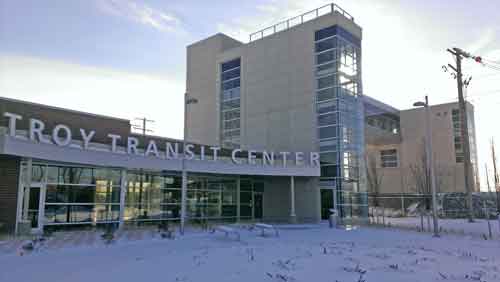
Troy, Grand Sakwa settle suit on transit center property cost

From The Troy Sentinel:

Photo by Larry Sobczak

While the city and Grand Sakwa Properties have settled on the cost of the property that the Troy Multi-Modal Transit Center sits on, who will reimburse the city for the additional cost is not yet clear.

While the city paid Grand/Sakwa $3.1 million Sept. 3 and the lawsuit was dismissed, Oakland County Circuit Court Judge Leo Bowman must sign the final order dismissing the case, which had not been filed at press time.

Troy City Attorney Lori Grigg-Bluhm explained that the matter was decided by case evaluation, a procedure in which three attorneys put a value on a case, which both parties accepted.

Bowman signed an order Aug. 15, 2014, giving the city the title to the land and requiring the city to pay developer Grand Sakwa Properties $1.07 million, based on a land appraisal.

Grand Sakwa had donated 2.7 acres of the total 77-acre mixed-use commercial and residential property at Maple and Coolidge to the city of Troy on the condition that Troy would develop the land for use as a transportation center. The consent agreement — dated June 2, 2000 — required that the city fund the center within 10 years of the date of judgment, which the Michigan Court of Appeals ruled never happened.

Last summer, Alan Greene, attorney for Grand Sakwa, said Grand Sakwa did not believe $1.07 million to be a proper number.

The transit center grand opening was Oct. 15, 2014.

The case evaluation award that the city must pay was set at $4.15 million, which includes all costs, including Grand Sakwa’s attorney fees and the land value. The city paid the $1.07 million to Grand Sakwa last summer to gain title of the land.

Grigg-Bluhm said that based on a trial court decision on Michigan condemnation law, the city and Grand Sakwa were required to value the property to include the transit center structure, rather than the vacant parcel.

Greene could not be reached for further comment before press time.

The 2,000-square-foot transit center building has a waiting area and public restrooms, an elevator, a 90-foot pedestrian bridge from the building to the tracks, a crash wall, platform enhancements, designated parking on the Troy side, and slips for taxis and buses, although the  Suburban Mobility for Regional Transportation bus schedule does not include a stop at the transit center at this point.

Under the terms of a Federal Rail Administration Grant, the FRA has the right to demand reimbursement of the $6.62 million cost of the transit center if it is not operated for at least 20 years. If the center was  to be abandoned, the city could be disqualified from any further federal transportation grants, Grigg-Bluhm said.

The city will work with the FRA, the Federal Transit Administration, the Michigan Department of Transportation and SMART for reimbursement of the settlement amount.

“The city does intend to seek all available federal funding,” Grigg-Bluhm said.

She noted that funding is available through the FTA and the FRA, and that the city needs to go through procedural steps to seek it.

The terms of a 20-year lease agreement with Amtrak stipulate that the city perform all necessary maintenance on the center and cover operating expenses, for which Amtrak will reimburse the city 100 percent.

“I’m very confident when all is said and done that Troy taxpayers will not have to pay for a federally funded project,” said Troy Mayor Dane Slater.

“We didn’t dip into the reserves,” Slater said of the $3.1 million payment. “We can use the transit center. It belongs to the city. It (the lawsuit) is over, which is very good. My goal is that Troy taxpayers will not pay for a federally funded project. I’m very optimistic.”

Source: http://www.candgnews.com/news/troy-grand-sakwa-settle-suit-transit-center-property-cost-86198

SEMCOG awarded $250,000 grant for Bus Rapid Transit project

From The Royal Oak Daily Tribune:

The Southeast Michigan Council of Governments will receive $250,000 in federal funding to support the development of a Bus Rapid Transit project along Woodward Avenue, the U.S. Department of Transportation announced Monday.

SEMCOG is among 21 organizations nationwide that will receive a share of $19.5 million in grants from the U.S. Department of Transportation’s Federal Transit Administration to support comprehensive planning projects that improve access to public transit.

The funds are made available through FTA’s Transit-Oriented Development Planning Pilot Program for communities that are developing new or improved mass transit systems, the agency reported.

SEMCOG and the transit authority are planning the Bus Rapid Transit for a 27-mile corridor along Woodward Avenue from downtown Detroit to Pontiac.

Specifically, the the local funding will go towards creating a plan for communities to guide development around transit facilities; formulating strategies for economic growth; assessing development opportunities in the corridor; and evaluating the use of mixed income housing and public private partnerships in relation to the project, the report said.

“Our nation’s transportation demands have exceeded our capacity, causing millions of Americans to lose precious time stuck on congested roads and transit systems,” said U.S. Transportation Secretary Anthony Foxx. “By investing in transit planned around housing, jobs and services, these communities are creating ladders of opportunity for their citizens and laying a strong foundation for economic development that our growing nation demands.”

A list of transit projects selected to receive federal funding can be found online at www.fta.dot.gov/grants.

Source: http://www.dailytribune.com/general-news/20150915/semcog-awarded-250000-grant-for-bus-rapid-transit-project