Category Archives: News

Che sorpresa ti aspetta nel vivace casinò lazybar: generosi bonus, giri gratuiti e una selezione di giochi colorati renderanno la tua serata fantastica.

Getting Back on Track

From Hour Detroit magazine

On the evening of Oct. 24, 1998, downtown Detroit was quite literally ground zero. Breathless reporters were perched on rooftops. Every TV station was live. Video beamed across the country via satellite. And then, at 5:47 p.m., explosions ripped through the 87-year-old J.L. Hudson building, and it collapsed in a plume of dust. While crowds — and Mayor Dennis Archer — cheered, Miles O’Brien, then a rising star at CNN, felt something else entirely. “Oh, I cried. I cried like a baby when they imploded Hudson’s,” he says without a trace of embarrassment. “I’m a fourth-generation Detroiter. … My whole family worked at Hudson’s.”

If these feelings had been festering for years, O’Brien found himself in December 2008 with an unexpected chance to do something about it. Dropped by CNN in budget cuts that claimed the entire science team, O’Brien landed in the world of public television as anchor of Blueprint America, a documentary series about America’s crumbling infrastructure. In the latest installment, Beyond the Motor City (PBS, Feb. 8), O’Brien turns conventional wisdom about Detroit on its head with the hypothesis that his hometown is not only poised for a rebirth, but could once again transform transportation in America.

Read more:
http://www.hourdetroit.com/Hour-Detroit/February-2010/Getting-Back-on-Track/

High-speed rail would get Michigan’s economy back on track

From Ann Arbor.com

Michigan rode the automobile to prosperity in the 1950s and ‘60s. But now we find ourselves falling further and further behind in the new economy. If we hope to catch up, one of the answers has to be high-speed rail.

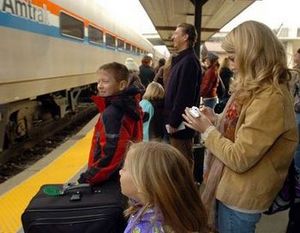
Thumbnail image for Thumbnail image for Thumbnail image for Amtrak090824.jpg

That is why it’s disappointing to see Michigan’s efforts toward high-speed railroad service languish, while the federal government funds similar projects elsewhere in the Midwest, as well as in states like California and Florida.
Yes, Ann Arbor and the state as a whole will benefit from the $244 million in federal stimulus funds that were announced last month. That money will improve the existing Amtrak service between Detroit and Chicago, which stops in Ann Arbor. We welcome any federal investment in rail service, but these improvements will not bring Michigan closer to its goal of high-speed rail service.

Read more:
http://www.annarbor.com/news/opinion/high-speed-rail-would-get-michigans-economy-back-on-track/

Guest Commentary: MDOT not taking full advantage of toll credits

From The Grand Rapids Press

Last month, the Michigan Department of Transportation canceled 243 future road and bridge projects around the state instead of seeking to use the multi-million dollar private investments in the Ambassador Bridge Gateway Project, inspection plazas and other capital improvements.

By doing so, MDOT is ignoring toll credits made possible by the past and future private investments by the Ambassador Bridge and Detroit Windsor Tunnel. Before MDOT pushes gas tax increases, it only makes sense to take full advantage of these private toll credits to the greatest extent possible.

In short, toll credits are earned for all the money we spend on road projects. For every dollar we spend, we get four dollars back.

Read more:
http://www.mlive.com/opinion/grand-rapids/index.ssf/2010/02/guest_commentary_mdot_not_taki.html

Study estimates benefit to Niles from having depot at $5 million

From The Niles Star

DOWAGIAC – Dowagiac’s historic train depot is garnering national notice, station host Ron Leatz reported to Dowagiac City Council Monday night.

Amtrak illustrated its season’s greetings Dec. 18 with five U.S. railroad stations, including Dowagiac’s.

“We went nationwide just before Christmas,” Leatz said.

Next, Leatz drew attention to the winter 2010 issue of The Michigan Passenger, a quarterly newspaper reporting passenger rail news since 1973 that is published by the Michigan Association of Railroad Passengers Inc. (MARP).

The dominant photo published with Editor J.R. Valderas’ Dowagiac-datelined report on the statewide celebration Oct. 21, 2009 of the 35th anniversary of the Blue Water shore-to-shore line shows the “crowded platform” for the arrival of the Chicago-to-Port Huron train.

“We had the largest turnout of any station on the Michigan line,” said Leatz, who organized the local commemoration with Vickie Phillipson, Chamber of Commerce and Downtown Development Authority program director.

The program included remarks by City Manager Kevin Anderson, The Museum at Southwestern Michigan College Director Steve Arseneau and Dowagiac Mayor Don Lyons, who presented a proclamation to Tim Hoeffner of the Michigan Department of Transportation.

On another page, the “Workin’ on the Railroad” color photo highlights milepost 177 in Dowagiac on Dec. 1, 2009.

Leatz belongs to MARP, which also publicized Dowagiac and Niles in its fall 2009 edition.

Valderas wrote about the “remarkable odds” that the Niles Michigan Central station received a new larger historical marker to replace one from 1993 as part of Joseph Weiser’s Eagle Scout project through Troop 555 of Huntly Baptist Church.

Built in 1892, Niles’ depot is listed in the National Register of Historic Places and has starred in such movies as “Continental Divide,” “Midnight Run” and “Only the Lonely.”
Weiser spent two years raising $3,425 for the large informative marker installed Aug. 3 and dedicated Aug. 9, 2009, with the Boy Scout receiving a key to the city.

Each side tells a story.

Facing the parking lot is the story of the Richardsonian Romanesque-style depot itself. The Ohio sandstone was meant to impress passengers traveling to the 1893 Columbian Exposition. It replaced a ramshackle structure that the Niles Daily Star dissed as “the old cockroach repository.”

Grounds featured a pond and gardens designed by German immigrant John Gipner, who presented roses grown at the station to women arriving in Niles.

The side facing the garden tended by the Four Flags Garden Club, tells about Michigan Central Railroad and its Oct. 2, 1848, arrival to usher in “an era of prosperity.”

Freight operations had been transferred to Elkhart in 1958.

Leatz also pointed out Chairman John DeLora’s column, “Stations benefit communities,” on a study done for Grand Valley State University which quantified that local towns receive by having an active train station.

The cities with the most service reap the most benefits.

The study looked at 22 Michigan stations along all three routes serving the state, which assisted Amtrak last year with $7.1 million to provide service on the Pere Marquette and Blue Water routes.

Amtrak spends $13.6 million in Michigan.

DeLora called Niles “a big winner,” with “nearly $5 million in benefits for a city of fairly modest size.”

Article source:
http://www.nilesstar.com/2010/02/23/study-estimates-benefit-to-niles-from-having-depot-at-5-million/

MDOT Officials Discuss Pere Marquette Line In Saint Joe

From WSJM 1400 AM and 94.9 FM

State transportation officials were in Saint Joseph this week to talk about the future of the Pere Marquette Amtrak line. Recent documents from MDOT regarding plans for a multi-state rail line called the Midwest Regional Rail Initiative indicate that the passenger service could be rerouted out of Saint Joe and Bangor, instead heading through the Kalamazoo region…and the Southwest Michigan Planning Commission organized Wednesday’s gathering for residents and others to express their concerns. State Representative John Proos was there, and tells us that he’s trying to convince MDOT that the West Michigan routes of the Pere Marquette are worth maintaining:

Listen to the interviews:
http://www.wsjm.com/pages/6447700.php?contentType=4&contentId=5648369