Category Archives: News

Che sorpresa ti aspetta nel vivace casinò lazybar: generosi bonus, giri gratuiti e una selezione di giochi colorati renderanno la tua serata fantastica.

Algoma Central Railway supporters: Don’t sign that railway deal

From Soo Today:

1297524343209_ORIGINAL

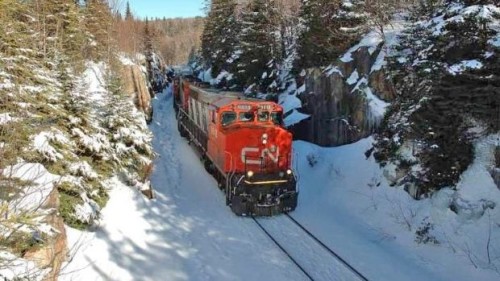
After more than a year of lobbying to keep passenger service running between the Sault and Hearst, a local working group is now recommending the city not sign a funding agreement with the successful proponent.

In a report to council included in the agenda for the June 22, 2015 regular meeting, Tom Dodds, head of the Economic Development Corp. and interim chair of the passenger rail working group, recommends against signing a funding agreement with Railmark Canada at this time, citing the Wixom, Michigan company’s failure so far to provide proof it has the working capital necessary to proceed.

Dodds recommends “other options” be explored to secure a third-party operator for the Sault-to-Hearst passenger Service and that he and the mayor write a joint letter to the Minister of Transportation and CEO of CN requesting “their continued commitment” to efforts to find a short and long-term solution.

“As of June 16, 2015, the Stakeholder Working Group had received no confirmation that RCL had working capital financing, no confirmation of the equity that RCL would be injecting into the company, no draft term sheet from a working capital financier, nor does the Stakeholder Working Group have any written comments from RCL regarding the draft agreements – despite two prior written formal demands with delivery dates and consequences,” says the report to council.

The federal government announced at the end of March that it would provide a $5.3-million subsidy over two years, on the condition the funds flow to Railmark Canada through the city of Sault Ste. Marie.

A working group report to council earlier this year says CN selected Railmark to run the passenger line from among three competing bids in the fall, after which members of the local working group began pressing the Ministry of Transportation for funding.

This came after what the working group has described as a “thorough analysis of (Railmark’s) bid” prior to final negotiations with CN taking place in January and after “due diligence” being undertaken on CN’s part before it signed a deal with Railmark as a third-party operator in March.

City council has also lent its support to efforts to save the rail line, having sent letters to federal Transportation Minister Lisa Raitt in support of the working group’s earlier recommendations that Railmark be funded as a third-party operator.

It is unclear what happens if the city doesn’t agree to fund Railmark.

MP Bryan Hayes, who has lobbied his Conservative colleagues for funding to keep the line running, told SooToday last week that he expects the funding would still be in place if the city doesn’t sign an agreement with Railmark and that the ball would be back in CN’s court.

CN reiterated this morning that should the city and EDC not complete the agreement with Railmark, it has no plans of continuing to operate the passenger service.

“The company is clear that it is not prepared to operate the Hearst passenger train,” said Mark Hallman, CN’s director of communications and public affairs.

CN will continue to operate the Agawa Canyon Tour Train after plans to have Railmark take over that service did not come to fruition.

CN will not be operating the Snow Train.

Dodds says in the report that Railmark Canada continued, as of Tuesday, with efforts to secure the required working capital and raises the possibility of a lawsuit should the city refuse to continue to negotiate with Railmark.

The report also notes that CN officials have been working with Railmark Canada earlier this week to help the company put a term sheet together for financing.

Dodds has said that if the Railmark deal does not come through, he hopes there would be an opportunity to find an alternative third-party operator.

According to the working group’s report to council, Railmark Canada has been operating the Sault-to-Hearst passenger service throughout May and June three times a week at its own expense – estimated to total more than $200,000 since May 7.

CN employees continue to operate the train under Railmark’s oversight, though Railmark employees are “gradually” taking their place, Hallman said.

Source: http://www.sootoday.com/content/news/details.asp?c=93488
More passenger train service may be arriving in Sarnia

From the Sarnia Observer:

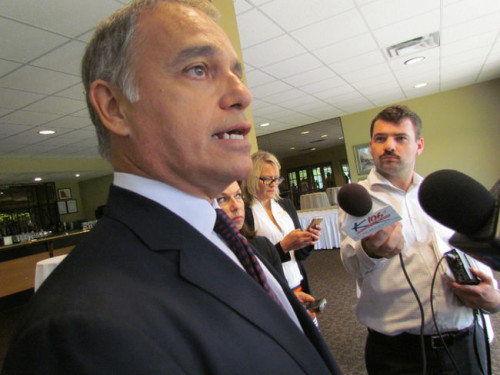
Via Rail CEO Yves Desjardins-Siciliano speaks to reporters on Wednesday June 17, 2015 at a luncheon in Sarnia, Ont. Via announced it is working to expand rail service in Sarnia, beginning in 2016 with additional runs to London. (Paul Morden/Sarnia Observer/Postmedia Network)

The audience at a Sarnia Golf and Curling Club luncheon hosted by the Sarnia Lambton Chamber of Commerce applauded Wednesday when the head of Via Rail announced plans to add more trains between Sarnia and London.

“You’ve made my day,” Sarnia rail advocate Jim Houston told Via CEO Yves Desjardins-Siciliano after the announcement of the changes expected to begin by 2016.

“I want to see the schedules before I make a real firm comment,” Huston said later, but added, “If we’re going to have four trains a day, for sure, that’s a blessing.”

Local rail advocates, along with Sarnia-Lambton officials, have been lobbying for years to see passenger rail service improved, even as Via cut it back to one train a day to and from Toronto.

Desjardins-Siciliano said Via plans to increase the service in Sarnia to four trains daily, starting in 2016, but he adding it’s not a done deal since it’s subject to the availability of track, something Via will have to work out with freight rail companies.

“We’re meeting with our freight partners to discuss those plans,” Desjardins-Siciliano said.

He said the first run will be from Sarnia to Toronto, with adjustments intended to “shave a bit of time” off the current trip.

The additional trains will be a “commuter run” during the day between Sarnia and London using two-car self-propelled trains.

Via announced earlier it plans to make London a passenger service hub in southwestern Ontario.

During his presentation, Desjardins-Siciliano challenged the community to get behind the changes, spread word about Via’s service and help increase the number of train riders in Sarnia-Lambton.

“The reality is that over the last 30 years, ridership has been declining in and out of Sarnia,” he said.

That led to a reduction in service in 2012 as Via worked to stay within its budget, he said.

Via Rail still has a more than $300-million deficit that has to be covered by Canada’s taxpayers, Desjardins-Siciliano said.

“We have to be very careful how we spend Canadian taxpayers’ money.”

What has changed more recently is that the federal government has provided Via with funding to improve its equipment, plus there has been growing demand for rail service in the country in recent years, he said.

“The market seems to be looking for rail service, like it wasn’t for the last 20 years.”

While ridership has continued to drop in Sarnia, Desjardins-Siciliano said, “some of that is self-inflicted” because of actions by Via.

In challenging the community to support the proposed boost in service, he said, “The community has to recognize its role in changing these statistics.”

Desjardins-Siciliano said it is “too early” to say if Sarnia will see its passenger train station staffed again, something lost in past cutbacks.

“Manning a station today requires significant traffic, because technology takes away a lot of the needs of manned stations,” he said.

“You don’t need a paper ticket. You can just have the ticket on your phone.”

Desjardins-Siciliano said he visited the Sarnia Via station Wednesday and promised the audience he would an official there in the coming weeks to look into the need for repairs to the building.

Source: http://www.theobserver.ca/2015/06/17/more-passenger-train-service-may-be-arriving-in-sarnia

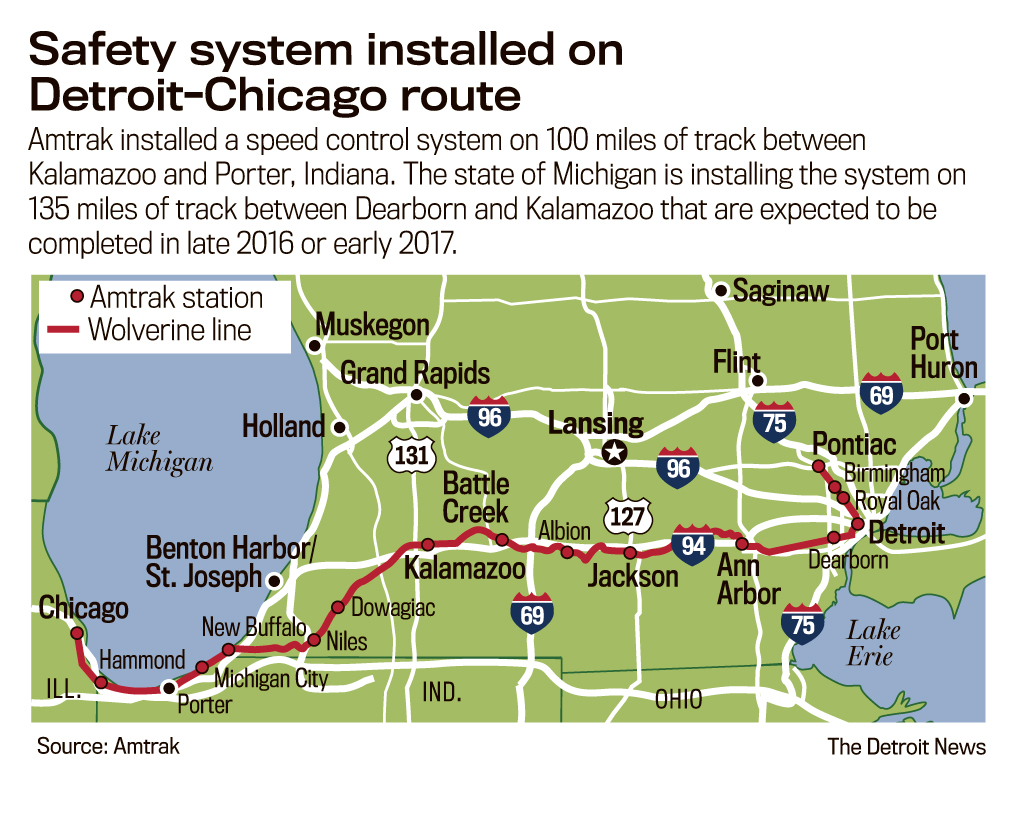
PTC installation on Wolverine route should be done in late 2016 or early 2017

From The Detroit News:

Amtrak and the state expect to have a speed control safety system along 283 miles of tracks in a year and a half as part of their effort to get faster passenger trips averaging a little more than four hours between Detroit and Chicago.

Michigan Department of Transportation rail chief Tim Hoeffner said the so-called positive train control system, part of more than $400 million in upgrades on the Wolverine Route, will protect against tragedies like the May 12 Philadelphia crash that killed eight people and injured 200.

“The engineer gets a target … when he will have to start lowering the speed,” Hoeffner said. “If you do not do that, the system says ‘we are watching’ and will take action to shut down the train.”

Amtrak installed the system on 100 miles of track it upgraded more than two years ago between Kalamazoo and Porter, Indiana. The state will have it on 135 miles of track between Dearborn and Kalamazoo that are undergoing upgrades to be completed in late 2016 or early 2017, Hoeffner said.

Automated train controls are federally required for higher-speed passenger rail by the end of the year, but hadn’t been installed on the section of track where the Philadelphia derailment occurred. Federal regulators say few rail operators will meet the deadline, according to press reports.

Hoeffner said the Michigan Department of Transportation, Amtrak and the Federal Railroad Administration began collaborating in the 1990s on a positive train control system for the Wolverine Route. The route carries more than 500,000 passengers a year.

Called Intermittent Train Control System, Michigan’s version of the technology first was installed between Kalamazoo and Porter, Indiana. Trains have hit speeds up to 110 miles an hour there since February 2013, Hoeffner said.

Contractors now are installing the system with track upgrades between Dearborn and Kalamazoo. Michigan is using $387 million in federal grants and $37.5 million of its own money to buy and improve the tracks for 110-mile-an-hour train speeds, according to Hoeffner.

“Our intention is to have higher speeds all the way across Michigan,” said Amtrak spokesman Marc Magliari in Chicago. The route has the most miles of 110 mph Amtrak rail outside the Northeastern corridor, Magliari said.

Hoeffner said the train control setup combines modern technology with traditional signal lights spaced at intervals along the track, which have told engineers since the early 1900s to slow, stop or remain at regular speed.

Engineers now also receive the same directions from an on-board display. If they fail to respond, the system can halt the train, after which the engineers need clearance from the railroad’s control center to restart, Hoeffner said.

The goal of MDOT and Amtrak is to run trains safely at higher speeds to lop more than an hour off Detroit-Chicago trips, making them competitive with auto travel, Magliari said.

“A lot of days of the week we’re already faster than driving, considering traffic congestion in Chicago and Detroit,” he said.

But there’s one remaining obstacle to reliably faster service: Passenger trains run at lower speeds and often get stalled — sometimes more than an hour — waiting for traffic to clear from the busy rail corridor between Porter, Indiana and Chicago’s Union Station.

It’s one of the nation’s most congested rail corridors, handling more than 100 trains a day and a key reason Wolverine Route trains often arrive behind schedule, Hoeffner said.

The state is partnering with Indiana and Illinois and the Federal Railroad Administration on an environmental study for a preferred passenger route through the area.

The study, whose completion is due in a few months, is a step toward applying for federal grant money. Hoeffner said the state hopes for federal approval of its study and suggested improvements by spring 2016.

Amtrak also set up a blue ribbon panel in October 2014 to address Chicago rail gridlock that Amtrak President and CEO Joe Boardman said causes unacceptable passenger service interruptions. Four-hour delays are a near-daily occurrence between Chicago and Cleveland, Amtrak said in a statement.

me_amtrak_wolverine_061015

Source: http://www.detroitnews.com/story/news/politics/2015/06/13/amtrak-make-mich-routes-safer/71182876/

M1 Rail CEO: Future expansion depends on federal money

From M-Live:

Brookville-Car-2-FINAL.-FIXED-e1433787339352-618x298The $140 million lightrail project underway in Detroit has received more than $100 million in philanthropic money from donors, M1 Rail President and CEO Matt Cullen said Monday.

But such money could not be depended on for an expansion of the 3.3-mile streetcar system – whether to Pontiac, Ferndale or even just to Eastern Market. It would depend more heavily on federal dollars, Cullen said.

“They’re much, much more likely to support the expansion of an existing system than a new one, so that was one of the reasons we embarked on doing this ourselves,” Cullen said after speaking at a Detroit Economic Club luncheon.

And those federal dollars would only come after the project has proven to be a useful addition to the community, he said. Cullen said once the M1 Rail line is up and running, and hopefully is a foundation for the Southeast Michigan Regional Transit Authority, then later it could be built upon.

In the works since 2008, the M1 Rail was first envisioned as a 9-mile Light Rail Transit system stretching from near the Detroit River to 8 Mile Road. But in 2011 that plan was scrapped in favor of the 3.3-mile line, for fiscal reasons.

Cullen said he thought initial estimates for a linear line out to 8 Mile were in the $600 million range, but said he is unsure what exactly it would now cost to expand the line there or beyond to Pontiac, for example.

“It probably wouldn’t be hard to extrapolate a per-mile, kind of a linear expense, but it’d be hundreds of millions (of dollars), obviously,” he said.

Construction work of the initial lightrail line is evident up and down Woodward Avenue. Scheduled to be complete later next year, the off-wire streetcar will run from Congress Street in Detroit’s central business district up to Grand Boulevard near the Fisher Building in the New Center area.

Also on Monday, M1 Rail officials named Brookville Equipment Corporation to design and build six individual streetcars, along with parts and support services for $32 million.

The streetcars from Brookville Equipment are expected to arrive in the fourth quarter of 2016. They’ll be equipped with vertical bike racks, WiFi wireless internet and HVAC systems to accommodate Southeast Michigan’s wide-ranging weather, and will comply with the Americans with Disabilities Act.

The latest breakdown of public and private money for the M1 Rail project could not be obtained Monday. Messages seeking this breakdown were left with M1 Rail.

According to a report last month in Crain’s Detroit Business, government funding from the federal, state and local levels totals $74.2 million, including two grants totaling $37.2 million from the U.S. Department of Transportation.

Cullen and proponents have said that similar projects across are followed by 10-20 times as much economic investment.

“We would expect to see billions of dollars in economic development,” Cullen said Monday.

Source: http://www.mlive.com/business/detroit/index.ssf/2015/06/m1_rail_ceo_future_expansion_d.html

M-1 Rail picks Pennsylvania bidder in $32M streetcar deal

From the Detroit Free Press:

Brookville-Car-2-FINAL.-FIXED-e1433787339352-618x298M-1 Rail has selected a Pennsylvania company to design and build its Detroit streetcars that would start hauling passengers up and down Woodward Avenue late next year, and perhaps someday to Cobo and the GM Renaissance Center.

Brookville Equipment of Brookville, Pa., will supply the six streetcars as well as spare parts and support services at a cost of $32 million, the M-1 Rail organization announced today.

Brookville is one of the few U.S-based manufacturers of modern streetcars. It has experience in battery-powered streetcars — a key concern for M-1 — through its work with the Dallas Area Rapid Transit system as reported in the Free Press last week.

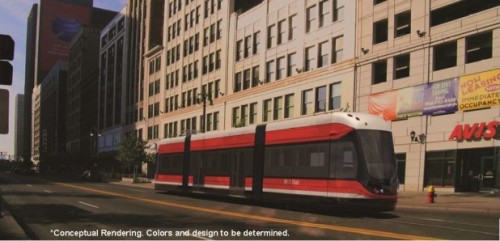
Matt Cullen, CEO of M-1 Rail, said the streetcars will be similar to those the company has delivered to Dallas, although slightly wider and a different color than that system’s blue, yellow and white cars. A conceptual rendering shows a Detroit streetcar with a red, white and black color scheme, although James Canning, M-1 spokesman, said that no final decision has been made regarding the colors.

Detroit’s streetcars will seat up to 32 passengers and, including standing room, could carry about 125 passengers. The three-piece cars would run up to 35 m.p.h.

Walk-up fares are expected to be $1.50, although passes and other fare options will be available.

About 3,000 to 5,000 people are projected to ride the streetcar line each day once it opens.

The M-1 Rail system is expected to have 60% of its 3.3-mile route along Woodward between downtown and New Center off wire, meaning that most of it will run on battery power. The rest of the route would use an overhead catenary system of electrified wires for charging the batteries.

M-1 said last year that it was negotiating with Inekon Group of the Czech Republic on the streetcars, but chose Brookville after previous bidders were asked for a best and final offer when M-1 and Inekon could not reach agreement, according to Canning.

“Brookville has had success building streetcars with similar operating systems and specifications to what we have planned for M-1 Rail, so we know exactly what we’re getting,” Paul Childs, chief operating officer for M-1 Rail, said in a news release.

“Other streetcar projects utilize overhead wiring for everything from vehicle propulsion to the infrastructure of their maintenance and repair sites. M-1 Rail will minimize its impact on the aesthetics of Detroit’s iconic Woodward Avenue, and we also will not have the labyrinth of wires overhead at the Penske Technical Center.”

Cullen told reporters today that M-1 Rail could be in a good position to receive federal funds for future expansion once the initial 3.3-mile straight loop proves successful.

Federal officials “are much, much more likely to support an expansion of an existing system than the creation of a new one,” Cullen said.

And future expansion doesn’t have to be limited to further north up Woodward.

“It’s not just linear,” Cullen said. “There’s a lot of people saying, ‘Hey, wouldn’t it be something if you could have a streetcar connected that went from Cobo to the Ren Cen. Or up Gratiot to Eastern Market.’<TH>

Founded in 1918, Brookville employs just over 200 nonunionized workers and entered the modern streetcar business in the early 2000s, according to the company.

Source: http://www.freep.com/story/news/local/michigan/detroit/2015/06/08/pennsylvania-company-supply-detroit-streetcars/28692607/