All posts by admin

Che sorpresa ti aspetta nel vivace casinò lazybar: generosi bonus, giri gratuiti e una selezione di giochi colorati renderanno la tua serata fantastica.

Spring 2010 newsletter

Spring 2010 stories include:
  • We‘re In The Money – Michigan receives funding for high-speed rail projects.
  • Spared for Now – Legislators restore full funding to the Blue Water and Pere Marquette.
  • Delayed Indefinitely – Shortage of funds delays proposed Ann Arbor-to-Detroit rail line.
  • Getting a Push – Woodward light-rail project receives federal funds.
  • My Black Journey – Amtrak launches website aimed at African-American travelers.
  • New Equipment for Amtrak? – Amtrak seeks to replace aging rolling stock.
  • Voicing their Concerns – Amtrak and TRAINS Magazine host Town Hall meeting.
  • Detouring through the Great Lakes State – Derailment detours Lake Shore Limited and Capitol Limited through Michigan.
  • Turning back the clock…. – MARP looks back at Michigan‘s past passenger rail operations.
  • Winter Park Bound
  • Ray Hamacher – Grand Rapids‘ great volunteer for Amtrak.
  • Jack Schramm – 1924-2010. 
  • Vice Chair Found – Whittier named new Vice Chair.
  • Wait a Minute . . . – Notes from MARP‘s Membership Meetings.
  • Chairman’s Corner – New Crystal Ball Needed.
  • Passing Through 

Copies of the publication can be found at every Amtrak station in the state of Michigan as well as locations having interest in passenger rail such as local libraries, hobby stores and city halls.

To receive this publication at your home or business, you must become a member of MARP. Join by filling out the application in the About MARP section of this website.

Click here to read a synopsis of past issues of The Michigan Passenger.

Meeting minutes – March 20, 2010 – Detroit

 MINUTES
 MICHIGAN ASSOCIATION OF RAILROAD PASSENGERS
Monthly Membership Meeting
Grand Trunk Pub, Detroit
March 20, 2010


Those Signing In:  Hugh Gurney, Clark Charnetski, Richard Pekarek, Ren Farley, J. P. DesCamp, Doug Faunce, Bob Tischbein, Larry Sobczak, Dwight Phillips, Jim Hinkins, Doug Wilson, Barney Whittier, John DeLora, Gus Swenson, Diane Patterson, Robert Patterson, Julien R. Wolfe, Dan Platz, Steve T. Sobel, John Langdon

Also Attending:  Carmine Palombo, SEMCOG, Rebecca Lockhart, Kenneth Borg, Ruth Johnson, Allen Porter

Call to Order:  Chairman DeLora called the meeting to order at 10:07 a.m.  All present were asked to introduce themselves.

Guest Speaker:  Delora then introduced Carmine Palombo from the Southeast Michigan Council of Governments, who is directing planning for the proposed Ann Arbor-Detroit commuter rail line.  The concept is to operate four round trips weekdays between Ann Arbor and Detroit and three round trips on weekends with intermediate stops in Ypsilanti, an airport connector station at the corner of Michigan Avenue and Henry Ruff Road in Wayne, and Dearborn.  Train sets would parked overnight in Ann Arbor.  These will be push-pull units. A total of $100 m will be needed to fully implement the service including platforms in Ypsilanti and Wayne, additional sidings, signals and track improvements.

SEMCOG and MDOT are working on the project in collaboration with three host railroads, Norfolk Southern, Canadian National and Conrail. 

Palombo anticipates that MDOT will be awarding a contract within the next week or so to have Great Lakes Central Railroad refurbish sixteen former METRA cars for the service.  These cars will be upgraded to meet current FRA standards.  They will be handicapped accessible and will have space for a limited number of bicycles.  MDOT will lease the cars for three years with an option to buy.  MDOT is looking at two bidders to lease locomotives from.  Contracts for new platforms at Ypsilanti and Wayne and for improvements at all stations are in process.

MDOT expects to award contracts for improving the junction at West Detroit within a couple of months.

                                                       -1-

Unfortunately, funding for other necessary track and signal work to implement the service as envisioned has not come through yet, so regular commuter service may be delayed until 2011.  Scheduled service is dependent on second round grants, which would be funded with an 80/20 match.  In the interim, SEMGOG, MDOT and Great Lakes Central are working with the host railroads on operating special trains for large special events in 2010.    Palombo hopes to provide more details on this later in the spring.

From the station in Wayne, dedicated buses will take passengers to both terminals at Detroit Metro Airport.  Palombo believes that minor adjustments in current SMART service will provide for this connection. Eventually, all buses will terminate at a new Airport Transportation Center near I-94 and Merriman Road, where passengers will connect with an airport operated internal transportation system.  Palombo confirmed that they had looked at the Norfolk Southern rail line just north of the airport, but saw too many complications including heavy freight traffic and difficulty in connecting to Ann Arbor by rail.

Approximately forty parking spots will be available at the Wayne station.  SEMCOG is looking to provide more parking at each station.

Because negotiations are still ongoing, Palombo can’t provide too much detail on the exact costs of operating the commuter service.  SEMCOG would prefer Amtrak as the operator, but that isn’t definite.  A round trip ticket between Ann Arbor and Detroit would probably cost around $6.00, with a fare between intermediate stations at about $1.50 one way.  If it is the operator, Amtrak would prefer to keep the commuter operation separate and distinct from its current intercity operation.

Ridership is very difficult to project because there has been no service since 1983.  SEMCOG is currently basing all plans on a ridership of 1,000 passengers per day.

In response to a question from Farley, Palombo indicated that the trains will use whatever station is Ann Arbor is in use, starting with the current Amtrak depot and moving to Fuller Street if and when that is completed.  Farley noted that UM has already issued bonds for the Fuller Street Transportation Center and will use revenue from parking to pay for the structure. 

Responding to DeLora, Palombo expressed doubt that MDOT could flex road money to the commuter rail project.  MDOT will be providing some funding for operations. 

Following a discussion on access to Detroit Metro Airport from the west, it was agreed that Amtrak may see the wisdom at adding the Wayne station as a regular stop.

                                                                 -2-

Once the commuter service is scheduled, Palombo would like MARP’s help in promotion.  Once in operation, MARP’s evaluation of operations and marketing would be welcome. 

Treasurer’s Report:  DeLora reported that as of February 28, 2010, the checking account had a balance of $2,063.67 and the Pratt Fund was valued at $13,203.01.  Approximately $800 in dues has been received in March to date.  Charnetski moved approval of the Treasurer’s Report.  This was seconded by Sobel and approved by the membership present.

Minutes of the February 13 meeting were reviewed.  Langdon moved acceptance with corrections.  Whittier seconded the motion and it was approved by the members present.

Coordinator Reports:

Public/Government Affairs:  Langdon noted that Rail World and Motive Power are the two bidders for locomotives for the Ann Arbor-Detroit commuter service.  He and Fischer have been assisting with the development of the Michigan Rail Plan, a document required by the FRA.  An MDOT contractor is putting this document together. 

Amtrak is saying that Michigan will have to pick up funding for Wolverine Service within five years.  DeLora noted that this may not be the case as at least the morning and evening trains are legacy trains.  The issue may have to go to arbitration.

Full funding for the Pere Marquette and Blue Water for Fiscal Year 2010 is now assured through a transfer of funds.  Some 90% of funding for the Grand Rapids Transportation Center is also assured.

The Governor has recommended $8.7 million for Amtrak service in Fiscal Year 2011.  This has been reviewed by the House Appropriations Subcommittee at this point.  Also included is $1 million for related Economic Development which the Michigan Municipal League hopes can be utilized for bike trails.

Langdon spoke in support of a bill that would authorize a vanity license plate for rail that could bring is $10 million annually if implemented. 

Langdon was well received at a legislative forum hosted by the Michigan Railroad Association.  He had a chance to get acquainted with representatives from CN, Norfolk Southern, CSX and Conrail and renew acquaintances with representatives from Amtrak and Great Lakes Central.

Responding to a question from Robert Patterson, Langdon was skeptical of the value of trying to advertize on the trains themselves as the equipment is frequently switched to other Midwest lines.  DeLora felt that advertizing in Michigan stations would be more effective. 

                                                                 -3-

Langdon passed out a list of rail related questions that members might ask of candidates for public office.  He reminded the group of the opportunity to submit questions for the Gubernatorial Forum at Central Michigan University in May.

Trains Town Hall Meeting:  DeLora expressed dismay at Amtrak’s efforts at the Town Hall Meeting in Chicago to defend its photography policy.  He has corresponded with Don Phillips of Trains Magazine on this issue. 

The equipment segment was more informative.  By default, Amtrak will take the lead in designing new equipment.  DeLora suggested design of half baggage/ half dorm cars on long distance trains and half baggage/half office cars on regional trains so train staff doesn’t have to use the café car for office space.  Amtrak agrees that the Horizon equipment has problems, but equipment on state supported trains is a state responsibility.

Rehabilitated cars are going into service as completed.  Some are now operating on the Blue Water and Pere Marquette. 

As to long distance trains, Amtrak will examine the poorest performers first and see how to improve their performance.

Patterson noted that the operations presentation was very informative.  Amtrak is now seeing the value of long distance trains.

Langdon asked if the American Association of Railroads could come up with a unified policy of photography.  DeLora responded that NARP is very concerned about the photo issue.

            Membership:  Reporting for Vavra-Musser, Langdon noted that letters have been sent to 486 NARP members living in Michigan inviting them to become members of MARP as well.  To date, 188 members have renewed.

            Website:  Sobczak showed samples from the newly designed website.  Included is a new link that will give the status of any train in the Amtrak system including color codes as to is on time status.  The group gave Sobczak a round of applause for his work on the website.

            Newsletter:  Langdon reminded the group that it is the responsibility of the Regional Chairs to tell Valderas how many copies of each issue they need.

Langdon moved that VPI Graphics handle mailing of The Michigan Passenger to members at the bulk rate, which is roughly twenty cents less than first class postage, but may take longer to deliver.  The motion was seconded by Gurney and approved by the members present.

                                                                  -4-

            Outreach:  Langdon handed out a sheet listing upcoming opportunities and asked members to sign up.

Regional Chair Reports:

            East/Central:  Pekarek reported that the Flint Metropolitan Transit Authority continues to provide service to job locations outside Genesee County, though not as extensively as in the past.  They are now looking at the possibility of scheduled service along the I-75 corridor from Bay City to Pontiac with stops along the way.

            Western:  Langdon informed the group that Amtrak Thruway Bus Service has now been extended from Kalamazoo to Sault Ste. Marie.  The Pere Marquette has had Superliner equipment for fifteen months now.  Several large trips are planned for April.

            Metro:  Hinkins briefly reviewed Carmine Palombo’s report earlier in the meeting.  It will be four to six weeks before we have any information on the Special Event trains mentioned.  It is clear that scheduled service beginning in October, 2010 is out.  He has noted some little red flags in the vicinity of West Detroit Junction, an indication that something may be happening.  From what he can gather, Milwaukee Junction will also be cleaned up with passenger trains using the northern track.

Williams reported that CP has been doing a lot of work on the Canadian side of the river in anticipation of a new double track rail tunnel under the Detroit River.  Little has been done on the U.S. side.  CSX needs to get moving on this.  The existing tunnel is inadequate and cannot be expanded.  CP is looking for better connections to Toledo.  Most CP traffic to Chicago operates on the old Wabash line now owned by Norfolk Southern, with one train daily operating via CSX.  Tim Hoeffner of MDOT would like to see three CP trains daily on the old Michigan Central line through Kalamazoo to help pay for maintenance on that line. 

FRA Grants: In Washington, FRA told DeLora that Michigan got no track work grants because the state didn’t fully fund the state supported trains in Fiscal Year 2009.

The three station grants will be helpful, though, especially the one for the Troy/Birmingham Transportation Center.  It is being designed so that it can be staffed in the future.

The new Dearborn station will be adjacent to Greenfield Village and utilize nearby Ford parking lots for long term parking.  The Battle Creek station will be renovated with expanded crew quarters and an upgraded passenger area.  A station track will be reactivated at Battle Creek. 

A total of eight projects have been approved between Porter and Hammond, Indiana, involving both track and signal work, but nothing on the Calumet River bridges as they cannot be used in the future for high speed rail.  The Englewood Flyover over the old Rock Island line in South Chicago will reduce traffic conflicts with METRA, which uses that line extensively.

                                                                    -5-

DeLora is hopeful that FRA will fund more track work in Michigan next year.

Old Business:

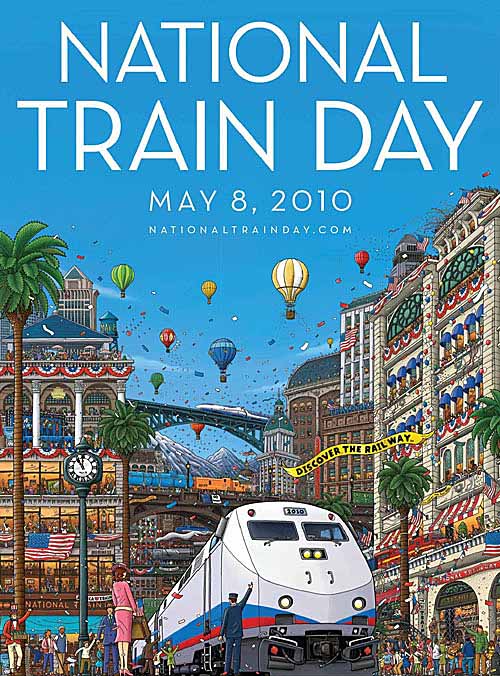
            National Train Day:  Delora asked Hinkins to head up the National Train Day observance in Detroit and Charnetski to take responsibility for the event in Ann Arbor.  Guidinger has agreed to oversee the event in Jackson and DeLora will take responsibility for Dearborn.  Events must be registered on the National Train Day website. 

Langdon agreed to take responsibility for events at stations at Albion and west.  Crossroads Village will be doing the event at the Flint station, the CVB in Port Huron and Jim Slater in Lapeer. 

            Future Meetings:  The next meeting will be on April 17 in Standish.  There will be no meeting in May because of National Train Day.  The June meeting will be in New Buffalo, with July in Durand, August in Battle Creek and September in St. Ignace.  The Annual Meeting will be on October 15 in Grand Rapids in conjunction with the fall NARP meeting there and the November meeting will be on November 13 in Birmingham/Troy.

            Nominations:  Whittier reported that a committee of seven was in place and would be doing all of its business by e-mail.

New Business:  On behalf of Langdon, Vavra-Musser and himself,  Whittier submitted a Take the Train to the Beach proposal.  MARP and St. Joe Today would work together to encourage residents in the Grand Rapids and Holland areas to take the morning train to St. Joseph for the day, either returning on the evening train the same day or staying over and taking the evening train the following day.  St. Joe Today would welcome each train, provide goodie bags and information to visitors and arrange reservations for those wishing to stay over.  Comments should be sent to Whittier at whittierbc@comcast.net

Charnetski noted that the University of Michigan is considering a light rail system which would connect the former Pfizer facility on Plymouth Road with the North Campus and the proposed Fuller Road Transportation Center. 

Hinkins informed the group that Jack Graham, an authority on Detroit streetcar and bus routes, has passed away.  DeLora wrote his obituary. 

Farley urged participation in the 2010 census.

                                                                -6-

Adjournment:

Langdon moved and Hinkins seconded adjournment.  The meeting adjourned at 12:30 p.m.

Respectfully Submitted:                                 Accepted:

Hugh D. Gurney                                             John DeLora

Secretary                                                         Chair

Amtrak’s ridership and revenue on record-breaking pace for fiscal year ’10

During the first six months of the FY ’10 fiscal year, Amtrak carried a record high of 13,619,770 passengers — a 4.3 percent increase over last year and roughly 100,000 more than the same period in FY ’08, when the company set its all-time record for annual ridership. A slowly improving economy and continued high fuel prices are contributing factors in ridership growth.

Comparing March 2010 to March 2009, ridership increased by 13.5 percent to a record 2.47 million passengers for the month. In addition, every single Amtrak route carried more passengers, with several experiencing double-digit growth.

This report comes from Amtrak This Week, a weekly newsletter for Amtrak employees.

35th Annual Durand Railroad Days Excursions of May 15th -16th Canceled

From a Steam Railroading Institute Press Release:

A very difficult decision has been made by Durand Union Station, Great Lakes Central, and the Steam Railroading Institute to cancel the upcoming excursions for the 35th Annual Durand Railroad Days, to be held May 15th and 16th. After initial approval and much discussion with Canadian National about being able to board at the Durand Union Station as a Great Lakes Central excursion, it was determined that the liability insurance policy required by CN to allow the excursion to carry passengers was more than the parties felt we could justifiably afford.

This would have been the first train excursions for Railroad Days in nearly a decade, and all involved are disappointed, but in the end we felt this was our only remaining course of action.

It should be noted that every possible option was looked upon by the parties involved for providing an alternative that would allow the excursions to continue. Discussions were held about the potential of running the trips from Pitt Junction  and continuing south as planned to Cohoctah. The distance from the Durand Railroad Days event (over one mile), not to mention the logistics and costs of the busing, quickly eliminated this as an option. Brief discussions were also held with RailAmerica as well about boarding northeast of the diamond, however similar issues arose and the parties involved decided it was best to cancel the excursions.

While DUSI, SRI, and GLC regret the cancellation, we hope to have some exciting announcements soon that may soften the blow of our inability to run this particular excursion. Please stop by our table at the Durand Union Station during Durand Railroad Days.

For further info on the event, please check out Durand Railroad Days website at http://www.durandrailroaddays.com, or the Durand Union Station website at http://durandstation.org/

Durand Railroad Days
Durand, Michigan
May 14, 15 & 16

Opinion: Michigan needs to follow China’s example and develop high-speed mass transit system

Originally appeared at:
http://theoaklandpress.com/articles/2010/04/09/opinion/doc4bbd262040289293655769.txt

By Tom Watkins
Special to The Oakland Press

I am traveling in China and seeing two futures for Michigan and America: one where we rush to play catch-up and the other where we fall even further behind.

China has a public transportation system that works — with trains, 4,000 miles of high speed rail, bus and even public bikes. America seems to be using training wheels and Michigan’s transportation system has never gotten on track!

China is on a mission to continue reshaping its rice paddies, steppes and the mountains around a rail service that will do for the country what President Eisenhower’s Interstate highway system did for America in the 1950s. There are plans to construct a 16,000-mile, high-speed network by 2020. China’s efforts are driving the country forward, facilitating mobility and creating economic and technology development.

Rail service in China has advanced a great deal since my first experience here in 1989, when I shared a jam-packed, non-air conditioned train car along with what felt like the entire population of China on a hard seat bench, if you could find space to sit at all. When I walked through the railcars 20 years ago, I dodged bodies crouched on the floor, sharing the same space with chickens, pigs, sunflower seed shells and big puddles of phlegm.

Today, China, with the world’s longest high speed rail network, is reportedly planning to spend in excess of $1 trillion (U.S.) on expanding its railway system. This is juxtaposed to the U.S., which hopes to build our first high-speed rail line by 2014, less than 85 miles linking Tampa and Orlando. Our efforts are “Mickey Mouse” in comparison.

The Beijing-Tianjin inter-city Express railway can catapult you 73 miles in 30 minutes, reaching speeds approaching 210 mph. The rail line between Wuhan and Guangzhou covers 600 miles in three hours, traveling at 220 mph. The journey on the old train took 11 hours.

The Chinese are notorious for traveling the world and studying best practices then returning to China to put these ideas to work — we would do well to emulate this practice.

Michigan and America need a massive public works strategy, backed up with extensive investment, to ride the rails to increasing prosperity.

Crossing China on the 48-hour Beijing-Lhasa (Tibet) high speed rail in 2007, I had a front seat to the extensive infrastructure investments China is making in rail, tunnels, bridges, roads and train stations that seem to dot the landscape.

I recall a 2008 trip to meet a friend at the Shanghai Railway Station for a day trip to Suzhou. I was feeling rather proud of my mediocre Chinese language skills when I hailed a dadi (taxi) and told the driver to (“qing dai wo qu huo che zhan”) or take me to the train station. He turned to me and responded in perfect English, “Which one?” Thinking of the 25-year-old, now abandoned hulk of the Michigan Central Train Station near downtown Detroit, I took a guess and chose one of the two train stations the dadi driver offered.

There are two modern train stations in Shanghai. And the high-speed Shanghai Maglev Train shoots you from the airport to the congested central city, a distance of 19 miles, in slightly more than seven minutes at speeds that top 268 mph.

Most people in Michigan have never heard of Chengdu, the capital of Sichuan province, Mianyang, Xian, Chongqing, or Changsha. Yet a rail system exists, connecting these once-isolated provinces and Chinese cities.

Training In Michigan

Detroit is one of the only major metropolitan areas in the U.S. and indeed, the world, without a mass transit system. It is not only an embarrassment but it is holding our region and state back economically. Michigan needs to join the 21st century and develop a sensible, affordable and effective mass transportation system.

The lack of a mass transit system is an anchor, pulling down our ability to climb out of the economic pit in which we find ourselves.

From New York, Washington D.C., to the Beijing-Lhasa (Tibet) train, intra-city mass transit and express railways not only move people, but also accelerate the movement of ideas and economies.

If words were rails, we would be competing with China for the most comprehensive intra-country train system. There’s a “whole lotta talk” going on — just not much action here in the “Motor City.

On April 19-21, the High Speed Rail World USA will hold its conference in Washington, D.C. to bring together high speed train operators, innovators, engineers and government leaders to discuss ways to tap the $8 billion in federal money earmarked for bringing high speed rail to the U.S.

It is ironic that for the past three decades Michigan’s powerful political and business leaders drive to the land of “No motorized vehicles” — Mackinac Island — to discuss the need for a modern mass transit system only to produce zip, nada — nothing?

In June, the Detroit Regional Chamber (http://mpc.detroitchamber.com) will once again host its annual Mackinac Policy Conference, ironically marketed as “30 years of Moving Michigan Forward,” even as outgoing Chamber President Dick Blouse laments that his greatest disappointment in his 16 years in Detroit with a one-word answer: “Transit.”

We could build the rails and the trains right here in Michigan, indeed helping to “move us forward” on two fronts. The question remains — will we? Or should we be adopting the Detroit Lions mantra, “There is always next year”?

As China keeps chugging along …

Tom Watkins of Northville is a business and education consultant in the U.S. and China. He served as Michigan’s state superintendent of schools, 2001-2005 and president and CEO of the Economic Council of Palm Beach County, Fla., 1996-2000.